


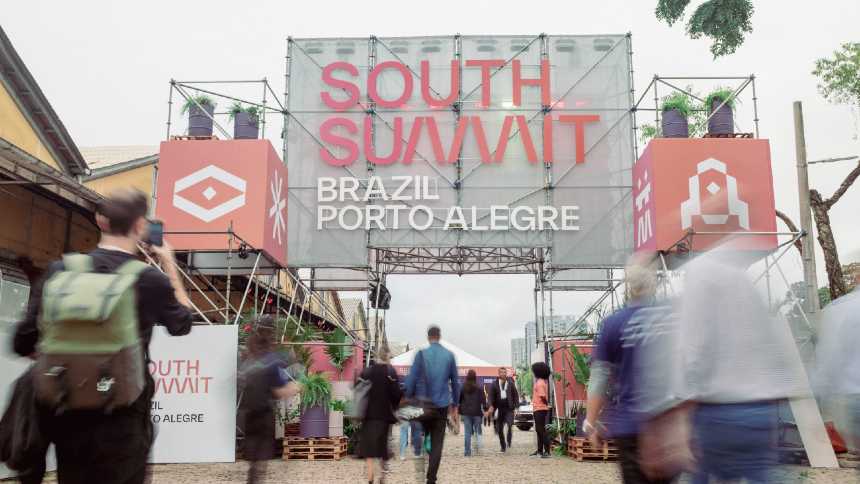
Entrepreneur José Renato Hopf has put the city of Porto Alegre on the global venture capital map with the South Summit Brazil. Now in its fifth edition, the event will highlight one of the topics that has been mobilizing entrepreneurs, investors, and top executives from large companies: artificial intelligence.
However, in addressing the topic of the moment, the South Summit Brazil, which takes place from March 25th to 27th of this year at Cais Mauá, aims to propose an essential reflection for today: not to leave out the human side of the technology that promises to be a great revolution.
“There is no innovation without people: artificial intelligence is powerful precisely when it amplifies human capacity,” says Hopf, president of South Summit Brazil, an event co-organized with the government of Rio Grande do Sul. “Technology only makes sense when it is designed to serve human beings. In the end, all innovation is human in nature.”
The agenda for discussing this topic includes names such as Salim Ismail, founder and CEO of OpenExO and director of Singularity University; and Hitendra Patel, CEO of IXL Center and one of the leading global innovation gurus.
In addition, Peter Skillman, global head of design at Philips, will discuss how, in a scenario where AI has democratized creative tools, competitive differentiation now comes from empathy and human-centered design.
Among the Brazilian names who will discuss the subject are Diego Barreto, CEO of iFood , one of the companies that has invested heavily in artificial intelligence, and Priscyla Laham, president of Microsoft Brazil, a company that invests in OpenAI, the owner of ChatGPT, one of the tools that has changed consumers' perception of AI.
“We will also use artificial intelligence to make the event more strategic, creating smarter connections between investors, founders , and leaders,” says Wagner Lopes, country manager of South Summit Brazil, an event for which NeoFeed is a media partner.
Businessman José Renato Hopf
While placing artificial intelligence on stage and behind the scenes, the event is becoming increasingly global. A record contingent of more than 20 international delegations, according to Hopf, is coming to Brazil to participate in the South Summit Brazil.
The startup competition is another example of the event's internationalization. There were 2,400 entries from 66 countries in 2026. The finalists represent 15 nationalities. Brazil leads with 25 startups qualified for the final, followed by Argentina with 5 and Spain with 4.
Uruguay follows with 3 startups. Chile, the USA, and Mexico each have 2 finalist startups, while Canada, Colombia, Ecuador, France, India, Israel, Peru, and Turkey have 1 startup each.
One of the traditions of the South Summit Brazil will be maintained: the team of investors who travel to Porto Alegre to participate in the event.
In the past, there were 900 investors from 130 venture capital funds, 40 of which were international. "The expectation is to surpass that number," says Lopes.
It is estimated that 25,000 people will participate in the three days of debates, panels, and side events – more than 70 events outside the main agenda have been mapped – that make up the South Summit Brazil, which is an association with the Spanish María Benjumea, the creator of the South Summit in Madrid, Spain.