






In 1955, when wood-burning stoves still dominated kitchens in the Brazilian countryside, Ueze Zahran, the son of Lebanese immigrants, decided to invest in a novelty that was not yet widespread in the country: liquefied petroleum gas (LPG).
His interest in LPG stemmed from a domestic incident: when fulfilling his mother Laila's request for a stove like the one she had seen at a friend's house in São Paulo, he realized that the real novelty wasn't in the appliance itself, but in the fact that it ran on gas, with a gas cylinder right next to it.
Ueze identified an opportunity in an emerging industry in Brazil. Based on this intuition, he founded Copagaz in Campo Grande (MS) and began building, practically from scratch, a cooking gas distribution business in regions where firewood and charcoal still predominated.
He would turn that investment into the foundation of a business conglomerate that would become a benchmark in the sector and position him as one of the leading players in the country's energy expansion.
Today, at 70 years old, Copa Energia is the largest company in Latin America in the bottling, marketing and distribution of LPG, with a 23.86% share of the national market, a presence in 24 states and the Federal District, net revenue of R$ 11.7 billion and a network that serves 30 million customers in the country.
Beyond the numbers, the company has transformed itself, over seven decades, into a platform of energy solutions, which today encompasses LPG, compressed natural gas (CNG), biomethane and, more recently, liquefied natural gas (LNG).
This portfolio is further complemented by investments in solar energy, technological innovation, and far-reaching social programs – without abandoning the family DNA and entrepreneurial spirit that have marked its trajectory.
“Copa Energia reaches its 70th anniversary sustained by the same values that have always guided our history: innovation, respect, partnership, determination, and care for our people,” says Agnaldo Inojosa, Vice President of Operations at the company.
Agnaldo Inojosa, Vice President of Operations at Copa Energia
Starting from the Brazilian Midwest, the company expanded its presence to other regions, built a national logistics structure, and began to design the capillarity that today covers practically the entire national territory.
This movement reached a new level in 2020 with the merger between Copagaz and Liquigás, an operation structured in partnership with Itaúsa. The combination of two traditional brands created a network of 13,000 resellers and 25 distribution centers.
Currently, Copa is present in 13 million homes, in addition to serving 152,000 condominium residents and 40,000 business clients.
“The merger with Liquigás was a milestone in our operational transformation,” says Inojosa. “We gained scale, logistical efficiency, even greater technical capacity, and unprecedented reach in the sector.”
Copa Energia is also undergoing a cycle of renewal in its governance. In 2025, it began the succession process in which Pedro Zahran Turqueto assumed the position of CEO, replacing his father, Caio Turqueto, who then dedicated himself to the chairmanship of the board.
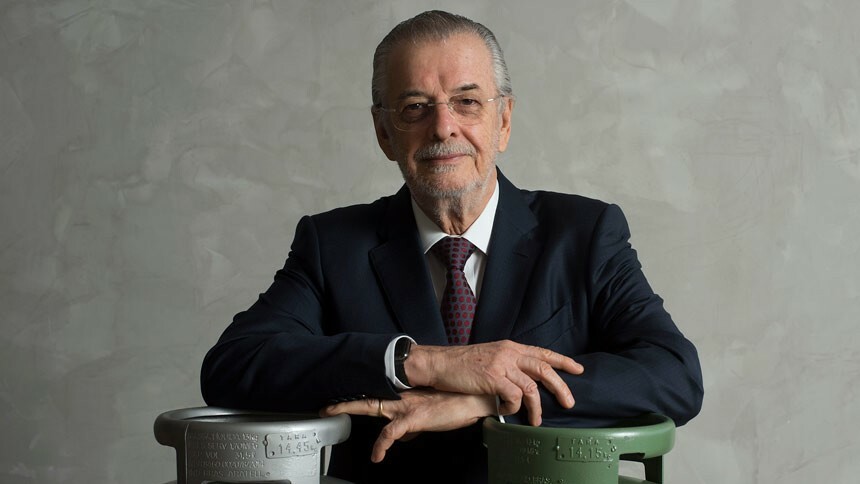
Under Caio's leadership, the company tripled in size. He oversaw the purchase of Companhia de Transporte de Gás (CTG) – which paved the way for the emerging biomethane market –, the inauguration of the first photovoltaic plant in Mataripe (BA), which generates electricity for the company's operational center in that location, and the creation of alternative routes to guarantee the supply of LPG during the flood crisis in the South of the country.
Pedro, who had previously led innovation projects as Vice President of Operations and Strategy, took over the company with the mission of accelerating Copa Energia's journey towards the energy transition, expanding its portfolio and seeking new business opportunities.
To accelerate this agenda, the company took another significant step by acquiring, in 2025, 36% of GNLink, a company specializing in LNG. GNLink has two gas liquefaction plants in operation, in Paraná and Bahia, and a third under construction in Rio Grande do Norte.
The diversification of the portfolio was accompanied by initiatives focused on innovation. In 2022, Copa partnered with the University of São Paulo (USP) to research the optimization of the LPG production chain in Brazil. This work gave rise to the Renewable Energy Hub, operating on the Butantã campus since the beginning of 2023.
The company, in fact, maintains a strong connection with academia. In conjunction with the Federal University of Mato Grosso do Sul (UFMS), it presented a project in 2023 that applies LPG as an energy resource in fish production.
At 70 years old, Copa Energia is the largest company in Latin America in the bottling, marketing, and distribution of LPG, with a 23.86% share of the national market.
The dialogue with academia complements the closer relationship with the startup ecosystem. In partnership with Cubo Itaú, Copa Energia launched Cubo Energy in December 2024, an innovation hub focused on energy solutions. In just over a year of operation, more than 90 connections were made between startups and companies, 14 success stories were created in the sector, and a series of initiatives were launched that brought real-world challenges closer to scalable solutions. And recently, a lounge was inaugurated that aims to be a permanent meeting point, where real-world challenges are transformed into new ideas, technological solutions, and impactful businesses for the entire supply chain.
“Copa Energia’s legacy is to bring energy safely, with quality and respect for people,” says Inojosa. “Our purpose is clear: to energize lives and businesses sustainably, contributing to the development of the country.”