






Until recently, the idea of talking to your bank as if you were talking to a friend sounded like science fiction. Today, this scenario is becoming increasingly real – and it's transforming the way millions of people handle their money.
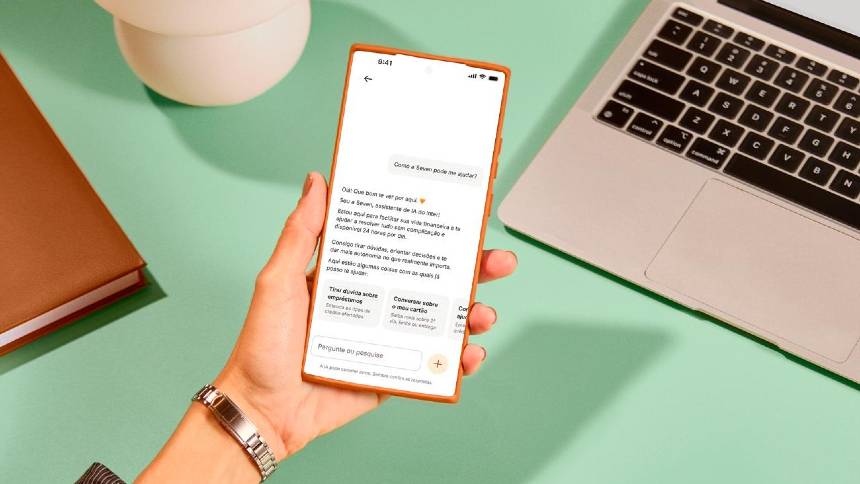
It is in this context that Inter launches Seven, its artificial intelligence assistant. The concept is both simple and ingenious: the customer says what they want to do and the AI executes it, but the operation is only completed after the user's final word.
“Seven is here to mark a transition we are making to an agent-based app,” says Guilherme Ximenes, CIO of Inter. “The idea is for the customer to have artificial intelligence agents helping with all the products the bank offers.”
Instead of opening the app, searching for the function, and following steps, the user can simply write – or, soon, speak – what they want. "It's a mix of traditional design with the conversation that people have become accustomed to having with AI tools," says Ximenes.
Seven isn't exactly new to Inter. Since the beginning of 2025, the assistant has been operating as a conversational agent to answer questions about the bank's more than 180 products and services.
In this first phase, 11 million customers used the tool. By 2026 alone, there were 20 million accesses. Before, however, Seven was limited to informing – it guided, clarified, and indicated paths, but did not act. Now, AI ceases to be a customer service assistant and becomes a proactive AI agent.
What does this mean? Imagine making a Pix transfer of R$100 to a friend. Instead of navigating through various app screens, the customer simply types what they want to do. Seven locates the contact in the favorites list, sets up the transaction, and awaits confirmation.
Another example Ximenes likes to cite: giving someone a gift. The customer asks Seven what Inter has to offer, and she brings the available gift cards, helping to complete the purchase right there.

One of the most interesting uses of Seven is also one of the simplest: communicating with your own bank statement. "In this case, the statement ceases to be a list of expense entries and becomes a source of insights," says Ximenes.
How much have I spent on Uber in the last three months? Is there any expense on my statement that stands out? Have my expenses increased or decreased compared to last month? Is there any expense that deviates from my usual routine?
AI cross-references the data and returns organized answers, often revealing patterns that the customer hadn't noticed. "I myself discovered how much I spend on streaming subscriptions," says Ximenes. "It seems simple, but it changes the way you see your money."
Other available features include installment payments for purchases on credit cards, reinvestment of funds with automatic redemption, customer service and resolution of frequently asked questions, and consortium concierge services, among others.
According to Ximenes, the rollout to the base of over 43 million customers will be gradual until it reaches all users, regardless of minimum balance, account age, or any other criteria.
Seven's competitive advantage lies in how it was built. The assistant was designed to progressively absorb capabilities from any vertical within the bank. Banking, shopping, credit, investments, insurance, global services, and benefits – each area is building specific agents that will be integrated into Seven.
In the near future, Seven will begin offering services such as limit changes, credit applications, investment management – including investment suggestions tailored to the investor's profile –, claims support, and points program management. The expectation is that, over time, most operations performed on the app will be possible through direct communication with Seven.
Seven's next step envisions AI anticipating customer needs, rather than simply reacting to their requests. Seven will remind users of recurring retirement contributions at the beginning of the month, or ask if they want to repeat a Pix payment they usually make. When a new payment slip is registered under the customer's CPF (Brazilian tax ID), Seven will notify them and help with the payment.
"The bank is ceasing to be a place where you go to get things and becoming an agent that works for you," says the CIO.
Why Seven? The number 7 has been part of Inter's trajectory since the beginning. It's its code in the Brazilian banking system (077), appears in the company's historical addresses, and has become a kind of internal cultural brand. Added to this is the fact that the bank operates in seven major business verticals, all integrated into the platform.
Seven is yet another chapter in Inter's pioneering trajectory, which was the first 100% digital bank in Brazil in 2015, anticipating a wave that the market would take years to follow. Later came the first marketplace integrated into a banking app in 2019, and Forum, the first financial social network, in 2025.
Today, the bank operates as a Global Financial Super App, with over 43 million customers worldwide, a loan portfolio of R$ 48.2 billion, net worth of R$ 10.4 billion, and total assets of R$ 98.6 billion.
“We have always been very close to technological waves,” says Ximenes. “And generative artificial intelligence is not a hype, it is a transformation that is here to stay.”


