


At a time when artificial intelligence and new financing models are redefining how businesses grow, one question becomes increasingly relevant for entrepreneurs and executives: what differentiates the companies that manage to thrive from those that fall by the wayside?
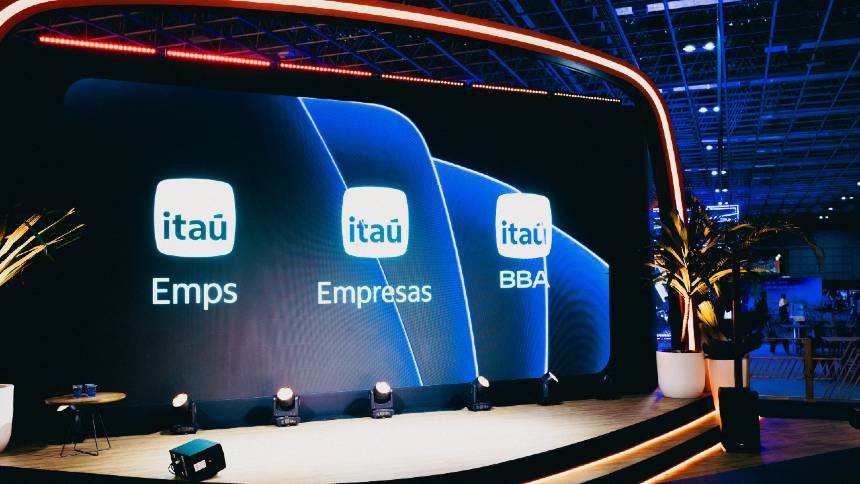
This was one of the central discussions that Itaú Unibanco brought to the Web Summit Rio 2026, the largest technology and innovation event in Latin America, held from June 8 to 11.
At the event, Itaú presented a perspective that helps answer this question: more than offering credit or financial products, the bank acts as an ecosystem capable of supporting companies at every stage of their journey – from entrepreneurs creating their first business to companies preparing to access the capital market.
The proposal addresses a growing demand in the business world: the need to combine capital with knowledge, planning, and the capacity for innovation.
In other words, growth today requires access to qualified information, market intelligence, risk management, international integration, and constant adaptation to technological changes that are occurring at an ever-increasing speed.
Itaú handles approximately R$ 40 trillion in financial flows annually, equivalent to R$ 1 in every R$ 4 transacted in the country. In the last five years, the bank has tripled its loan portfolio for businesses through Itaú Empresas and Itaú BBA.
This scale has allowed us to develop a structure capable of serving companies of different sizes and profiles, combining financial solutions, technology, specialized consulting, and access to different markets.
But what is the concrete impact of this model on companies? To answer this question, Itaú, in partnership with the Getulio Vargas Foundation (FGV), conducted two independent studies that analyzed the performance of client and non-client companies between 2019 and 2024.
The objective was to identify if there is a relationship between the support offered by the bank and indicators such as survival, expansion, innovation, and internationalization. And the results show that there is.
The first study analyzed the performance of Itaú Empresas, identifying significant impacts on the trajectory of the businesses it serves.
The most significant data point relates to business survival. According to FGV (Fundação Getúlio Vargas), companies served by Itaú Empresas have up to 30% greater chances of remaining active after five years compared to similar businesses that do not have a relationship with the bank. Even in the first year of the relationship, the probability of continuity is 8.6% higher.
In a country where thousands of businesses close down every year, the results confirm that access to credit, financial planning, and expert guidance can make a difference in the ability to weather periods of instability.
According to FGV, the results are not solely due to access to financing. The key difference lies in the combination of credit, consultative support, data intelligence, and customized solutions, designed according to the development stage and needs of each company.
Another noteworthy indicator concerns international integration. Client companies are 70% more likely to become exporters and 50% more likely to become importers. It should be noted that access to new markets and more sophisticated inputs is usually associated with productivity gains, making companies more competitive.
According to research by FGV, the credit granted by Itaú Empresas generates a cumulative effect of R$ 486 billion in the Brazilian GDP and more than 6 million jobs secured over five years. Every R$ 1 granted in credit generates R$ 1.56 in economic activity.
While Itaú Empresas focuses on strengthening SMEs, Itaú BBA steps in when medium-sized companies reach a new stage of maturity. This segment serves approximately 15,000 economic groups, has a presence in over 2,000 municipalities, and offers solutions ranging from structured credit to access to capital markets.
The study conducted by FGV shows that the relationship with Itaú BBA is associated with significant progress in three areas: internationalization, innovation, and business expansion.
In terms of international integration, the companies analyzed registered growth of approximately 70% in export volume and 47% in import volume after establishing a relationship with the bank. More than just selling to other countries, this means integrating into global supply chains, accessing technologies, and increasing competitiveness.
In the area of innovation, the numbers are also striking. Patent registrations grew by 126%, while trademark registrations increased by 29%.
Another relevant dimension is business expansion. The probability of going public increases by more than 200%, while corporate debt issuance grows by 150%. Furthermore, companies typically open an additional branch after establishing a relationship with the bank.
The aggregate impact is also significant. According to FGV, Itaú BBA's operations with medium-sized companies add R$ 105 billion per year to GDP, R$ 49 billion in income for families, and R$ 34 billion in tax revenue.
Both studies analyzed different segments, but reached a similar conclusion: companies that have access to credit, financial intelligence, strategic guidance, and solutions suited to their stage of development tend to grow more, innovate more, and create more value for the economy and society.