

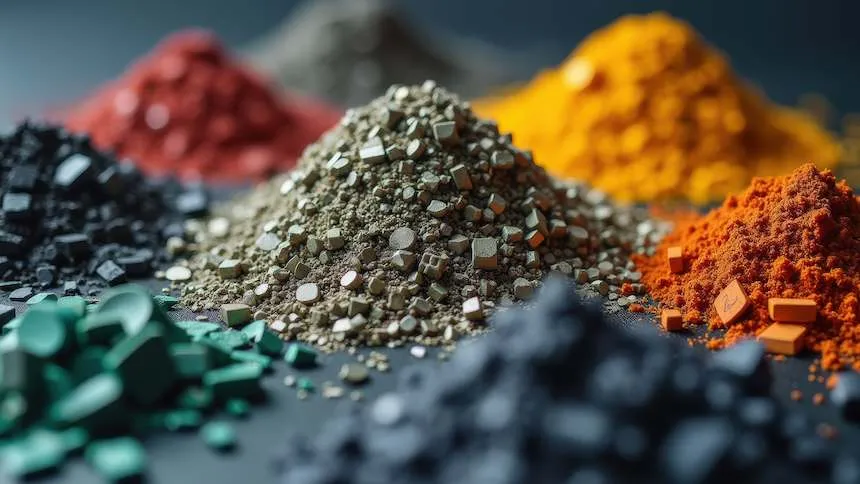
Through a series of initiatives, the United States government has been implementing, since the beginning of the month, an aggressive and multifaceted state policy to ensure the supply of minerals critical to American industry.
The strategy includes a $10 billion credit line for the productive sector to access 50 critical minerals and the creation of a trade bloc among allies and partners that would regulate minimum prices for strategic minerals to prevent China – which produces about two-thirds of the world's rare earths and refines almost 90% of them – from suddenly increasing exports and setting prices lower than those of other countries.
Brazil has entered this game in earnest, with at least three demands expressed by presidential advisor Celso Amorim in response to the proposal presented two days earlier by a White House envoy to Brasília, the Assistant Secretary of the U.S. Department of Economic, Energy and Trade Affairs, Caleb Orr.
In a meeting with representatives of the Brazilian government, Orr stated that the U.S. is willing to create a partnership between the two countries that would include the processing of these minerals in both Brazil and the United States.
According to him, due to the high concentrations of rare earth elements in Brazil – which has the second largest reserve in the world – and the funding already provided, the country would be a natural next step to encourage local processing.
In an interview with the UOL portal, Amorim said that the US stance can be seen as positive, but simply processing minerals domestically is not enough.
"There are three points, and the main one is that we need to define our needs for using this processing and only export the surplus," said Amorim, referring to the use of rare earth elements extracted in the country in areas such as artificial intelligence, defense, and high technology.
The statement indicates an intention to ensure some level of protection for the national industry in accessing rare earth elements and elements such as lithium, which are essential for the production of electric batteries, semiconductors, and other advanced technologies.
The second requirement refers to the degree of processing, which would need to be discussed. "It's the difference between beneficiating pig iron and special steels, to use older terms," Amorim stated.
The third point – and certainly the most controversial – is Brazil's demand for no exclusivity. "We want to be able to trade with everyone," concluded Amorim, referring to the Brazilian government's perception that the United States is seeking to exclude China from trade transactions related to this issue.
The White House's gesture of rapprochement comes days after the mining company Serra Verde – which extracts rare earth elements in Minaçu (GO) for the production of magnets for electric vehicles and wind energy – secured a US$565 million loan from the DFC, a development bank linked to the US government.
Even with Serra Verde controlled by international funds, Orr reinforced the possibility of US government equity participation in the company. Another mining company operating in the country, Aclara, had already obtained financing of up to US$5 million last year for feasibility studies of the Carina project.
Negotiations are expected to advance next month when President Luiz Inácio Lula da Silva will be received at the White House by Trump.
Dual strategy
The US government's offensive to avoid dependence on Chinese supplies of critical minerals and processed rare earth elements—essential inputs for enabling the emerging technologies of the new global energy economy—from manufacturing smartphone screens to wind turbines, rechargeable batteries for electric cars, smart grids, and even missiles—includes a two-pronged strategy.
One of them, announced earlier this month, is Project Vault, a Trump administration initiative to stockpile more than 50 critical minerals, including rare earth elements. It will be funded by a $10 billion loan from the U.S. Export-Import Bank (EXIM), with up to an additional $2 billion in private capital.
More than a dozen companies have signed up to participate, including General Motors, Stellantis, Boeing, GE Vernova, and Google. Project Vault also aims to support the U.S. manufacturing sector by keeping supply chain risks off company balance sheets and ensuring a 60-day mineral reserve for emergencies.
At current prices, the $12 billion budget would be enough to buy all the grams of critical minerals used outside of China in a year.
The other initiative, FORGE (Forum on Geostrategic Resource Engagement), aims to diversify global strategic mineral supply chains, reducing dependence on China through international alliances.
The goal is to stimulate investment and coordination among 54 countries, including the European Union and Japan. It was in this context that a partnership was offered to Brazil.
“Under the Trump administration, the strategic focus of the United States shifted from 'energy security' to 'security' in a broader sense, with the State Department leading the initiative that, under the Biden administration, rested with the Department of Energy,” says Carlo Pereira , CEO of Gin Capital, an investment platform focused on mining and data centers.
According to him, without fanfare, the American government is already exerting influence in Brazil in the area of critical minerals, investing directly in private rare earth projects in the country, such as Serra Verde, through agencies like the DFC.
“This approach, which includes acquiring stakes in strategic companies, allows the U.S. to secure its interests more directly and quickly than through government agreements, which are seen as complex and difficult to implement in practice,” says Pereira.
The executive says he considers the Brazilian government's cautious stance toward US initiatives, such as Forge, to be correct, as it seeks to avoid excessive dependence, similar to the strategy of countries like Saudi Arabia.
“Despite the diplomatic stance, Brazil lacks a clear and robust state policy for critical minerals,” says Pereira, noting that the funding allocated in the PAC for mining (R$ 55 million) is minuscule compared to the billions invested by the US.
"We have two bills stalled in the National Congress, and the initiatives are fragmented, which weakens the country's negotiating position," he adds, citing the conditions expressed by Amorim.
Brazil in the spotlight
According to Pereira, the criticism that has emerged in the international press regarding the White House's intention to impose minimum price controls on the critical minerals market ignores the nature of mining and the capital structure of companies in the sector.
“The vast majority have shares listed on American stock exchanges, and by closing a purchase or sale agreement for critical minerals based on prices following the American initiative, they run the risk of seeing their shares depreciate if they break that commitment to close at a lower price with China,” says Pereira.
Furthermore, the extraction of rare earth elements in Brazil, which he says is mostly ionic clays, is more similar to the chemical industry than to traditional mining. "The companies in the sector, such as Aclara and Serra Verde, are mostly foreign-owned, listed on international stock exchanges, and finance their projects through IPOs even before starting operations."
Pereira warns that, in recent weeks, there has been an "unbelievable" movement of international investors (USA, Europe, Japan) courting Brazilian rare earth projects.
"These investors operate with extreme speed, setting short deadlines, even until May, to close partnership and sale agreements ( off-take ), demonstrating that opportunities will not wait for state bureaucracy," he says.
Therefore, the Brazilian government needs to be vigilant because it is not up to private companies to define a national processing strategy. "Just as Vale focuses on iron ore extraction, rare earth mining companies will seek the best margin," he says.
The executive states that it is up to the State to create a clear policy with incentives and tax breaks if it wants the benefits to occur within the country.
“Current regulations apply to the sale of mining rights, but not to the export of the final product, which is a transaction between private entities,” he warns. “We run the risk of the country losing strategic opportunities due to a lack of a long-term vision.”