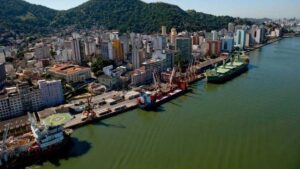


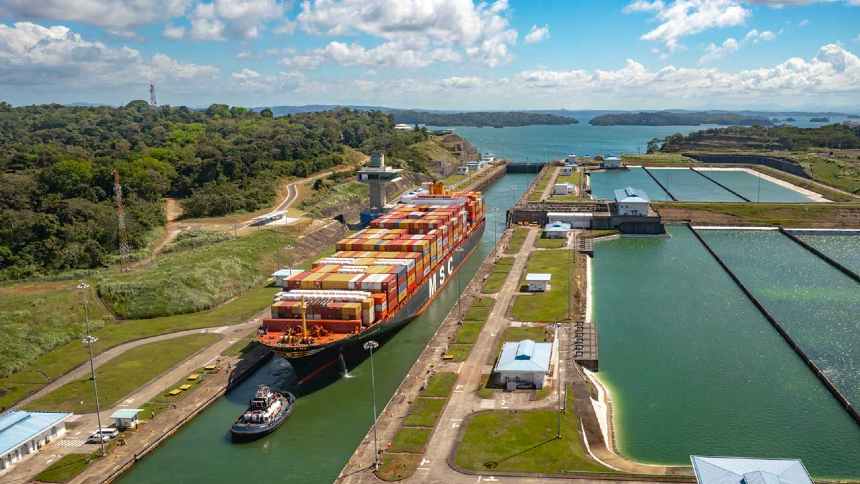
In a controversial decision, the Supreme Court of Panama annulled the concession of two ports at each end of the Panama Canal to a Hong Kong company, CK Hutchison , which had operated the two assets since 1999 and through which approximately 14,000 ships pass annually, concentrating 5% of world maritime trade.
The Supreme Court declared unconstitutional the terms under which CK Hutchison manages the ports of Balboa, on the Pacific coast, and Cristóbal, on the Atlantic coast, in response to a petition from the country's Comptroller General.
The central argument of the lawsuit is that the contracts violated the interests of the government and taxpayers – an audit by the agency pointed to a loss of public revenue of up to US$1.3 billion since Hutchison took over, which had renewed the concession in 2021.
Hutchison's unit operating in Panamanian ports denounced the decision, stating that it damages Panama's reputation as a reliable country for doing business. The company said its contract was the result of a transparent bidding process and that the decision is "diametrically opposed to previous decisions" in similar contracts.
CK Hutchison shares fell 4.6% in Hong Kong trading on Friday, January 30, hours after the Panamanian court's late-night ruling caused the Hang Seng index to drop more than 2% – a sign of both the company's importance to the market and investors' growing concern about political risk.
The verdict represents a victory for US President Donald Trump in his offensive to reaffirm and apply the Monroe Doctrine ("America for the Americans," from 1823, now renamed the " Donroe Doctrine "), aiming to restore American preeminence in the Western Hemisphere, as foreseen in the government's national security strategy, released in November.
Trump had been pressuring the Panamanian government since last year, when he warned that the Chinese infrastructure built around the canal over the past three decades posed a threat to U.S. security. "China is operating the Panama Canal, and we did not hand it over to China," Trump said in his inaugural address.
Panamanian President José Raúl Mulino, a White House ally with a master's degree in maritime law from Tulane University, had complained about the terms of the agreement with Hutchison after taking office in 2024. But he rejected Trump's threats to take control of the canal as an affront to Panama's sovereignty.
The small Central American nation, however, is vulnerable to pressure from the White House because it uses the US dollar as its national currency and has neither a central bank nor armed forces – in 1989, American troops invaded the country to overthrow then-dictator Manuel Noriega.
In a show of Trump's insistence, while the Comptroller General of the Republic filed a request with the Supreme Court to terminate CK Hutchison's concession contracts, Mulino decided to withdraw Panama from the Belt and Road Initiative – one of the names for the Chinese initiative involving more than 140 countries in infrastructure, connectivity, and trade projects worldwide.
China in the crosshairs
The termination of CK Hutchison's concession in Panama represents Trump's second victory in his offensive to undermine Chinese investment in infrastructure projects in Latin America.
The projects total US$300 billion and include subway lines, bridges, hydroelectric dams, power plants, stadiums, and ports, such as the deep-water port of Chancay in Peru, inaugurated in 2024 and operated by the Chinese company Cosco.
At the beginning of the year, when American soldiers kidnapped Venezuelan President Nicolás Maduro and his wife, China was severely affected, as it was the destination for 90% of Venezuelan oil exports. The Asian country has invested US$67 billion in Venezuela since 2007, and last year a Chinese company signed a US$1 billion, 20-year agreement to develop Venezuelan oil fields – a project that is unlikely to come to fruition.
CK Hutchison, founded by Hong Kong billionaire Li Ka-shing, is not owned by the Chinese government, and the Panamanian Supreme Court's decision will maintain the transit of Chinese ships on the waterway, as the ruling will not affect the canal's operations – which functions as an 82 km long shortcut between the Atlantic and Pacific Oceans.
From October 2023 to September 2024, China accounted for 21.4% of the cargo volume that transited through the canal, becoming the second largest user after the US.
The Panamanian court's decision, however, is likely to further complicate the sale of CK Hutchison to the American investment giant BlackRock and MSC , a global shipping and logistics company, which had been underway since last year amid pressure from Trump against granting the Panama Canal concession.
In March, CK Hutchison agreed to sell 90% of its assets in the Panama Canal and an 80% stake in port subsidiaries operating 43 ports in 23 countries, including facilities in the United Kingdom, Germany, Mexico, and Australia, in a deal valued at US$23 billion.
The Chinese government, however, opposed the sale, demanding that the Chinese state-owned shipping company Cosco have a majority stake and veto power in the company that manages the global port assets – threatening, if not met, to bar MSC ships from entering Chinese ports. Since then, the sale has stalled.
If completed, the sale of CK Hutchison could reshape global maritime trade. Headquartered in Geneva, MSC is the world's largest container shipping company, with over 800 ships and a capacity of 5.6 million twenty-foot equivalent units (TEUs). BlackRock manages US$14 trillion. Meanwhile, the Chinese state-owned company Cosco has operations in more than 160 countries.
Even after losing the concession for the Panama Canal, Chinese companies maintain investments in approximately 130 ports worldwide, compared to only a few controlled by American companies. This demonstrates Chinese advancement in a strategic segment of the trade war with the US, where control over cargo movement and ports can affect freight prices.
In relation to maritime trade, Chinese companies own more than 5,500 ocean-going merchant ships, compared to only 80 owned by American companies, reinforcing the enormous capacity of China's shipbuilding sector, which is 232 times greater than that of the US.
In practice, the Panamanian Supreme Court's decision will not unbalance this US-China dispute over the seas, but it will certainly give Trump political strength to proclaim his Donroe Doctrine in an election year.