

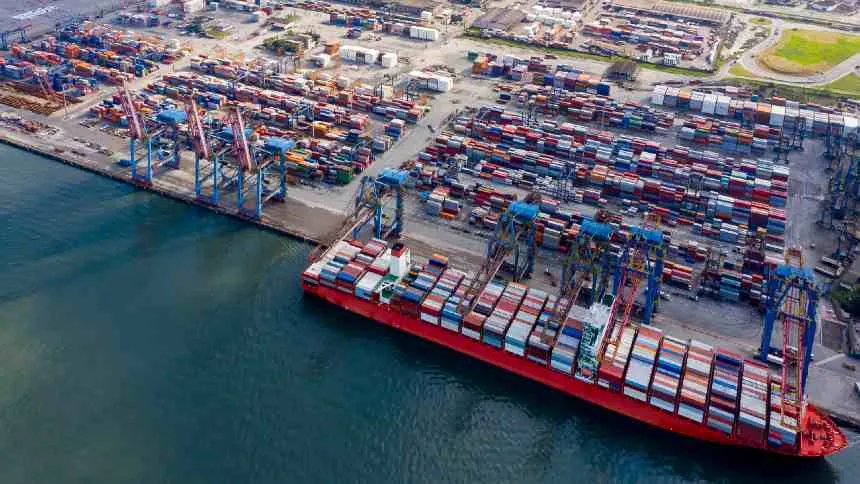
The auction for the mega container terminal at the Port of Santos , Tecon 10, scheduled to take place in early 2026, took a new and controversial turn on Tuesday, December 16, with the Ministry of Ports' decision to accept all recommendations made last week by the Federal Court of Accounts ( TCU ) regarding the bidding model proposed by Antaq (National Agency for Waterway Transportation).
With this, three more requirements that divide experts will be incorporated into the auction's bidding document model, which must now undergo adjustments by the state-owned company Infra S/A before it can be published.
The rule initially proposed by Antaq stipulates that the bidding process be carried out in two phases. The first phase would be restricted to companies without container operations at the port, to avoid market concentration.
If there are no interested parties – a highly unlikely scenario, as at least 10 major global companies in the sector are expected to participate in the auction – the bidding will be open to current container operators in Santos, such as the MSC and Maersk groups, associated with BPT, as well as CMA CGM and DP World. Therefore, if a shipping company (a company that owns ships) were to win the bid, the company would be obliged to divest its current asset.
However, the TCU (Brazilian Federal Court of Accounts) not only approved the model proposed by Antaq (National Agency for Waterway Transportation) but also included three other recommendations that were of an advisory nature, meaning they could be adopted or not by the agency.
One of the measures, in practice, was to definitively veto the participation of shipping companies in the auction, regardless of whether or not they have operations in the Santos port complex. This recommendation removes the Chinese giant Cosco from the auction; Cosco transports approximately 10% of the containers in circulation worldwide on more than 500 ships, making it the fourth largest global shipping company (behind only the Swiss MSC, the Danish Maersk, and the French CMA CGM).
Another recommendation calls for the adoption of a minimum concession fee, the value and assumptions of which will be defined jointly with Antaq.
The third and controversial suggestion from the TCU (Brazilian Federal Court of Accounts) was to impose, as a mandatory investment for the winner of the auction, the construction of an internal railway yard with a minimum throughput capacity of 900 TEUs (Twenty-Foot Equivalent Unit) per day.
The new terminal will occupy 622,000 m², increasing cargo capacity by 50%. The auction is expected to raise R$ 6.5 billion in concession fees, with an investment of R$ 40 billion over 25 years. The project foresees up to 3.5 million TEUs/year – each TEU represents a 20-foot container, or about 6 meters –, four berthing berths and a passenger terminal.
Experts and industry executives interviewed by NeoFeed criticized the TCU's "stroke of the pen" and the MPor's decision to incorporate the suggestions. Some had already criticized the decision to exclude port operators from the auction, and all considered the decision to veto foreign shipping companies, such as the Chinese company Cosco – which is expected to join the current port operators excluded from the bidding and take the matter to court – to be excessive.
There is also reservation regarding the obligation of the winning bidder to build an internal railway yard. The perception is that the new rule will directly impact the investment capacity of the winning company and tends to exclude less capitalized players, reinforcing the selective nature of the bidding process.
Direction
“I believe the beneficiaries are clear: any operator that is not based in Santos, and companies that currently lack the structure or experience for a project of this size and importance,” summarized a senior executive in the sector who preferred to remain anonymous.
Felipe Kfuri , a partner in the Infrastructure area of the law firm LO Baptista Advogados, observes that the restriction on the participation of shipowners is based on competition principles, insofar as it seeks to avoid excessive vertical integration and discriminatory practices in a highly concentrated port like Santos.
However, the broad restriction, applied indiscriminately to shipowners with or without operations in the Santos port complex, can be considered excessive, in the expert's view, as it lacks a concrete analysis of market power and eliminates less restrictive solutions.
“In this context, the argument that this assessment could be carried out a posteriori by Cade, the legally competent authority to analyze mergers and acquisitions, with the possibility of approval, rejection, or imposition of antitrust remedies, including divestments, is legally sound,” he says, noting that this alternative would preserve the competitiveness of the bidding process and allow for a case-by-case analysis.
According to Kfuri, the rule tends to benefit independent port operators and financial investors by reducing competition in the auction, but it may result in less aggressive bids and less competitive pressure.
Daniela Poli Vlavianos , from the law firm Arman Advocacia, which has extensive experience in logistics contracts, states that this restriction accepted by the Public Prosecutor's Office finds a clear legal basis in the competitive logic that governs the Brazilian port sector.
The sensitive point, however, lies in extending the ban to shipowners who do not currently operate in the Santos port complex, as is the case with Cosco. "There is, indeed, a possible regulatory overreach in excluding, in an abstract and preventive manner, a relevant global player, without concrete demonstration of immediate competitive risk in the specific market of the Port of Santos," says Vlavianos.
According to her, the risk of litigation is real: "A company like Cosco has sufficient legitimacy and legal interest to question the legality and proportionality of the restriction, especially under arguments of violation of free enterprise, equality among competitors, and the absence of individualized competitive analysis."
Another executive from the port sector, who agreed to speak anonymously, endorsed the criticism, but raised his voice. “Restricting shipowners who don't operate in Santos only makes sense when the bidding process is directed towards one player, practically wrapped up as a gift, like what we're seeing in this case,” says the executive, who doesn't hide his irritation with the “succession of errors” in the drafting of the tender.
“Logically, in an auction, a restriction like that makes no sense whatsoever and is totally contradictory to the main objective of the auction, which is to expand the capacity for container handling efficiently,” he adds, noting that there is no technical basis to support this view. “So much so that establishing a minimum grant is the same as acknowledging that the auction is rigged.”
Regarding the requirement for the investor to construct an internal railway yard, the executive believes that, given the total investment, the requirement is not relevant. "It was more of a governance discussion topic for the investment that should have been addressed within the scope of FIPS," he says, referring to the Internal Railway of the Port of Santos, a Special Purpose Entity (SPE) that manages the operation and expansion of railway infrastructure in the port of Santos.
According to Kfuri, from the law firm LO Baptista Advogados, the requirement for the implementation and operation of internal railway infrastructure modifies the economic profile of the project, by introducing high investments, long-term returns, and greater exposure to demand risks and coordination with external agents.
"These factors reduce the predictability of cash flows and increase the complexity of financial modeling, requiring more robust financing structures, a larger volume of collateral, and less operational flexibility," he says.