

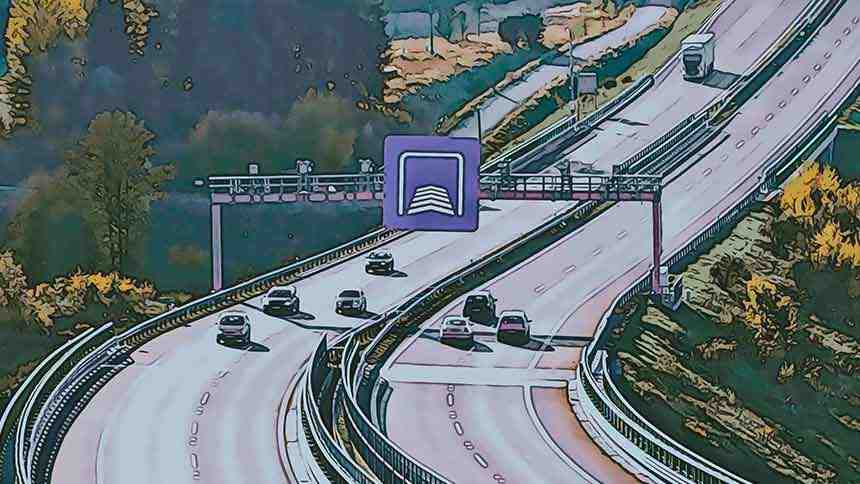
The Ministry of Transport has decided to implement a "corrective measure" to address the major crisis involving free flow , the new electronic toll system without booths or barriers. Launched in 2023, the model is embroiled in controversy due to R$ 563 million in fines for late payment due to toll evasion, with a large portion of drivers not even having been notified.
In an interview with NeoFeed , the executive secretary of the Ministry of Transport, George Santoro , and the National Secretary of Transit, Adrualdo Catão, confirmed that they sent a decree to the Attorney General's Office (AGU) – which should be approved soon – extending until December 30 the suspension of payment of fines for toll evasion already issued.
The trade-off for this measure is that drivers must settle any outstanding toll payments. The concessionaires will also have an extension to approve a unified payment system.
At the same time, they met with the concessionaires to try to extract a consensus from them around a unified online toll payment model for free-flow highways, with communication integrated into the driver's digital driver's license.
According to them, the concessionaires are legally responsible for promoting information campaigns for drivers on how the free flow system operates. Furthermore, they missed the deadline stipulated by Contran Resolution No. 1,013/2024, published on June 12, 2025, which caused the problem.
“The Contran resolution was approved after extensive public consultation and dozens of meetings, but no concessionaire submitted a proposal for a unified billing model by the deadline in December, nor afterwards,” says Santoro.
The regulation mandates the approval and unification of toll collection systems by concessionaires within 180 days before the start of gantry operation on a free-flow highway – which, according to them, was not done due to disagreements between the concessionaires.
“The electronic payment system represents a market that moves between R$ 5 billion and R$ 8 billion per year, with the potential to reach R$ 150 billion. There are many actors and interests at play,” says Santoro. “Each one wanted a solution that would meet their interests.”
A "TED" (bank transfer) for the toll.
The ministry's executive secretary, however, adopts a conciliatory tone. According to Santoro, part of the delay in approving a unified electronic toll payment system for free flow tolls is due to the multiple actors involved – concessionaires, banks, payment methods, credit card operators, regulatory agencies, system suppliers, signaling and equipment – requiring the standardization of procedures.
The new regulation aims to standardize everything from completion flows to data communication, aligning with Brazil's strict traffic regulations. The intention, it assures, is to provide freedom where possible, guidance where necessary, and avoid imposing rigid technological standards.
The unified payment model agreed upon by the concessionaires is based on messaging, similar to a TED (Electronic Funds Transfer), with automatic clearing and file transfer – a set of technologies and processes that allow the exchange of messages between different systems or users.
Santoro says that the technological alternative avoids choosing a specific solution, such as a proprietary API, which is also being considered. The messaging system is perceived as open, compatible with various participants, he states.
“With the decision to use messaging, the sector indicated that it is possible to complete the integration in about four additional months, accelerating the operationalization of communication between dealerships, payment methods, and Senatran,” Santoro adds.
In practical terms, when a vehicle passes through the toll gate, sensors and cameras capture the license plate, date and time, vehicle category, and tag (if present). This information is generated into a message, which is sent to a central system. Depending on the case, the system consults tag operators (Sem Parar, Veloe, ConectCar, etc.), vehicle databases, and government or concessionaire toll collection systems.
“The solution includes integration with the Digital Driver's License: the user will see free-flow passages and their status, whether they were paid via tag or are still pending, and will receive push notifications to alert them about outstanding debts, increasing transparency and reducing delinquency due to lack of awareness,” says Santoro.
According to him, the lack of a unified payment model integrated into the traffic data system would make the automatic renewal of driver's licenses unfeasible. "Four million drivers are at risk, since they didn't even know they might have committed a toll evasion infraction," Santoro states.
The Brazilian Association of Highway Concessions ( ABCR ) avoids creating controversy on the subject. In a statement, the organization claims that free flow has been implemented effectively in Brazil, with toll payments made on time exceeding 90% (in some cases reaching 97%).
"In other words, the vast majority of users already understand how the system works; the free-flow billing models are defined in the concession contracts themselves, and they are made fully available by the concessionaires," the statement informs.
"What is being discussed with Senatran, regarding this topic, is the offering of more payment solutions in order to increase user convenience. This is the case, for example, with the Digital Traffic Wallet, which could be used as a central hub for information on fares, payments, and any fines," the entity adds.
Ricardo Kaoru, CEO of ConectCar and president of Abepam (Brazilian Association of Automatic Payment Companies for Mobility), states that defining a unified model is important to provide predictability to the system and facilitate integration between concessionaires, payment operators, and users.
"The messaging-based model is a well-known approach in the mobile ecosystem and allows for the structured exchange of information between the different participants in the chain," Kaoru tells NeoFeed . "Furthermore, it is essential that the architecture is capable of ensuring security, reliability, and high availability, considering that the system supports billions of transactions per year."
Kaoru reveals that the market for automatic payments for mobility has shown consistent growth in recent years, driven by the digitization of services, the expansion of vehicle tags, and the adoption of new billing models, such as free flow.
"To give you an idea, according to data from Abepam, in 2025, the country registered around 15 million active tags, an increase of approximately 67% compared to the previous two years," says Kaoru. "Following this perspective of progress, the expectation is that, by 2027, this number will reach 20 million, which would represent an additional growth of 33%," he adds.
Catão, the National Secretary of Transportation, in turn, reiterates that the department did not enter into conflict with the concessionaires, despite the crisis generated. "We noticed that they didn't understand the technical model for toll collection, messaging, or API, so we sat down with them to define a new deadline, by mutual agreement," he says.
According to him, the objective was to overcome the technical issues of homologation and give the driver the right to know, through the CNH app, where they have been and where they will pay. "The resolution calls upon Senatran (National Traffic Department) to take responsibility for enabling communication with citizens, even though it originally fell to the concessionaires, focusing on public policy and legal certainty."
Catão warns that collecting fines has never been the government's objective. "This needs to be clear for the sake of free flow security, which is being attacked by demagogues who claim the model is revenue-generating, which is a lie," he says.
Santoro, in turn, says that the concessionaires sought closer ties after noticing the mobilization in the National Congress to create barriers that, in practice, could make free flow unfeasible. Therefore, he emphasized the need for concessionaires to conduct information campaigns.
“Communicating is a complex art; it’s not enough to spend money to communicate well,” says the ministry’s executive secretary. “Taking the wrong steps, such as not explaining how the model works or installing free-flow systems near urban areas of cities, alongside highways, can create legal uncertainty and destroy a program that has already proven to be very good.”