


BTG Pactual's chairman and senior partner, André Esteves, is optimistic about Brazil's short- and long-term prospects. However, the question remains whether the benefits will be temporary or permanent. And the outcome depends on how the country handles its internal issues.
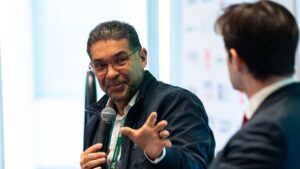
During a panel discussion at the Global Managers Conference, hosted by BTG Pactual Asset Management on the morning of Tuesday, March 31st, Esteves spoke about the prospect of a resumption of foreign investor flows following the end of the war in the Middle East, the positive impact of commodities, and the country's neutrality in the global scenario.
At the same time, he reiterated the need for fiscal adjustment and brought a new topic to the table: the need to strengthen institutional frameworks.
Below are the main points addressed by Esteves:
Short-term cash flow, long-term commodities.
According to him, in the short term, Brazil should once again benefit from the flow of international resources to emerging markets, as seen before the war in the Middle East , which was responsible for the Ibovespa 's record highs in recent months.
According to Esteves, this flow should resume as soon as "the dust settles," arguing that the United States should not prolong the conflict, much less invade Iran.
He highlighted that the war was yet another factor that tarnished the American image, one of the factors that led managers to reduce their positions in the country, in addition to high valuations and doubts that began to arise regarding the effects of artificial intelligence (AI) on business and the economy.
“This war and the behavior of the international community suggest that this certain unease with the United States is not going away. On the contrary, it has intensified. When the dust settles, I think the previous trend [flow to emerging markets] will resume, perhaps even with greater intensity,” he stated.
Looking further ahead, Esteves shows great optimism about Brazil and Latin America . For him, the region is well-positioned to meet global needs by producing a large volume of commodities at low costs, whether agricultural, mineral, or energy-related. In the case of Brazil, this is further enhanced by the country's good relations with all the emerging power centers, allowing it to escape the division occurring in the world.
“There’s a statistic I really like: if you look at the growth in global food consumption over the next 20 years, 80% will be supplied by Brazil,” he said. “That’s tremendous soft power . You talk to any senior officer in China or the Middle East, and you see that everyone is concerned about food security.”
Elections and fiscal adjustment
This stance is independent of which government will take office in this or future elections. Esteves said that the choice of the new president is not a topic of discussion among foreign investors, highlighting, moreover, that the country has been able to make progress on the necessary reforms.
Regarding the reforms, he believes that changes can be well received by the population if they are well communicated. A relevant factor is the fact that the population is increasingly leaning to the right. "When you're on the side of gravity, it's easy to get things done. And Brazil has enormous distortions," he stated.
Among the changes that he believes still need to be addressed is the issue of public spending , especially that related to social security.
"Brazil is the only country in the world where a person retires and has a productivity gain of 2.5%. This doesn't happen in France, Norway, or social democracies. We're going to have it here, and we're poorer. It makes no sense at all," he said.
Institutional Brazil
Beyond public spending, Esteves believes that Brazil needs to advance in defending its institutions. Following the Banco Master and Reag cases, as well as the revelation of organized crime's presence in the fuel distribution sector, the chairman of BTG Pactual said that the issue can no longer be underestimated.
“There is a certain war between institutional Brazil and non-institutional Brazil,” he said. “How could the fuel market in Brazil have become 20% informal? It’s a controlled market, it has a regulator, it has an agency, it has control at the pump. How could this have happened? How could a small bank create a R$ 50 billion hole in the FGC (Credit Guarantee Fund) and embezzle R$ 12 billion from a public bank?”
According to Esteves, the extrapolation of non-institutionalism leads to examples from Mexico and Russia , where organized crime and the systematic disregard for rules result in poor business environments.
“For real development to happen, you need rules, you need the law to apply to everyone, for the game to be played within the four lines. You need predictability, not just economic or political, but also in the application of the laws. And I think this aspect is highly relevant and very underestimated,” he stated.