

The growing instability of the international order, intensified by the aggressive trade policy of US President Donald Trump and his efforts to weaken multilateral institutions such as the UN and the World Trade Organization (WTO), has placed geopolitical risks back at the center of investment decisions.
It is in this context that two executives from the Swiss bank Lombard Odier – Michael Strobaek , global chief investment officer, and Clément Dumur, portfolio manager – wrote an article, which NeoFeed had first-hand access to, proposing a reflection on how geoeconomics has come to shape portfolio construction.
With over 200 years of history, Lombard Odier is globally focused on wealth management, with a presence in Brazil, where it began operating last year. The third largest Swiss financial institution in assets, the Swiss bank manages the equivalent of more than R$ 2 trillion.
In the article, titled "Geopolitical Fear Spreads Faster Than Capital ," the authors argue that the rules-based international model of the globalization era has evolved into a new world order of "geoeconomics" and strategic autonomy.
Unless energy markets or supply chains are disrupted, geopolitical stress tends to be short-lived in asset prices. Therefore, investors should analyze whether geopolitical events create significant economic or resource constraints and impair companies' ability to generate profits.
The definition of a new world order based on geoeconomics is one of the article's strengths. The term geoeconomics emerged in the early 1990s, when it began to be used to describe the use of economic instruments as tools of geopolitical power – how countries employ trade, tariffs, technology, energy, supply chains, sanctions, and strategic investments to achieve political objectives.
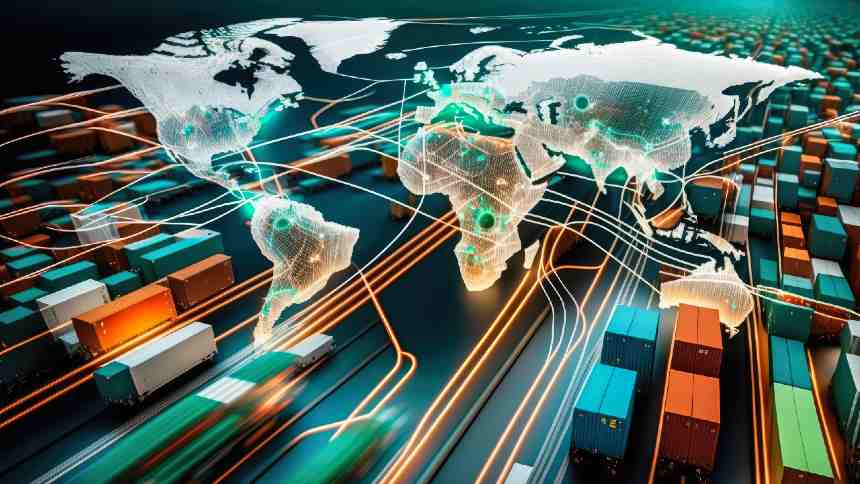
The interdependence between geopolitics and macroeconomics is central to the authors. The former defines where flows of goods, capital, and energy can go; the latter depends on how these flows function. Therefore, geopolitical shocks only affect markets in a lasting way when they impact essential economic channels—energy, commodities, critical technology, or logistical bottlenecks, such as the Strait of Hormuz.
According to the authors, historically, volatility caused by international tensions is episodic. The VIX index, the so-called "fear gauge," usually reacts in a short and limited way. Therefore, recessions directly caused by geopolitical events are rare – the Yom Kippur War in 1973, which raised the price of oil, is the classic exception. Most of the time, political crises only amplify existing weaknesses.
After tracing the history of economic evolution in the 20th century up to globalization, the authors note that multilateral institutions weakened amidst the rise of national populism. The Covid-19 shock, they argue, crystallized these trends.
“Governments were reminded of how interconnected the world had become; this interdependence meant vulnerability,” wrote Strobaek and Dumur. Therefore, policy priorities shifted decisively from supply chain efficiency to supply chain resilience.
In this context, they argue that the “new world order of the Trump era” seems less like a disruption than an acceleration. Security, sovereignty, and strategic autonomy have taken precedence over cost efficiency, with the economy once again serving geopolitics rather than the common good.
"Trade policy, industrial subsidies, and tariffs are once again tools of diplomacy," they state. "Geoeconomics has ceased to be a theoretical construct and has become the operational reality of the world's major powers."
"Market noise"
IMF research cited by the authors shows that geopolitical risks are imperfectly priced: they are rare, difficult to measure, and often underestimated until they materialize.
"Prolonged tensions, such as those between the US and China, tend to lose their psychological impact on investors when they don't generate immediate economic disruptions," they say. "Markets ignore the noise."
Still, Strobaek and Dumur warn that this should not be confused with complacency. In a more fragmented world, the disciplined investor needs to focus on “material constraints”—a concept coined by strategist Marko Papic that describes the physical, fiscal, and industrial limits that shape government decisions. Available energy, productive capacity, demographics, and supply chains define what is possible, not political rhetoric.
Another key point is that markets remain anchored in corporate profits. If demand and costs remain stable, geopolitical shocks rarely leave permanent scars. Outside of recessions, companies tend to preserve profit growth, sustaining valuations, employment, and consumption.
Therefore, the authors argue, geopolitics should be treated as an element of long-term strategic allocation, not as a trigger for immediate tactical reactions. The world is changing, but it is also adapting—unevenly and noisily. "The investor's task, therefore, is not to predict the next geopolitical shock, but to ensure that portfolios are built with sufficient resilience to withstand them," suggest Strobaek and Dumur.
For them, the key question for any investor today is straightforward: "Does this geopolitical event harm companies' ability to generate profits?" If the answer is no, the geopolitical noise remains just that—noise.