

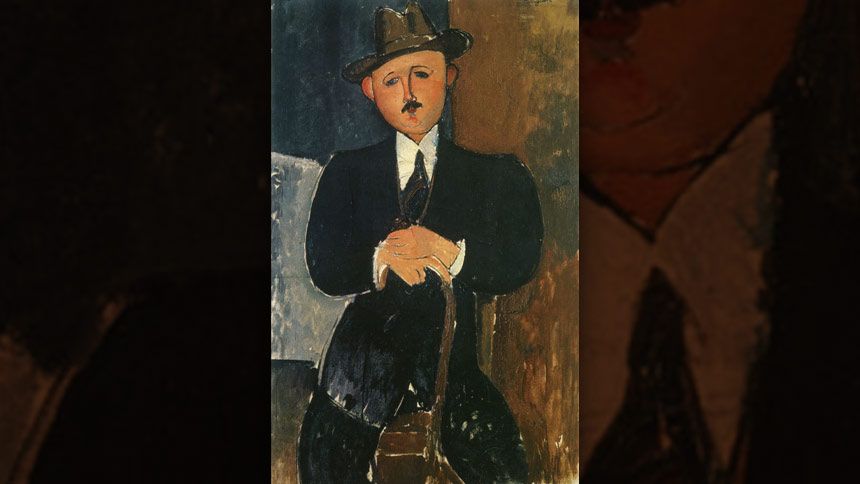
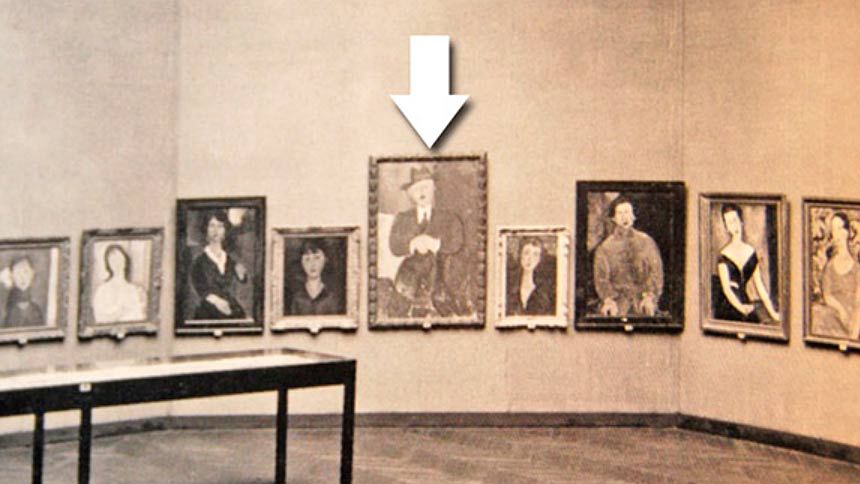
From the small town of La Force, in the Dordogne region of southwestern France, a 79-year-old farmer upheld his grandfather's fight. In early April, the New York Supreme Court made its decision: the painting Homme assis appuyé sur une canne (“Man sitting leaning on a cane”) belongs to Philippe Maestracci and not to the art dealer and billionaire David Nahmad.
As the sole heir of Oscar Stettiner, the farmer is therefore the rightful owner of the oil portrait painted in 1918 by the Italian Amedeo Modigliani (1884-1920). Judge Joel Cohen's decision puts an end to one of the biggest (and longest) disputes in the contemporary art market . And it exposes the intricate labyrinth involved in returning works looted by the Nazis to their rightful owners.
Valued at US$30 million, the painting had been confiscated by the Third Reich in the early months of World War II .
On September 1, 1939, when Germany invaded Poland, the British gallery owner Stettiner owned a gallery in the 8th arrondissement of Paris . Founded by his father fifteen years earlier, Stettiner et Cie. was a benchmark in the international art market.
Eighty days after the start of the conflict, to escape persecution by Adolf Hitler 's forces, he abandoned everything and fled with his family to the Dordogne.
Arrested by the Gestapo, Stettiner survived the war and, until his death in 1948, was tireless in his search for the Modigliani painting.
In 1946, a Parisian court even recognized him as the owner of the painting. By that time, however, the painting had already disappeared.
The last trace of Homme Assis dates back to 1944, when the American dealer John Van der Klip allegedly sold the portrait to a United States Army officer for a paltry 16,000 francs, the equivalent today of something between US$2,200 and US$4,400 — a pittance for the work of one of the masters of Western modernism, who, at that time, was already an artist with a consolidated reputation.
The buyer's name? Van der Klip claimed not to remember. Later, according to The Art Newspaper , it was discovered that the American had lied.
The first clue
The artwork would not be heard of again for more than 50 years. In June 1996, it reappeared at a Christie's auction in London , where it had been taken by Van der Klip's heirs. The Panamanian offshore company International Art Center (IAC) acquired the painting for US$3.2 million.
With the painting's resurgence, Philippe Maestracci now had a concrete path to follow. To that end, the farmer hired the Canadian company Mondex, which specializes in the recovery of lost works of art.
From the beginning, investigations indicated that the true owner of IAC was David Nahmad. For years, however, this was only a suspicion. The art dealer denied any direct link to the company—and the company's legal structure made it difficult to identify its owners.
It was only in 2016, with the outbreak of the Panama Papers scandal, that the links between IAC and Nahmad were finally proven. The leak of 11.5 million secret documents from the Panamanian law firm Mossack Fonseca exposed the workings of a global offshore finance system.
These structures are not illegal by definition, unless they are used for illicit practices such as tax evasion, money laundering, or concealment of assets—which was not found to be the case with IAC.
Moreover, as James Palmer, founder of Mondex, says in an interview with NeoFeed , the use of offshore companies is very common in the art world.

By registering a work in the name of companies based in tax havens , in addition to reducing tax costs, it is possible to keep the owners' identities confidential — ensuring discretion in a market where anonymity can protect investment strategies and/or avoid legal disputes.
While offshore tax havens are helpful for art dealers, collectors, and investors, they can become a major obstacle for investigators and heirs of looted artworks. The lack of transparency makes tracing the chain of ownership difficult.
"Without information about the ultimate beneficiary of these organizations, it is practically impossible to recover the artwork," says Palmer. "Cases involving offshore companies are always more complex, and the solutions require a lot of work, insight, and creativity: it is necessary to unravel the connections between various people and entities."
Purchase in good faith
Currently, Homme Assis is housed in a nearly 1,400-square-meter warehouse at the Port Francs et Entrepôts de Genève. A global leader in the storage of works of art, fine wines, gold, and high-end collectibles, the Swiss warehouse complex functions as a tax-free "vault."
Owned by the Nahmad family, the building houses approximately 5,000 pieces by artists such as Modigliani, Picasso , Renoir, Monet, Matisse… making David Nahmad, at 79 years old, one of the largest and most influential art dealers.
In some market analyses, his collection is cited as the largest private collection in the world, valued, in the most conservative estimates, at US$4 billion.
Born in Beirut and based between Monaco and New York, the art dealer assures that when he bought the Modigliani in 1996, he was unaware that the portrait had been stolen by the Nazis. "If I imagined that a work of art had been looted, would I lend it to a museum?" he challenged in an interview with The New York Times in 2016.
Shortly before, he had loaned the painting for an exhibition at the Jewish Museum in New York.
The argument of bona fide purchase is a recurring one — as is the claim by heirs that experienced buyers should be wary of gaps in the history of the works, especially during the Second World War.
After all, it was always well known that for Hitler, a frustrated artist, confiscating Picassos, Van Goghs , Matisses, Klees… was almost as important as military victories. From 1933 until the end of the conflict, it is estimated that 700,000 pieces were stolen in occupied Europe.
At the start of the legal dispute over the painting Homme assis , Nahmad even argued that the work he bought in 1996 was a different painting by the Italian artist.
But in 2020, Mondex researchers found a photocopy of the painting in Paris, at the Wildenstein Plattner Institute for art history research, with the inscription in French: "Modigliani. Stettiner Family. Stolen." The document had been filed away in 1950.
Further proof of the painting's provenance is the receipt attesting that the art dealer from the 8th arrondissement lent the canvas to the Venice Biennale of 1930.
As Judge Cohen wrote in the sentence, Nahmad's defense "presented no evidence identifying anyone other than Mr. Stettiner as the owner of the painting." Nor did they show that "Mr. Stettiner disposed of the artwork voluntarily."
In 2016, the Lebanese art dealer vowed: “If it is proven that this painting was looted by the Nazis, I will return it.” Palmer now hopes that Nahmad will soon fulfill his promise.
Meanwhile, from La Force, Maestracci celebrates. As Stettiner's grandson told the French news platform Sud Ouest : "My grandfather's story was still open and it needed to be brought to a close."