

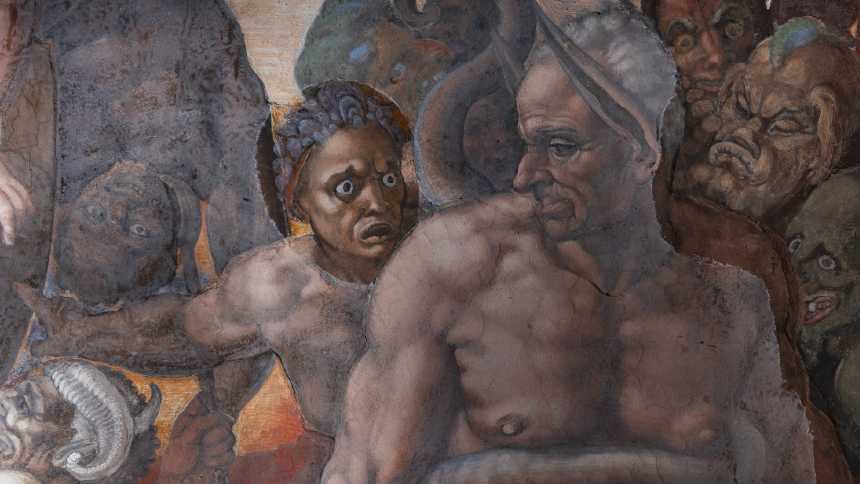
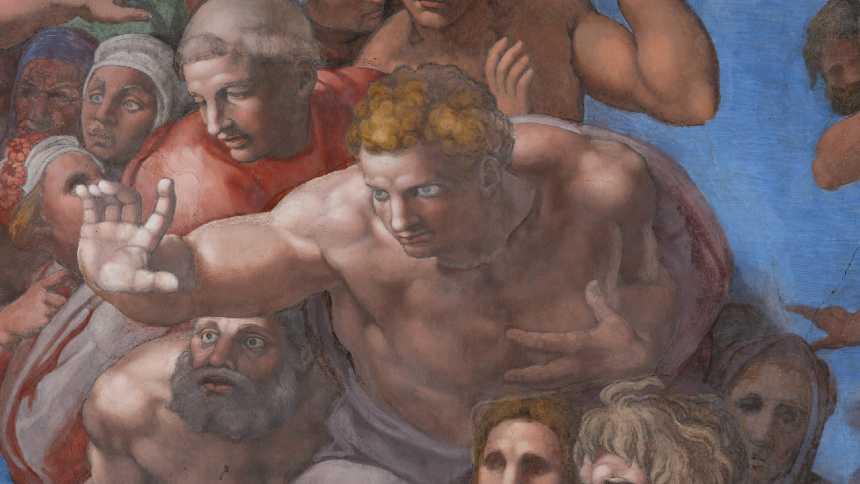
Rome — A meticulous, “sacred” ritual has been taking place at night inside the Sistine Chapel for the past two months. Restorers climb onto scaffolding, place double sheets of special Japanese paper ( washi ) over small sections of the Last Judgment fresco created by Renaissance genius Michelangelo Buonarroti (1475-1564), brush with deionized water, remove the wet material, and the original colors reappear.
It's a visual spectacle never before seen up close, as it's not open to the public. The technique works like a sponge, absorbing salts and residues caused by breathing, sweat, and climate changes, without damaging the original pigments. All in a matter of minutes, as the NeoFeed report witnessed, just centimeters away—and almost 20 meters high.
This white veil, identified as calcium lactate (calcium salt of lactic acid), was altering the contrasts of light and shadow in the masterpiece, and was identified during one of the meticulous reviews carried out periodically on site.
“Looking from below, it was practically invisible,” reveals Marco Maggi, head of the Conservation Office of the Vatican Museums, to NeoFeed . “It was only close inspection, combined with scientific analysis, that allowed us to identify this substance on the surface. We rediscovered Michelangelo colors,” adds the anthropologist.
It was therefore decided to undertake extraordinary maintenance of the painting, which was completed in 1541, with the last conservation of this magnitude having been carried out about 30 years ago. The Vatican avoids using the word "restoration" because the fresco is not damaged.
From time to time, the Sistine Chapel undergoes discreet conservation work. Since 2010, the Vatican Museums have maintained an annual routine maintenance protocol, carried out over five weeks in January and February. At night, when there are no visitors, teams of professionals clean surfaces, check structures, and monitor the condition of the paintings and marbles.
In 2024, experts decided to conduct a much more thorough review of Michelangelo's work. "It meant not only cleaning and documenting, but also implementing stricter controls, without chemical solvents, ensuring complete safety for the operators, the collection, and the environment," says Maggi. It was during this process that the surprise arose.
The human pressure on the Sistine Chapel is enormous. A relatively small space, approximately 40.9 meters long, 14 meters wide, and 20.7 meters high, where masses are celebrated and where the last conclave took place in 2025, when 133 Catholic cardinals met to elect Pope Leo XIV .
Watch the video that shows how the technique works:
Besides being a sacred place, it receives visitors from all over the world, reaching almost 25,000 per day. People's breath, humidity, and microscopic particles released by the constant flow of tourists end up altering the microclimate of the environment and favoring the deposition of substances on the painted surfaces.
With the removal of the surface layer, the restorers gradually regained a clearer perception of the intensity of the tones and the contrasts that structure the monumental composition of the artwork on one of the chapel walls.
“It was a cataract,” joked Barbara Jatta, director of the Vatican Museums, in a conversation with journalists, comparing the state of the artwork to the eye disease, which is now being removed.
Until the work is completed, scheduled for Holy Week, the Sistine Chapel will continue to receive worshippers and visitors, while restorers from the Paintings and Wood Materials Laboratory of the Vatican Museums work on the large scaffolding, protected by a screen that reproduces the image of the Last Judgment.
The cleaning of the fresco is being funded by a group of patrons from Florida, in the United States, and all phases are being documented by the Photographic Laboratory of the Vatican Museums, creating a precious record.
The Last Judgment (Italian: Il Giudizio Universale ) was commissioned from Michelangelo in 1533 by Pope Clement VII of the powerful Medici family. The theme would showcase the artist's full creative force: the representation of the final judgment of souls.
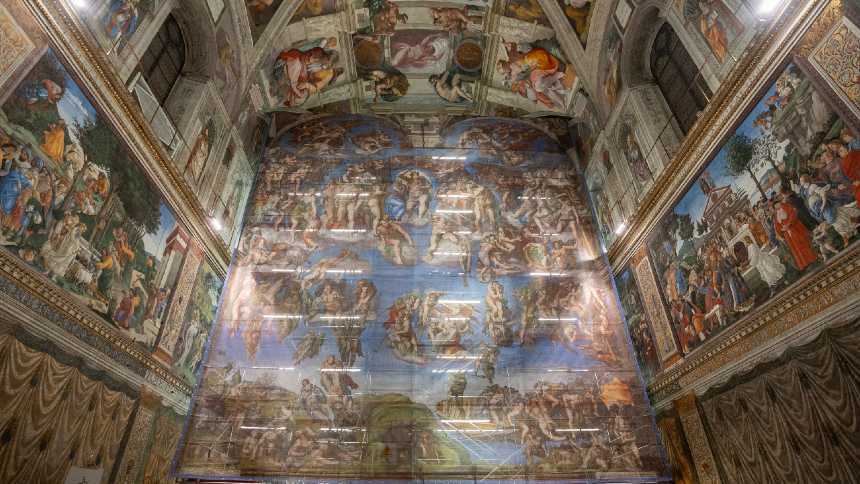
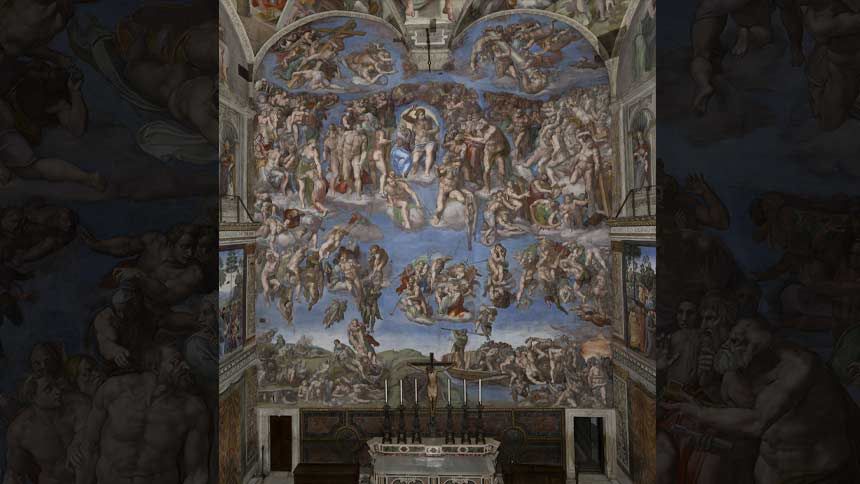
Work began in 1536, during the pontificate of Paul III Farnese, and was completed five years later, in 1541. To allow the genius to dedicate himself entirely to the project, the pope even released him from other artistic commitments, including the long work on the tomb of Julius II, and assured him an annual salary of 1,200 ducats until his death (about US$250,000).
When the fresco was finally unveiled, accounts from the time say that Pope Paul III was so impressed that he knelt before the painting, imploring divine mercy for Judgment Day.
With its hundreds of moving figures and a dramatic composition dominated by the figure of Jesus Christ, The Last Judgment has become one of the most impactful works in the history of art and one of the symbols of the Vatican.
Despite the scale of the current intervention, the Vatican Museums' strategy is to avoid major restorations in the future. The focus is on continuous preventative conservation, a tradition that dates back to the 16th century. As early as 1543, during the pontificate of Paul III, the figure of the mundator (Latin for "cleaner") was created, responsible for periodically removing dust from the decorations of the Sistine Chapel.
Even after more than five centuries, the fresco continues to surprise those who observe it closely. "It's impressive to see these colors still so vibrant," says Maggi. "We ourselves were impressed when we saw them again." The Italian pride in housing one of the most important works of art in the world, at this moment, truly shines through.