

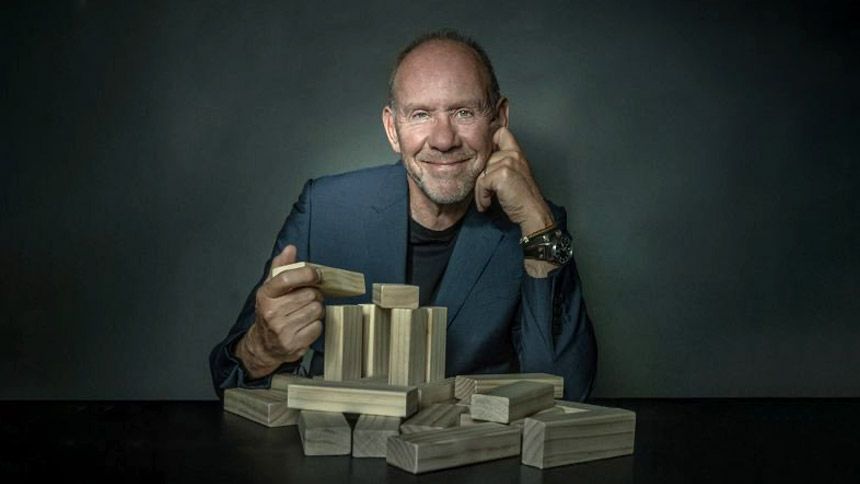
At 66, businessman and investor Ricardo Semler is preparing another game-changer. In the 1980s, he dismantled the hierarchy of the company created by his father and transformed Semco into a global benchmark for democratic management. Now, he wants to turn the tables on the last major industrial institution—the oldest and most resistant to change: the school .
Semler has just launched UnTethered — known in Portuguese as DesColada — a global education platform designed to scale the teaching model he has been developing since the early 2000s. His thesis: school has ceased to be merely a pedagogical problem and has become a macroeconomic bottleneck.
While companies are constantly reinventing themselves, education remains anchored in the 19th century, shaped by the Industrial Revolution .
On one hand, flexible structures, decentralized decision-making, valuing autonomy, creativity, collaboration, and critical and strategic thinking. On the other hand, rigid hierarchies, standardized curricula, fragmented disciplines, and learning through repetition.
The disconnect between how we learn and how work actually happens is not only increasing but also compromising the capacity for innovation in companies—and countries.
How can we devise original solutions for a constantly changing world when our education system is based on right or wrong, on the predictability of what can be proven?
It was from concerns like these that Semler, in 2005, inaugurated the first Lumiar school in São Paulo.
Considered one of the most innovative in the world by UNESCO , the OECD , and Stanford University , the methodology places the student at the center of the learning process, transforming them into the protagonist of their own knowledge—a model based on the collective construction of knowledge.
UnTethered radicalizes the method. “The Nova Lumi [school] is an attempt to adapt the school to today's world, without the remnants of the traditional school,” says Semler, in a conversation with NeoFeed .
The new platform took approximately three years to develop and involved around US$2 million in investment. Structured to adapt to different official curricula, it functions as a learning hub. Students are organized into small groups, matched by competence and interest. They are responsible for choosing the topic to be studied.
While most schools try to restrict screen use, Semler proposes technology as the central focus—real-time information flows, games, social networks, streaming , and instant, live global connections with simultaneous translation.
Thanks to the new tools, Nova Lumi can work anywhere — wherever there is an internet signal. In school buildings, community spaces, corporate campuses, and even refugee camps.
And this has nothing to do with the solutions proposed by education startups. " Edtechs aren't innovating in anything at all, just packaging obsolescence," he says. "As long as schools aren't truly reopened, as we're trying to do, everything will just be an accelerator of nonsense."
The experience at Semco
Semler's trajectory as an industrialist helps explain his gamble. A law graduate from the University of São Paulo and with a doctorate in business administration from Harvard, at the age of 21 he took over Semco, founded in 1953 by his father, the Austrian engineer Antonio Curt Semler. With the 1980s crisis, the company nearly went bankrupt.
At the helm, Semler reduced hierarchy, decentralized decisions, placed employees at the center of the process, and opened up company information. He diversified the business and made Semco grow, even in challenging times.
His experience made him a global reference. His first book, Turning the Tables , from 1988, was translated into more than 30 languages and sold around 2 million copies.
In 2005, after a serious car accident, he stepped down from managing Semco and began to dedicate himself primarily to educational projects.
If Semler previously dismantled the gears of the corporate world, now he targets the education that shapes individuals before they enter the job market.
“The school will undergo major changes for the first time in 200 years,” he says. “The question is what will drive this change: panic measures—or intentional choices to move forward.”
If it works out, the businessman will have turned the tables on the last big player.
From San Diego, California, where he currently lives, Semler spoke with NeoFeed about the revolution he envisions for an industry that generates approximately $6 trillion annually globally.
Below are the main excerpts from the interview:
Why is it so challenging to change the education system?
Only the school and the Church have remained unchanged for hundreds of years. Nothing else is as outdated as these two areas of life. The origin of conservatism is fear. The most frightened are the parents: they don't want to expose their children, their moral beliefs, and their values. And how do you protect them? By not letting your children do anything you didn't do. And, inside that little building [the school] , everything seems protected.
Hasn't the new economy highlighted the importance of change?
No. Fear still prevails. Many, especially parents, don't see that there's a great deal to be learned from technology. The first reaction, even in developed countries, is: "Don't let them into school." They prefer to leave their children to the periodic table, even if they don't use that knowledge later. It's a conservative reaction, born of fear and backwardness.
What can we say to those who want to ban screens in schools?
It took 32 years for the Bic pen to be accepted in schools. Initially, calculators were also banned. Today, the fear is that AI, social media, and games will steal children's concentration. It takes time to look back and say, "Wow, what nonsense that was."
"Only the school and the church have remained unchanged for hundreds of years."
But screens are really distracting.
Sure. All that was missing was someone saying they'd rather do sine and cosine calculations. But children and teenagers won't concentrate because that [teaching model] is idiotic. The class is so boring that anything will be more interesting. As children grow older, they lose their curiosity, the magic of knowledge. There comes a time, at 14 or 15, when they say, "What do I have to do to get out of here?" They memorize what's needed to pass the year, they learn what's necessary for the college entrance exam. It's a waste of ability and interest. However, this model represents 96% of learning in the world. Traditional schooling is indefensible, a crime against childhood.
If students pass the year and get into college, isn't that a sign that something is working?
Let's suppose someone gets a 9 on a geography test today. A year from now, that 9 is worth a 2. Why was the student tortured, forced to memorize that? Only to regurgitate it on the test? What kind of real learning exercise is that?
So, what do you suggest?
We advocate for relevance-based learning. If it's relevant to children, it sparks interest. And, being interesting, it leads to knowledge retention.
How does it work in practice?
The platform has a tool called "world reading," which captures the morning's news and suggests two or three avenues for discussion. Students choose the topic to be explored. The conflict in the Middle East, for example. The analysis can lead to understanding how oil prices are determined, what imperialism or dictatorship is. And this leads to the study of history, geography, mathematics, economics…
"Edtech companies are not innovating in anything at all, they are just packaging obsolescence."
Constructivist schools follow this line of thought.
Yes, but often they don't meet the official curriculum requirements. Our software can be adapted to various guidelines. It checks off required content and alerts students when it hasn't been covered. In other words, all the time students spend at Nova Lumi is, in fact, school time.
Does the new model eliminate the need for teachers?
Nova Lumi immediately dismantles the idea of the traditional teacher. In a world that changes from week to week, what's needed is someone who can constantly update themselves and make cross-references between areas—not someone who focuses solely on memorized information. We work with tutors and mentors. The tutors are a kind of guide and advisor, guiding the students.
And the teachers?
They are experts in specific subjects, spread around the world. They can go live, with simultaneous translation, to talk about what is being discussed. Another possibility is to use a platform like Slack to share experiences with a school in Tehran, for example. After an hour, the child knows more about the war in Iran than their parents do in a month.
In other words, the new platform takes school everywhere.
Yes, all you need is an internet connection. DesColada questions the need for a physical school—and this is worrying a lot of people. If we bring together ten children or teenagers, we have a dashboard that tracks them, we manage curricular requirements, there are tutors nearby, a pool of teachers available, and the students spend five hours a day there, why is a building necessary? We want, for example, to offer the platform in refugee camps, where children spend an average of 17 and a half years. That's 27 million children who, during all that time, are without school.
The edtech market is projected to grow at an annual rate of approximately 14% until 2030, when it is expected to reach US$400 billion. How would you rate the solutions offered by these startups?
Edtech companies aren't innovating in anything at all; they're just packaging obsolescence. What is a good school today? It's one that has a lot of money invested in buildings, that throws in a bit of AI to give it a modern feel. But go to a chemistry class and everyone's memorizing the periodic table like they did a hundred years ago. In other words, nothing has changed. It's a total deception. The school deceives the parents, the parents let themselves be deceived, the children cheat and pass the year. As long as the school isn't truly liberated, as we're trying to do, everything will just be an accelerator of nonsense.
Some startups propose to end school and replace teachers with avatars.
The sociological, tribal function of the school will never cease to exist. Interaction among students is fundamental for them to develop creativity, intuition, and questioning within a group.
How will the platform be marketed?
There's a business here, but nothing monumental. We don't have a sales department yet, but the idea is to sell subscriptions to private schools that already charge their students high fees. For small schools that can't afford it and public schools, it will be free. We want to disseminate the DesColada methodology. We are offering the manual, the do-it-yourself guide , and a portion of the open-source software for anyone who wants to do it.