


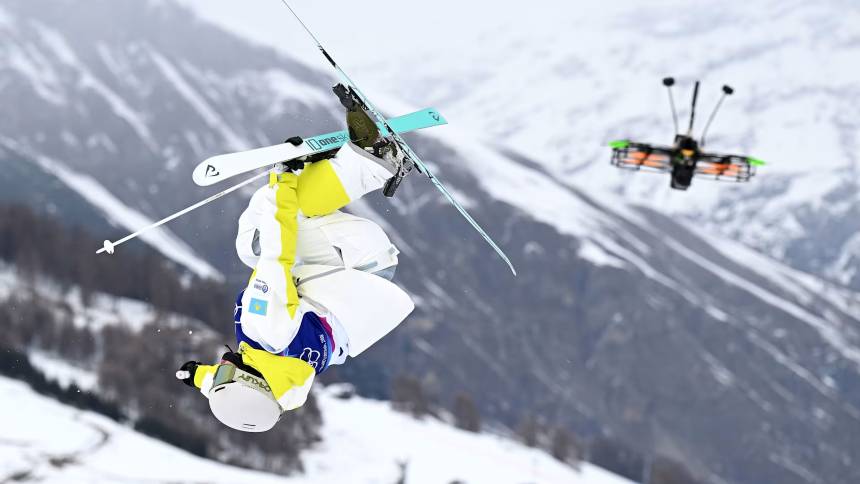
With approximately 2,900 athletes from 93 countries, the 2026 Winter Olympic Games , being held in Milan and Cortina d'Ampezzo, Italy, until February 22nd, is putting viewers "on the track," literally, during the sporting competitions.
These images, which allow for a very realistic follow of the Olympic athletes, are possible thanks to equipment making its debut at this Winter Olympics: so-called "first-person view" (FPV) drones .
They are piloted by an operator equipped with virtual reality glasses and a remote control. And, unlike traditional drones, which have been used in live broadcasts for over a decade, they are producing striking images and substantially transforming the way we watch the competition.
Valued at US$150,000, equipped with small cameras and capable of reaching 177 kilometers per hour, these drones are bringing spectators closer to the athletes and the competitions, capturing maneuvers, jumps, and descents on tight turns at high speed up close.
“Technology is offering us more and more opportunities,” says Yiannis Exarchos, CEO of Olympic Broadcasting Services (OBS), the operation responsible for generating images and content for the competition, in material released by the International Olympic Committee.
“But the Olympic Games are not a display of technology,” Exarchos continues. “It’s about finding more engaging ways to tell the stories of the world’s greatest athletes in the most efficient way possible.”
In this edition, out of a total of 25 drones, 15 fit the FPV concept and are participating in the broadcasts of all outdoor sports, as well as some indoor modalities, such as speed skating, capturing angles that, until now, were not possible in these competitions.
“We saw an opportunity to take sports coverage to a new dimension,” says Exarchos. “Especially for some of the winter sports, it was a great opportunity to really show and let people feel what it’s like to practice sports at that level.”
In translating this concept, FPV drones follow the athletes throughout the entire course and track, offering spectators a highly immersive experience and a closer perception of the speed and technique involved in each competition.
Just like the preparation of athletes for the Winter Olympics, the project to integrate FPV drones into the broadcast required a long period of operator training and close participation from the athletes, as well as an extensive period of operator training.
“The most important thing was to ensure safety and make sure that the athletes themselves would embrace the idea and feel comfortable,” says the CEO. “For each sport, we conducted a series of tests in collaboration with the International Federations and introduced the drones to all the athletes.”
Three-time Olympic champion in the luge discipline and in his fifth Olympics, German Felix Loch is one of the athletes who embraced innovation and said they have no problem with the use of the technology, which was adopted for the first time at the Paris Olympics in 2024 with images of cycling.
“These are definitely different images. It turned out really cool. We have to admit, what these guys are doing there is really great,” Loch said in an interview with Agence France-Presse (AFP).
Drones are particularly useful for sports that utilize a sliding track – such as luge, bobsled, and skeleton – as these devices eliminate the need to position cameras at each turn of the course.
Aside from this benefit, all this preparation work is also explained by the fact that, since 2015, the use of drones has been prohibited by the International Ski Federation. In that year, a drone fell on the slopes during a World Cup Ski event in Italy and nearly hit one of the athletes.
At the controls of the drones are names like Florian Blang, a professional drone pilot who spent years training for the 2026 Winter Olympics. Before that, he filmed world mountain bike championships, ski World Cups, and hockey games.
“There are incredible pilots who wouldn’t dare fly here,” Blang told The Wall Street Journal . “The director wants you to get close and you have to decide in fractions of a second if it’s safe enough – because athletes make mistakes too.”