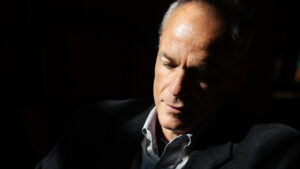



On the sixteenth floor of a building located in the heart of San Francisco's financial district, André Ferraz has a glass wall behind him that reveals the chaotic order of the Californian bay.
Against the current that fuels the dreams of entrepreneurs worldwide, this 28-year-old from Pernambuco wants to import the 100% Brazilian technology of In Loco, a high-precision geolocation company created in Recife, to Silicon Valley (which is almost always an exporter).
But opening up this sea of business is no simple task – and Ferraz knows it. The businessman is betting on originality as his greatest asset. "Initially, we would bring to the United States products already established in Brazil. There, we operate in the marketing sector," the executive, who is both founder and CEO of In Loco, told NeoFeed .
In Brazil, In Loco uses data analytics technology to provide companies of the caliber of JCDecaux and Otima with tools that guarantee better interaction with their customers. Thanks to this service, a company can, for example, know the places a person has been and their purchasing intentions, collecting relevant details when targeting specific advertising.
This tactic, also known as retargeting for mobile platforms, has benefited giants like Rede Globo. The company had a campaign displayed on Clear Channel's digital clocks, spread across various locations in Rio de Janeiro.
In Loco was able to map the exact location of each digital clock and identify, daily, who passed nearby. With this data, the company provided the advertiser with the possibility of interacting with all the people who passed near that outdoor media the previous day.
The company's work on this and other cases has given In Loco a database of over 70 million connected smartphones. This means that, every day, the company processes approximately 16 TB of data on its servers.
It would be natural, therefore, for the company's internationalization to occur through this marketing approach – but everything changed shortly after the company received its largest financial investment.
In June of last year, the startup raised US$20 million in a Series B investment round, which included participation from Valor Capital Group, Unbox Capital, and the South African fund Naspers.
In June of last year, the startup raised US$20 million in a Series B investment round.
With his capital duly secured, Ferraz chose to disembark in San Francisco with no return date, abandoning his duties in Brazil. He took with him only In Loco's new product, launched in July, which, according to him, promises to solve the issue of privacy in the era of the Internet of Things.
"We understand that no more than one person has visited the same places at the same time. The way you move around is, so to speak, like a fingerprint," says Ferra. "We created a device that creates a digital identity from this information, without the person needing to provide any other data, such as name, email, address, or document number."
Ferraz assures that not even In Loco would be able to discover the identity of its users, because the location information of each device is encrypted and the keys are not stored by the organization.
The product can, for example, be a security and privacy component for banks and online retailers. "Magalu is one of our clients. They use our technology to prevent fraud in their e-commerce environment," says Ferraz. "We use the user's location data to see if it relates to the types of transactions that are taking place."
This means that if a person tries to make a purchase on the Magalu website, but the electronic device they are using does not match the account holder's usual travel habits, the transaction will be declined.
If a person attempts to make a purchase on the Magalu website, but the electronic device they are using does not match the account holder's usual travel habits, the transaction will be declined.
This model, already proven in Brazil, had as its first client one of the country's main banks – acquired about three months after the product's debut. Now, six months after its launch, In Loco already offers this device to four of the five largest financial institutions in Brazil and eight of the ten largest retailers. Banco Original , Santander , TIM, and others are on the list.
"Since it's a new product, there are always many questions. To address customer insecurities, we've adopted a very aggressive model, with a guaranteed return on investment," says Ferraz. "We establish what would be considered a successful model within a given period, and if we don't reach that goal, we don't charge for the software for a year."
This same initiative will be replicated, without changes, in the United States, where Ferraz wants to establish robust operations. "Our objective abroad is not linked to revenue or number of users. In this first phase, we want to plant the In Loco flag. Our goal is to win one or two large clients, the kind whose name everyone recognizes," says Ferraz.
Relying on his investors' connections to open his first doors in the United States, Ferraz is also doing his part. Even without being a big fan of business events, the executive has been attending as many meetings as he can, hoping to build his own network.
On the same day that he received the NeoFeed report, Ferraz was about to board a plane to New York for meetings with potential clients. The executive says that In Loco in the United States is composed of three people, but that five positions are already open. "I believe we will close 2020 with 15 or 20 professionals on the team," says the entrepreneur.
This timid start, however, is not discouraging. The entrepreneur reveals that he has experienced a positive reception from potential clients and that with each new meeting it becomes clearer that the product he is carrying has the potential to solve a global problem.
Without fear of competition.
Focused on the horizon, but without neglecting to look to the sides, Ferraz and In Loco chose not to patent their new product . "Software patents are very fragile; you only need to change one small thing to implement it without any legal impediment," says Ferraz. "Our technology is different from anything that exists, and we treat it as an industrial secret, kept under lock and key." He continues, "If we really wanted the patent, we would have to reveal many things we've done."
João Teixeira, co-founder and CEO of Hands Mobile, a company that also works with geolocation for insights in the Brazilian advertising market, reveals that he follows the company's movements in the market. "We have a very close relationship with national players, but In Loco maintains a distant stance," he tells NeoFeed .
According to Teixeira, in addition to this separation, another peculiar characteristic of In Loco is that it "works only with geolocation and does not share profits with some of its clients." He continues, "We adopted a business model that helps large applications structure themselves to understand how they can go to market and co-participate in the revenue generated from our data insights. In Loco, in turn, does not share this profit and focuses its energy exclusively on geolocation."
Ferraz disagrees, stating that In Loco's work is broader, involving other technology tools for marketing, and says that contracts vary according to the needs and objectives of each client, and that in many of them there is, in fact, revenue sharing. Similarly, he says, In Loco maintains an open dialogue with various players in the Brazilian market. "We exchange a lot with different companies in the ecosystem, such as Adobe, for example," Ferraz counters.
Differences aside, Teixeira said he hasn't yet taken his operation to the United States because he believes Brazilian companies face significant challenges abroad . "Here, you conquer São Paulo and you can say you've conquered Brazil. In Mexico, if you dominate Mexico City, you can claim the country. But in the United States, you need to work six different territories to conquer the nation," he states.
The CEO of Hands Mobile also cites the weight of the competition on American soil, which, in his words, is home to a robust geolocation market. "Furthermore, the United States has this belief that technology is something that belongs to it. It's difficult for a software company, especially from Latin America, to position itself there," says Teixeira.
Aware of the obstacles that await them, Ferraz and the In Loco team maintain that they have no competition anywhere in the world. At least, not yet. And perhaps the greatest proof of the company's potential has been an attempted acquisition.
Ferraz and the In Loco team maintain that they have no competition anywhere in the world.
"We were approached in Brazil by an American player who wanted to negotiate our operations. Personally, I have absolutely no interest in selling the company, regardless of the amount offered. The original plan is to grow In Loco until we take it to an IPO or something similar. But we're in no hurry," says Ferraz.
Genesis and failures
In Loco never declared war against the clock – perhaps that's why it allowed itself the luxury of taking four years to win its first client.
The business started in 2010 as a university project. "Actually, this idea came about in two stages. Since my father is in this field, I had access to computers from a very young age. Around the age of 10, I started breaking codes and systems and was amazed by the 'power' I had even as a child. I started thinking about what a prepared person, with technical knowledge, could do," says Feraz.
Years later, the entrepreneur devoured Mark Weiser's book "The 21st Century Computer" and was fascinated by the concept of ubiquitous technology, which argues that technology will be something natural and will be in everything. "I was fascinated by this concept, but the memory of how fragile the system is made me think that, in the wrong hands, we can lose control of our lives in a world where ubiquitous technology operates."
The idea of using location as a privacy and security tool came to him organically on his way to college. "I got to class and told everyone. Right there I put together a team and we started working," he says, confessing that he thinks this whole business of keeping big ideas secret is silly.
"As a university project, In Loco was born in 2010, but it became a company in 2013. We promised that this would be our full-time job and that the startup would protect everyone's privacy," says Ferraz.
The initial team consisted of 16 friends, but gradually dwindled to six, and soon two more joined – precisely the two who still lead the company, which today has 250 employees spread across offices in Recife, São Paulo, Rio de Janeiro, and Brasília.
The path to this structure, which has just expanded its ambitions internationally, was not without its setbacks. In Loco failed twice, over three years, before getting it right. "First, we made a geolocation app for shopping malls. Then we developed a platform that was a kind of Google Maps for indoor environments, and it didn't work. Only the third product, this marketing one, gained traction and allowed us to grow," says Ferraz.
Today, In Loco has 250 employees spread across offices in Recife, São Paulo, Rio de Janeiro, and Brasília.
In Loco's journey wasn't easy, and the script followed that of many startups. When they went to negotiate with their first investor in 2013, they didn't have the money to hire a lawyer. "So, I studied all the possible rules and took on that role," says Ferraz, smiling.
According to Ferraz, this situation taught him to understand the problem, devise a solution, and only then execute the plan. "I see many companies, especially those that raise a lot of capital, acting as if money solves everything. It doesn't surprise me that so many startups are currently in a phase of reducing costs and balancing the books. We were forced to think and act differently, but I think it was very healthy," says Ferraz.
* This report was updated at 1:25 PM on January 30, 2020.
Follow NeoFeed on social media. We're on Facebook , LinkedIn , Twitter , and Instagram . Watch our videos on our YouTube channel and subscribe to our newsletter to receive daily news.