

You're there, foot flat on the gas. Nothing. A little more. Still nothing. For a second, you think they've exaggerated. That the myth isn't real. And it's precisely at that moment that the world changes.
It's not acceleration. It's a rupture. The turbo kicks in all at once—full, brutal, without warning. The car doesn't just respond; it explodes forward. The engine screams behind you, the rear end squats, air is violently sucked in, and the space around you compresses. Your body is glued to the seat, the steering wheel eases from your grip, the straight line becomes a tunnel closing in on you. There's no progression. No smoothness. Just force. Violent. Instantaneous. Unquestionable.
And the most disconcerting thing of all: you didn't ask for this now. You asked for it before. But the answer came too late to back down. There's an unpredictable gap between your decision and the mechanical consequence. And when that consequence finally arrives, it's no longer under your control.
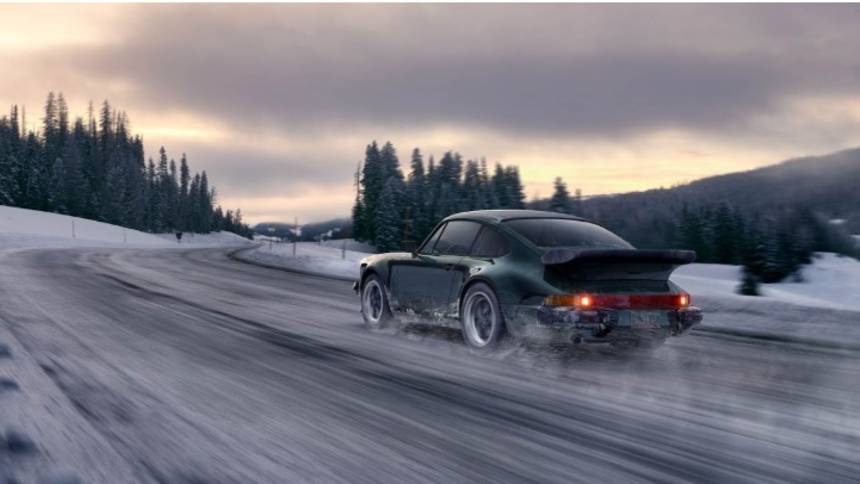
It was precisely because of this behavior that the classic Porsche 930 earned the grim nickname " widowmaker ." The danger of that car was never just its power, but its timing . The chronic turbo lag created a dangerous illusion of control. You'd step on the gas, and the naturally aspirated engine would seem docile, almost lazy below 4,000 RPM.
And then, in the middle of a turn, when you had already relaxed or floored it too much out of frustration, the power would kick in. With the engine mounted in the rear and the traction sending all the fury to the rear wheels, the abrupt delivery would whip the car. It was a machine that punished overconfidence with brutality, but which, paradoxically, was loved and desired precisely for that reason.
I'm passionate about classic cars. And the 930, in particular, has always held an absolute fascination for me. Perhaps because it's from my era: we were both born in the late 1970s. There's something profoundly special about machines that don't hide their true nature. Cars that don't shield you from their own ambitions, that don't filter experience, and that demand respect. That invite you—almost provoke you—to go a little beyond the safe limit.
My other great passion is technology. And, I confess, there's a part of me that would love to be on the other side of the table today, as an entrepreneur. Holding that steering wheel in my own hands. Putting the pedal to the metal. I close my eyes and imagine the absurd adrenaline rush of applying Artificial Intelligence within a real-world organization—like Buscapé was back in 2013, with its R$600 million in revenue and 1,500 employees. A playground full of powerful levers where this new technological layer could multiply efficiency insanely, accelerate growth, and rewrite the way of operating from scratch.
I don't have that steering wheel today. My operation is small; we're just seven investors passionate about innovation at Headline Brasil. And honestly, I envy those who have that scale in their hands right now.
However, I have a very rare privilege. Over the past twenty years, I've had the chance to invest in more than 100 startups. And today, my place is in the passenger seat alongside the best " widowmaker pilots" the ecosystem has ever produced. Founders who are at the absolute forefront of applying AI to real businesses. I follow them closely, and I can say that even they operate with bated breath, feeling their way through the limits of this new physics.
I sit in the passenger seat watching as they floor the accelerator, waiting for the turbo to kick in. And I can say with considerable conviction, looking at the control panels of dozens of companies: the punch hasn't come yet.
Since January, the market's pace has shifted dramatically. We see more capable models emerging in quick succession, innovative tools like OpenClaw enabling true agent orchestration, costs plummeting, and capabilities soaring. It's a seismic shift every two days. The feeling is one of inexhaustible technological abundance.
And the best business leaders are doing exactly what great race car drivers do when facing a straightaway: they're not waiting. They're applying AI relentlessly, aggressively, and across all areas of the company simultaneously. In customer service. In sales engineering. In logistics operations. In the financial back office . In executive decision-making.
The bottleneck has reversed: software engineering is no longer the limit. The limit now is the human capacity to imagine and specify products at the same speed that AI builds them. Tools that three months ago were state-of-the-art for programming are now used by teams only to sketch ideas. It's a simultaneous and furious rewriting of the entire system. Everything building up, one gain on top of another.
Still, almost none of this appears in the current numbers. This is because there is an inevitable lag between plugging the technology into the management system and the results becoming apparent in revenue, cost reduction, and margin. Everything that has been intensely built by leading companies during the last two months is still within the engine's response time. What we are experiencing now are the final milliseconds before the Porsche's turbo kicks in.
Everything is being connected, adjusted, and tested. The system is gaining momentum, and energy is being compressed behind the scenes of top-tier operations. But this time, it's not just a turbo boost. It's the exponential force of AI activated in every gear of the company simultaneously.
And when that pressure is released—over a very short window, in the next three to six months—the response won't be gradual. It'll be like in 930. Sudden. Brutal. A punch.
It's easy to look at this momentum and think, "But if a company accelerates like that, won't it lose control and crash?" The risk of execution always exists. Those who accelerate too fast can, indeed, skid. But, in today's corporate landscape, the physics of the widowmaker is reversed.
The real mortal danger isn't getting behind the wheel of this machine. Those who accelerate risk crashing, but those who don't accelerate are absolutely certain to be seen in the rearview mirror of those who floored it. It's parking at cruising speed and suddenly seeing your competitor disappear on the horizon, propelled by efficiency gains and increased margins that you simply don't have time to catch up to.
For companies that haven't stepped on the gas in recent months, it will be too late. We are going to witness inexplicable leaps in productivity.
For companies that haven't stepped on the gas in recent months, it will be too late. We will witness inexplicable leaps in productivity. We will see a compression of operating costs that seemed impossible from the perspective of traditional economics. Margins will expand much faster than any Excel spreadsheet could predict.
And above all, we will see a ruthless divergence in the market. Because the impact that is coming is not additive, nor multiplicative. It is factorial. It's not about doing the same thing 10% better. It's about a definitive distancing from those who stayed on the sidelines thinking that AI was just a glorified chatbot.
Just like with the classic German sports car, the real risk of artificial intelligence today isn't the sheer power of the technology itself. The risk lies in the lag between cause and effect. It's in you not believing in the impact of the turbocharger, simply because the pedal hasn't yet translated into torque.
If you're out there building AI, testing tirelessly, adapting your team, reviewing processes, and you feel that all this Herculean effort of the last few months hasn't yet yielded real results... breathe. That's expected. The engine still seems docile.
Keep flooring it. Go beyond 4,000 RPM. And hold the steering wheel tight. Because... here comes the punch!
Romero Rodrigues is head of venture capital at XP and managing partner at Headline in Brazil and Latin America.