

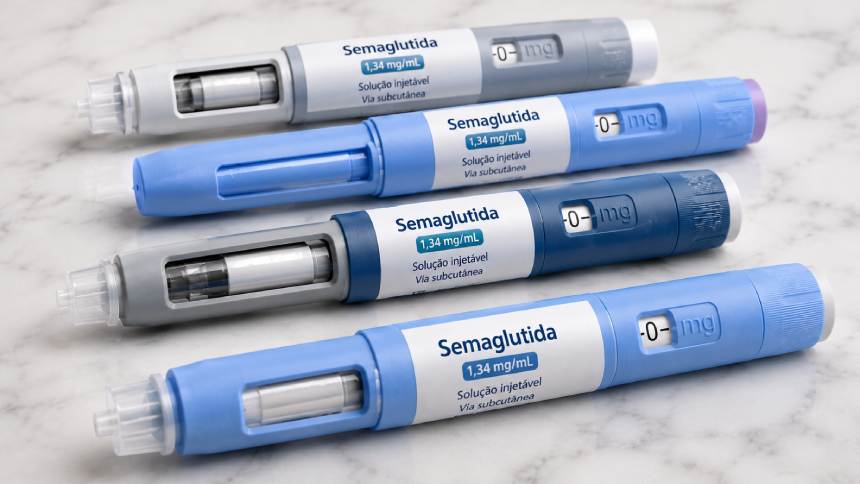

Following the approval of the registration of the Ozivy slimming pen, from EMS , on May 26th, the first semaglutide to be manufactured in Brazil, technicians at the National Health Surveillance Agency (Anvisa) are now working to approve the next application on the list, which is that of Ávita Care.
In recent days, the company provided the final clarifications to the agency so that the registration can be issued in June, NeoFeed has learned. In practice, Ávita Care, which imports and distributes products, represents the European pharmaceutical company Adalvo, from Malta, before the regulatory body; Adalvo is the company that will actually produce semaglutide for the Brazilian market.
Based in the city of Vinhedo, São Paulo, Ávita, which belongs to the Soluto group, explains on its website that it "acts as the holder of Anvisa registrations, conducting legal representation, importation, storage, distribution, pharmacovigilance and customer service under a single CNPJ (Brazilian tax ID number)." In other words, the Brazilian company will be responsible for the strategy to introduce the semaglutide-based slimming pen from its European partner into Brazilian pharmacies.
In this regard, the company already has a plan in place to quickly gain market share in the pharmaceutical industry. However, the company itself will not be at the forefront of product sales.
According to information obtained by NeoFeed , Ávita Care will transfer the marketing of the pen in the country to the Swiss pharmaceutical company Sandoz, one of the largest in the world in biosimilars and generics.
Sandoz in Brazil has been headed by Isabella Wanderley since February of this year. The executive previously led Novo Nordisk in Brazil between August 2021 and September 2025. Ávita sees her experience as CEO of the manufacturer of Ozempic , and her knowledge of the Brazilian market for weight-loss pens from the beginning, as a competitive advantage.
In any case, Wanderley left the leadership of Novo Nordisk under pressure, at a time when the Danish pharmaceutical company began to lose market share in Brazil to the American company Eli Lilly . The US company brought the Mounjaro pen to Brazil last year, considered more effective than Ozempic and containing tirzepatide as its active ingredient. Today it leads the market.
The model that will be established between Ávita Care and Sandoz, based on products manufactured by Adalvo, is similar to the one Novo Nordisk signed with Eurofarma at the end of last year.
In October, the two companies announced the launch of the Poviztra pen, also based on semaglutide, produced by Novo Nordisk, but with promotion and marketing handled by Eurofarma.
Although using the same active ingredient, the idea was to offer a cheaper GLP-1 analog medication option than Ozempic and Wegovy, without being considered a copy. The plan was also, in a way, to neutralize the impact of the patent expiration by allowing new players to enter the segment.
Ávita Care's haste is precisely so that the Sanchez family's pharmaceutical company does not navigate the semaglutide market alone for too long, taking into account the period after the expiration of the patent for Ozempic and Wegovy, from Novo Nordisk, at the end of March.
With this partnership with Sandoz, Ávita's strategy, according to NeoFeed , will be to ensure a distribution similar to that of EMS , which stated its intention to produce 1.2 million units in the first year, with an initial distribution of 350,000 pens.
"The company is prepared to begin distribution in pharmacies as soon as it receives registration from Anvisa (Brazilian Health Regulatory Agency). The plan is to enter the Brazilian market as a competitive player," says a pharmaceutical industry executive who is familiar with the company's plan.
On Monday, May 25th, one day before the publication of the approval of EMS's pen in the Official Gazette of the Union (DOU), Anvisa also changed the registration status of Ávita Care, in the internal process, to "analysis completed." However, approval was still pending, which generated expectations in the sector in the following days that the approval would be faster than anticipated.
But the regulatory agency's technicians requested further explanations regarding the good practices of Adalvo's production units, a mandatory requirement of Anvisa for the registration process, and where the pens destined for Brazil will be manufactured. The European pharmaceutical company plans to produce semaglutide in factories in Canada and China.
Last year, Anvisa announced that it would prioritize registration requests for semaglutide, allowing them to "jump the queue" over other drug applications. Another priority for ensuring faster approval would be confirmation of domestic manufacturing.
“But Anvisa also warned that it would grant two approvals per semester, under this priority model. Therefore, there is an expectation that Ávita Care's approval will be next and will be granted by the end of June,” said another source consulted by the report.
The value and date of the EMS pen.
One week after obtaining registration approval, EMS determined that the Ozivy pen will be available in pharmacies starting June 15th. The product will cost R$ 452 for a box containing one pen.
For those opting for the three-month treatment, the cost will be R$ 863.23 for a box containing two 1mg pens. This means a monthly cost of R$ 287 under this plan. From the fourth month onwards, the cost will increase to R$ 498. NeoFeed had previously revealed, as an exclusive, that EMS's semaglutide would cost approximately R$ 500.
“This investment will guarantee greater access to these products in Brazil. And there are still many patients to enter this market,” says Marcus Sanchez, vice president of EMS, to NeoFeed .
And it is precisely this audience that Ávita Care is targeting. The company is working to prevent the same thing from happening with semaglutide as happened with liraglutide, whose patent expired in Brazil in November 2024. The reference medications are Saxenda and Victoza, also from Novo Nordisk.
Shortly after the patent expired, EMS obtained approval from Anvisa (Brazilian Health Regulatory Agency) and, in August of last year, launched the Olire (for obesity) and Lirux (for type 2 diabetes) pens. Since then, no other pharmaceutical company has obtained approval, making it the only one to produce liraglutide in Brazil.
Before approving EMS's semaglutide, Anvisa summarily denied registrations that were in progress at the agency. In April, the agency reported that the Embeltah pen, from the Indian pharmaceutical company Dr. Reddy's, was vetoed due to a lack of proof of efficacy, safety, and quality.
With this race for approval from Anvisa (Brazilian Health Regulatory Agency), pharmaceutical companies are competing for a market that is expected to exceed R$ 15 billion in 2026, considering all the slimming pens approved in Brazil. Last year, the revenue of retail chains from these products reached R$ 10 billion.
The growth in demand for slimming pens in Brazil follows a global trend. A recent report from BTG Pactual shows that, last year, the global GLP-1 market reached US$63 billion, with projections to exceed US$73 billion in 2026.
According to the bank's document, treatments based on the drug represented 8% of all medical prescriptions in major pharmacy chains in the United States. Five years ago, it was less than 1%.
Contacted by NeoFeed , Ávita Care did not respond to the interview request. Sandoz responded that "due to corporate policy, the company does not comment on potential or eventual partnerships, nor does it disclose details about pending registration applications."
Anvisa reported that "there are currently 13 registration requests for synthetic semaglutide and four for biological semaglutide." It also explained that "it is not possible to anticipate deadlines before the technical team concludes the process, which is also subject to technical questions that may arise during the process."