


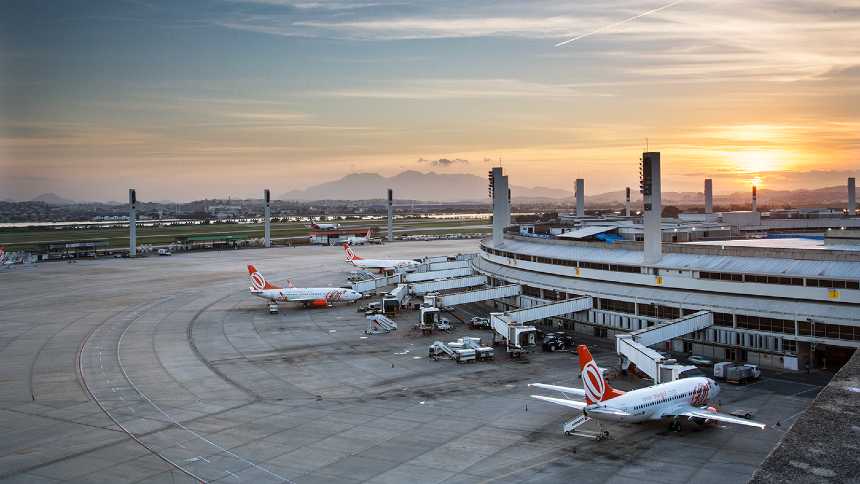
Following a highly competitive auction on the B3 stock exchange, the Spanish giant Aena won the concession for Tom Jobim International Airport ( Galeão ) until 2039 on Monday, March 30th, with a bid of R$ 2.8 billion. The amount paid represents a premium of 210.88% over the minimum bid of R$ 932 million stipulated by ANAC (National Civil Aviation Agency).
The Spanish giant won the bid against Zurich Airport Group after 26 oral bids, which ranged from one cent in Brazilian reais to R$100 million more than the previous offer.
The third competitor, the Vinci-Changi consortium – the current concessionaire of Galeão Airport, along with Infraero – withdrew from the bidding process after seeing its offer of R$ 1.88 billion surpassed by higher bids from the other two incumbents in the initial stages of the live bidding process.
In the first phase of the auction, in which the three competitors submitted written proposals, Aena and Zurich offered R$ 1.5 billion in concession fees, while the Vinci-Changi consortium agreed to pay R$ 934 million.
The world's largest airport operator in terms of passenger numbers, Aena has also become the largest in this respect in Brazil, holding concessions for 18 airports, including Congonhas (São Paulo) and Recife.
In 2025, the company transported 45.6 million passengers, a volume that is expected to increase with the incorporation of Galeão Airport, responsible for approximately 18 million users per year. With this, the company could surpass São Paulo/Guarulhos International Airport , currently the largest in the country, which recorded 47.2 million passengers in the same period.
The auction result was surprising due to the high premium and fierce competition for an asset that has faced many problems since the first auction in 2013, when the concessionaire RIOGaleão was created, formed by Changi , a Singaporean giant in the airport sector (51% stake), and Infraero (49%).
Since then, the consortium has accumulated R$ 7 billion in losses at Galeão Airport, in a series of difficulties that have transformed the project into one of the most emblematic cases of crisis in Brazilian airport concessions.
The contract was signed in 2013 based on optimistic demand projections, which predicted strong growth in the number of passengers due to the 2014 World Cup and the 2016 Rio Olympics – but this scenario did not materialize over the years, compromising the economic and financial balance of the business.
The Covid-19 pandemic has definitively worsened the situation, causing a sharp drop in passenger traffic and increasing the concessionaire's debt.
The situation was aggravated by direct competition with Santos Dumont Airport, located in the central region of Rio, which concentrated highly profitable domestic flights and reduced traffic at Galeão Airport, which at one point operated at only 30% of its capacity.
Faced with this imbalance, RIOgaleão resorted to administrative and judicial disputes to try to revise the contractual obligations, including the originally agreed-upon concession fee. The impasse dragged on for years until the federal government and the Federal Court of Accounts (TCU) moved forward with a renegotiation, recognizing the unfeasibility of the initial model – which explains the short period of the new concession, until 2039.
On another front, the establishment of operational limits at Santos Dumont Airport, starting in 2024, mitigated the concessionaire's losses. Furthermore, RIOGaleão underwent a corporate restructuring last year.
The investment fund Vinci Compass acquired, for an undisclosed amount, 70% of Changi's stake. With this, RIOGaleão entered the auction with Vinci Compass holding 35.7% of the concessionaire and Changi holding 15.3%. The remaining 49% stayed with Infraero – which decided not to participate in the auction and is expected to receive compensation of R$ 502.8 million.
Assisted sales
The agreement reached at the TCU (Brazilian Federal Court of Accounts) was crucial in making Galeão viable, paving the way for the so-called assisted sale of the concession, with new rules and a lower financial burden, which explains the fierce competition in the auction for the asset.
The new contract brings relevant changes to the concession model, such as replacing the fixed grant with a variable contribution corresponding to 20% of gross revenue, a measure that reduces the financial pressure on the winning concessionaire's cash flow.
Also removed was the requirement, stipulated in the original contract, for the construction of a new runway, a high-cost project that would require significant investments and which proved incompatible with the current level of demand at the airport.
In 2023, Galeão Airport recorded a record number of passengers, with 17.5 million, although still far from its potential capacity, estimated at more than 30 million users per year, which shows significant room for expansion. Financial performance followed this recovery: in 2024, RIOgaleão's revenue reached R$ 1.14 billion, a 37.4% increase compared to the previous year, according to the company's own report.
The contract also provides for a financial compensation mechanism for Galeão Airport should Santos Dumont Airport exceed established operational limits, reinforcing the role of the Ilha do Governador terminal as an international hub. Furthermore, the renegotiation puts an end to billion-dollar disputes between the concessionaire and the Federal Government, creating an environment of greater stability and legal certainty for the arrival of a new administrator.
“Since it is a transfer of control, the new controller will take over the concessionaire in its current situation, with the same assets and liabilities, and will seek to balance the operation based on a new concession model, replacing the fixed grant with a variable one,” says Diogo Nebias, an expert in infrastructure contracts and partner at the law firm Panucci, Severo e Nebias Advogados.
Aena directly manages and operates concessions for 47 airports in Europe, Latin America, and the Caribbean, including hubs such as Madrid-Barajas and Barcelona-El Prat in Spain. With the auction win, it will now control two of the three largest airports in the country.