


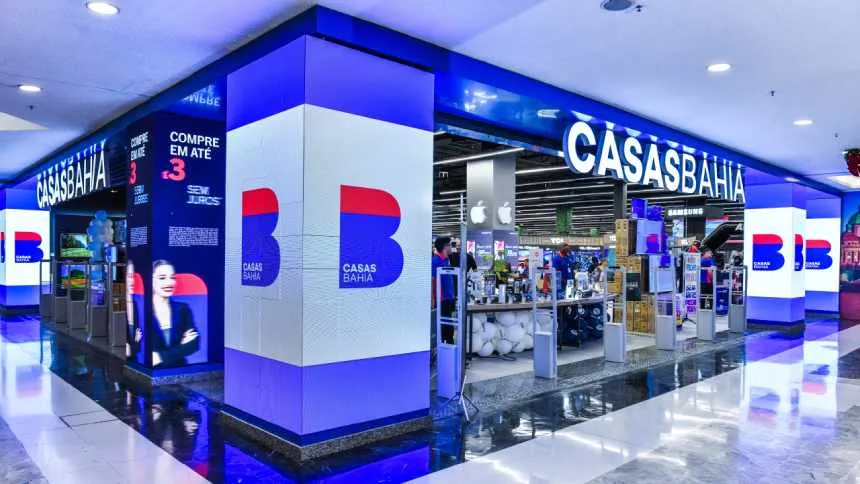
In the transformation plan that Casas Bahia has been implementing since 2024, based on the "back to basics" philosophy, one point that was missing was the financial aspect, with the correction of the capital structure. That is no longer the case.
The retailer announced on Wednesday, March 11, that it reduced its net debt by 75% in the fourth quarter, causing its financial leverage to fall from 1.9 times in the third quarter to 0.4 times at the end of the year, paving the way for the company to begin thinking about the next phase of growth.
“The market has always been concerned about leverage, recognizing operational gains, but saying that with high interest rates we wouldn't come out on the other side,” says Renato Franklin , CEO of Casas Bahia, to NeoFeed . “We have now crossed an important barrier, establishing a much stronger balance sheet, signaling a new phase for the company.”
The transformation of the capital structure began in August of last year, with the conversion of debentures by Mapa Capital , which reduced the debt by R$ 1.6 billion and became the controlling shareholder of the company. Four months later, in December, came the second phase, which cut another R$ 3 billion .
Franklin says these operations will result in a significant reduction in financial expenses, of approximately R$ 450 million per year. "Looking at the projected cash flow, the two transactions combined will save us R$ 7.5 billion in cash flow over the next five years," he states. "The financial expenses for the second half of the year will be much better than those for the second half of 2025."
Addressing financial expenses is crucial for Casas Bahia to return to a positive balance on its bottom line. In the fourth quarter, the company recorded a loss of R$ 1.5 billion, a 3.4-fold increase. For the year, the total loss was R$ 3 billion, a 2.8-fold increase.
The negative impact of financial expenses was amplified by the board's decision to make a non-recurring provision of R$ 1.4 billion related to tax credits. Excluding this effect, Casas Bahia closed the fourth quarter with a loss of R$ 79 million, an improvement of 82.5%. For the year, the negative balance increased by 47.2%, to R$ 1.5 billion.
Financial expenses were a "thorn in the side" of Casas Bahia's balance sheet, diverting attention from the operational side, which has been showing improvement. In the fourth quarter, Casas Bahia recorded a 6.1% increase in net revenue, to R$ 8.5 billion, and rose 7.3% compared to 2024, to R$ 29.2 billion. EBITDA advanced 29.1%, to R$ 826 million, with the margin growing 1.8 percentage points, while for the year it reached R$ 2.5 billion, a 29.7% increase.
During the period, consolidated GMV grew 8.7% year-on-year, totaling R$ 13.1 billion. While e-commerce GMV grew 21.7%, the indicator for physical stores remained stable, with the "same-store sales" metric, which considers the results of units operating for more than 12 months, rising 2.6%, less than the 17.1% recorded in the fourth quarter of 2024.
According to Franklin, the positive results for physical stores are a consequence of the strong comparison base established in 2024 and the migration of consumers to digital. Furthermore, customers who prefer to go to stores, generally those with low incomes, ended up reducing their consumption due to the difficult macroeconomic climate.
"The growth in market share has been very significant online. The trend is that, as we improve the profitability of online sales, it will reach a share close to what we have in physical stores," he says.
Focus on installment plans
With adjustments well underway on the operational and financial fronts, Casas Bahia will focus on reviving an area that has always been synonymous with the company: installment sales .
At Investor Day, scheduled for March 23, Franklin plans to present a program of over 100 initiatives for the next two years focused on increasing installment sales in both physical and online markets.
The initiatives include investments in specialized media, prioritizing the offering of products that are more aligned with installment payment plans, and using technology to better understand customers and release credit more quickly and effectively.
"Additional sales in any category bring in contribution margin; the gross margin is large, but when I make a sale on credit, it's much stronger," says Franklin.
Last year, the credit portfolio totaled R$ 6.6 billion, a 7% increase year-on-year, but the assessment is that it is possible to advance further, given the company's scale and the expertise it has gained over the years. "When we look at the credit portfolio, it grew less than we would have liked; we grew R$ 450 million," says Franklin.
He emphasizes that the idea is not to rush sales, since the macroeconomic scenario is not yet favorable for granting credit. The first step is to structure the operation.
“Growth is not expected in the first half of the year; we'll wait for things to improve,” he says. “We'll start to gauge the market, but our main expectation is to see interest rate reductions and improvements in household debt levels so we can accelerate growth.”
Shares of Casas Bahia closed the trading session down 3.13%, at R$ 3.09. Over 12 months, the shares have accumulated a decline of 40.6%, bringing the market value to R$ 2.8 billion.