

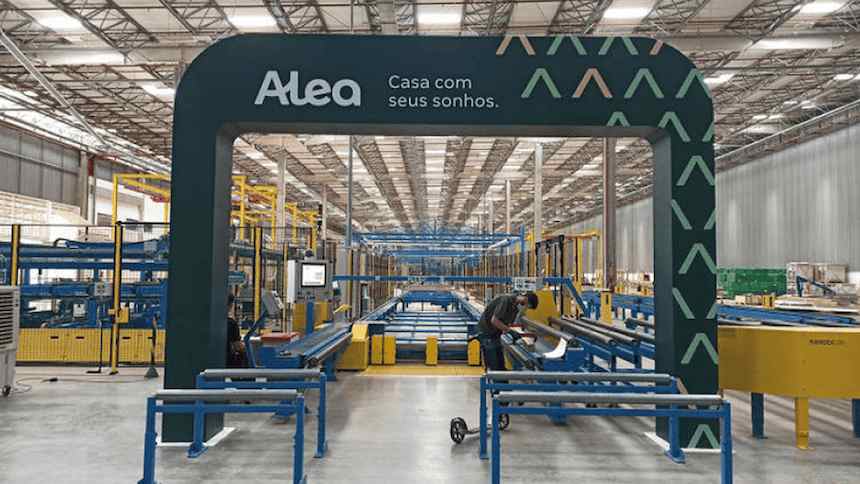
After Squadra escalated its criticism of Hapvida's management and Mak Capital requested the removal of Oncoclínicas' board, a group of asset managers is now joining forces to pressure Tenda to discontinue Alea , the construction company's subsidiary that operates in the off-site segment, using the wood frame construction system.
NeoFeed has learned that, following the release of Tenda's results in early March, JP Morgan arranged a meeting between Cláudio Andrade, chairman of the board, and a group of buy-side asset managers dissatisfied with Alea's performance.
Representatives from AZ Quest , Ibiuna , Kinea , Vinci , and others were present at the meeting. There was a direct demand for the discontinuation of the project, which includes a factory in Jaguariúna, in the interior of São Paulo state, but which, according to minority shareholders, never justified the investment.
"There's no consensus within the company either. Management itself knows that this is holding back the stock price from rising," says a manager who participated in the meeting but asked not to be identified.
Andrade, who is a partner at Polo Capital, a major shareholder with almost 20% ownership, suggested that investors needed to have the same patience that the market had with Elon Musk 's ideas. He added that "a 2% to 3% loss in a billion-dollar company should be seen as R&D."
“They are destroying value with our money,” says Welliam Wang, equity portfolio manager at AZ Quest, to NeoFeed . The asset manager, which holds over R$39 billion under management, responded by dedicating its March investor letter to the topic.
AZ Quest's question is "why do some companies continue to insist on investments that no longer make sense?" Although it did not explicitly mention Alea's operation, NeoFeed confirmed with Wang that the question is directly related to the poor performance of Tenda's subsidiary.
At first glance, Tenda is experiencing a recovery period. The company ended 2025 with a net profit of R$ 505.7 million, an increase in adjusted gross margin to 36.8%, and cash generation of R$ 243.8 million.
The company's core business , which is the construction of affordable housing, has returned to efficient operation, with improved operational indicators and greater predictability. When looking at Alea's performance, however, it seems like an outlier.
Created as a venture into the industrialization of civil construction, Alea was born with a narrative of gaining scale, reducing costs, and transforming the production of affordable housing in Brazil. But in practice, the opposite has been seen. The operation accumulates recurring losses, consumes cash, and has required successive revisions of expectations.
In the fourth quarter of 2025, for example, Alea recorded a loss of R$ 50.2 million, with a negative gross margin (-29.4%) and EBITDA also in the red (R$ -56.1 million).
The original plan for Alea was to reach breakeven last year, but the new projection has been postponed to 2027. In its latest financial report, the company states that "Alea's cash burn for the second half of 2025, annualized, points to an annual burn in 2026 already moving towards the guidance of R$ 60 million to R$ 80 million".
For AZ Quest, what was once a growth thesis has become, in practice, a continuous adjustment process. In the letter, the asset manager identifies a recurring pattern in the market and describes the moment when the investment logic begins to shift.
"When results consistently fall short of expectations, accumulating losses of over R$ 500 million over 5 years [...] what was supposed to pay for itself becomes 'R&D' with no end in sight."
In Alea's case, the repositioning was reflected in the balance sheet. The company says it traded accelerated expansion for restructuring; shifted from economies of scale to efficiency; and left the promise of results for the implementation of the adjustments.
Strategy or persistence?
AZ Quest's letter goes further and questions the very rationale behind the bet. When discussing the concept of efficiency, the asset manager uses the same character chosen by the chairman of Tenda's board.
When discussing Musk, the text notes that businesses with high operational complexity and structurally low margins tend to destroy value – especially when they require a high level of execution.
And it draws a direct parallel with the industrialization of civil construction. "Elon Musk would never enter structurally complex businesses with low margins [...] such as the attempt at industrialized production of low-income housing, which even has negative margins," write the managers at AZ Quest.
The implicit interpretation is that Alea may not only be a problem of execution, but also of design. Even with the negative results, the operation continues to demand capital and attention from the company.
In this context, the insistence raises the central question of to what extent it makes sense to continue allocating resources to a thesis that, so far, has not been proven.
According to AZ Quest, the answer lies in governance. The asset manager, without naming names, describes a scenario where power structures and incentives can lead to the maintenance of "investment decisions despite unsatisfactory results."
At this point, the manager demonstrates some of the dissatisfaction that was present at the meeting within JP Morgan: governance ceases to function as a control mechanism and begins to act as a shield for the decision itself, and "when the response to legitimate shareholder questions becomes 'if you don't agree, sell,' who is being protected?"
The Alea story doesn't only impact Tenda. It reveals aspects of corporate behavior. As the letter itself states: "in the short term, the market functions like a voting machine, but in the long term, like a balance scale."
For Tenda, the outcome of this story goes beyond a subsidiary. It will help define how the market views its capital discipline.
On the B3 stock exchange, TEND3 shares have accumulated a 35.5% increase in value this year and a 129.5% increase over the last 12 months. Tenda's market capitalization is R$ 3.9 billion.
Contacted by NeoFeed , Tenda provided the following statement:
"The Construction Company informs that its Board of Directors is monitoring the progress of Alea and understands that the initiative has the potential to generate value for the company in the long term, by operating in the home development market and addressing the labor shortage in the sector through industrialization."
"Currently, Alea represents a limited portion of the operation, with cash consumption equivalent to approximately 1% of the company's revenue. It is an investment with potential, with a lower level of exposure than usual market practices for research and development initiatives, which range between 3% and 4% of revenue."
"The Board is open to dialogue with its shareholders to hear and consider different points of view, while maintaining its commitment to decisions that serve Tenda's best interests in the long term."