

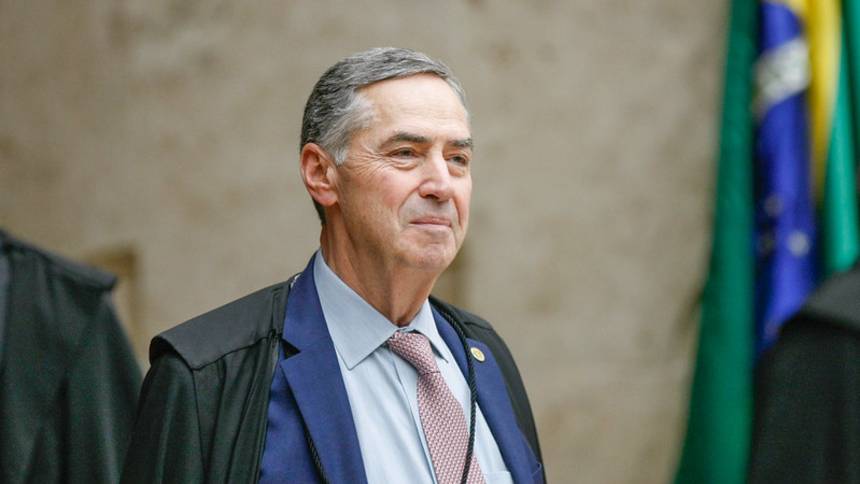
The impact that artificial intelligence (AI) will have on people's lives and businesses will be far greater than all the great inventions in history. Therefore, according to Luís Roberto Barroso, former Justice of the Supreme Federal Court (STF) , it is necessary to begin discussing how to regulate the technology, but without creating rules that hinder research and development.
"We were experiencing difficulties regulating the digital economy when suddenly the fourth industrial revolution appeared, which is AI," said Barroso on Wednesday, March 25, during his participation in the South Summit Brazil , an event for which NeoFeed is a media partner. "The risks are not small."
The former Supreme Court Justice listed four areas in which AI will have a direct impact: the job market; the use of technology for military purposes; the mass spread of misinformation and fake news ; and the possibility of singularity, a hypothetical future point at which AI will surpass human intelligence to the point of gaining consciousness and acting on its own.
"AI is causing a structural change in people's lives, in the meaning of what it is to be human. It is the transfer of human capabilities to machines, which involves decision-making," he said. "We will see the disappearance of many jobs. We will feel the impact of not being able to transform Uber drivers into programmers."
For him, the big issue is that technology is already part of everyday life and is evolving rapidly. Barroso cited that while it took landline telephones 75 years to reach 100 million users worldwide and mobile phones about 16 years, ChatGPT took two months to reach that milestone. "The point is that you need to regulate while the train is moving," he said.
This characteristic makes regulating AI "extremely difficult." Therefore, the former Supreme Court Justice argued that it is necessary to consider the issue in terms of "general principles," creating rules to protect democratic principles and ensure that the technology is transparent.
"We must be careful about the risk of having excessive regulation, which inhibits research and results in market reservation for the actors already there," he stated. "Despite all the modern advancements, it is traditional values that drive humanity: goodness, justice, the pursuit of truth, and the dignity of people."
In addition to technology, Barroso stated that it is necessary to rethink the rules governing large companies in the sector, from the most varied segments of the economy, due to the size they have reached, with market values equivalent to the GDP of large countries.
According to him, one of the challenges these companies face is the issue of competition, with many companies being monopolies in areas that have gained importance in people's lives, such as internet searches, social networks, and marketplaces.
"These companies have an increasingly large hold on public space," he stated. "It's a matter of digital sovereignty."