


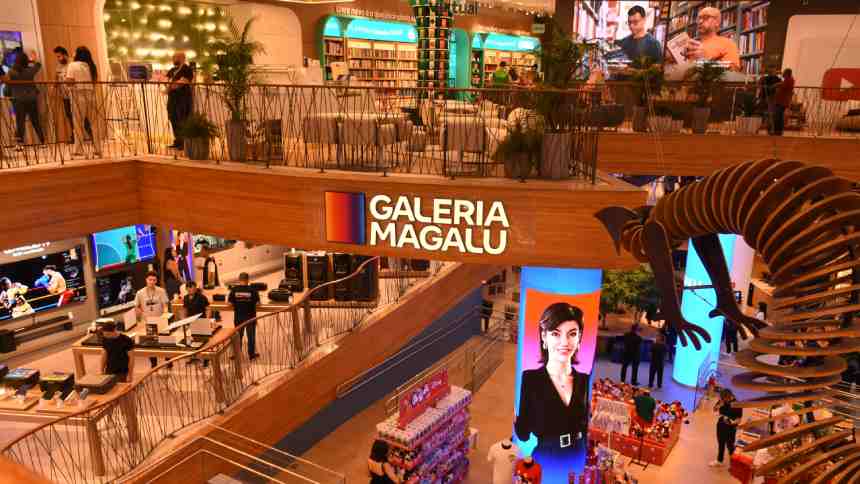
The giant retailer Magazine Luiza will inaugurate, on Tuesday, December 9th, the Galeria Magalu, a mega physical store of 4,000 square meters (m²), on Avenida Paulista, in São Paulo, which brings together in the same space the products of its five brands: Magalu, Netshoes , Época Cosméticos, KaBum! and Estante Virtual.
The new store, located in the same building that previously housed Livraria Cultura in Conjunto Nacional, is expected to become the top-grossing store among the company's approximately 1,300 physical locations in Brazil within six months, once it is fully operational. It is projected to attract a monthly flow of 100,000 people.
In an omnichannel concept, with a direct connection between physical and digital retail, the company already sees, based on the experience of the store on Avenida Paulista, the potential to replicate the model in approximately 50 of the company's physical units in Brazil, with sufficient size to house Magalu's five brands.
“Magalu was multichannel, but our entire ecosystem wasn't yet. We needed to bring this concept to the companies we acquired in the last five-year cycle. And now we are making this practice a reality,” says Frederico Trajano, CEO of Magalu, in an interview with NeoFeed .
“Just as it was a strategic advantage for Magalu to be a leader in electronics in traditional categories, we are now bringing this strategic advantage of sales channels to our brands. Having a physical presence makes a difference,” he adds.
Last year, the company conducted a kind of pilot project in a Magalu store on Marginal Tietê, in São Paulo, when it began to have a physical unit for KaBuM! and Netshoes. Since the start of operations, the unit's revenue has more than tripled.
“It was an absolutely successful pilot. With Magalu alone, the store was making R$ 5 million as a single point of sale. With the addition of the other brands, even in an outlet concept, that revenue jumped to R$ 21 million in November. This encouraged us,” says the CEO.
The idea for implementing the Magalu Gallery began in April 2024, following the closure of the bookstore. According to Magalu's CEO, the project's conception alone took eight months. The trend is for future units of this model to take even less time. The company has not yet defined which ones will be opened next.
According to Trajano, there is also the possibility of a modular concept, with some of the five brands, in smaller stores. "That number is potentially smaller, but we haven't defined that yet. The fact is that there are many possibilities for the Magalu ecosystem."
According to the businessman, 45% of everything the chain sells online is either picked up in the physical store or is in the ship-to-store model (a logistics model where products are sent directly from physical stores to the end customer). This model should be further enhanced with the new store.
The Galeria Magalu space will also serve as a venue for activations by Magalu's partner brands – there are around 150 in the new physical store – which can use the unit to hold, for example, live events with digital influencers.
Lu herself, a virtual influencer created by the network in 2003 and who now has 8.4 million followers on Instagram, will have her "home" in the new store, with interactive activities for the public and product displays.
The retailer is also inaugurating the YouTube Theater, a cultural space located inside the store that will host shows and events with content creators. At the store entrance, there is also a dedicated space for exhibiting part of the collection of the Pinacoteca de São Paulo. The CEO of Magalu is a member of the board of the cultural institution.
In the case of Época Cosméticos and Estante Virtual, these will be the first physical stores in Brazil. Netshoes will offer customization of sneakers and team jerseys. At this year's São Silvestre race, the store will feature the engraving of times on runners' medals.
Magalu will also generate revenue through brand advertising, in a branded commerce model. According to Trajano, advertising contracts and brand promotions over a year and a half will cover the implementation costs of Galeria Magalu. The company does not disclose the investment in the store.
For Trajano, the opening of the first Galeria Magalu represents the end of his second (five-year) cycle at the helm of the company, which began in 2016 when he took over as CEO. And it embodies the concept of an ecosystem.
According to Trajano's analysis, the first phase was digitalization, when the company reached R$10 billion in revenue, with R$2 billion coming from online sales. Following the pandemic, e-commerce grew and came to represent 70% of total GMV.
"After that, I understood that it was necessary to diversify the company's revenue streams, which is when we began the strategic ecosystem cycle," says Trajano.
“We entered several product categories, set up a logistics company (Magalog), a cloud services company (Magalu Cloud), and expanded our financial product offerings. And this physical store embodies that concept.”
According to the CEO, the next cycle will have a significant artificial intelligence component. But it will continue with the concept of multichannel retailing. "Lu from Magalu will be one of the big stars of our strategic cycle."
In early November, NeoFeed exclusively revealed the start of the AI model implementation, expanding Lu's presence in the company's WhatsApp sales . Conversion rates have been three times higher than other channels.
Interest rates and the macroeconomic scenario.
At the launch event for Galeria Magalu on Monday, December 8th, the president of Magalu's board of directors, Luiza Helena Trajano , complained about the long period of high Selic interest rates, currently at 15% per year, which, according to her, mainly harms small entrepreneurs.
“There is no reason for interest rates to be at this level. This causes problems for small and medium-sized businesses. I used to be a small business owner. It is the small businesses that generate jobs. And they are the ones that suffer the most,” says the president of the board.
Along the same lines, the CEO states that the country is currently experiencing a dichotomy, where the unemployment rate is low, but the cost of capital, generated by the Selic rate, affects the financial results of the retail sector in general.
“Next year, 11 million families will stop paying income tax. This means R$ 30 billion directly for consumption. There is no problem with demand. The big difficulty is converting this revenue into profit,” says Fred Trajano.
“The cost of capital is so high that financial expenses are eating up companies' profits. Selling isn't the problem. Converting the sale is the challenge for a country with the highest real interest rate in the world,” adds the CEO.