

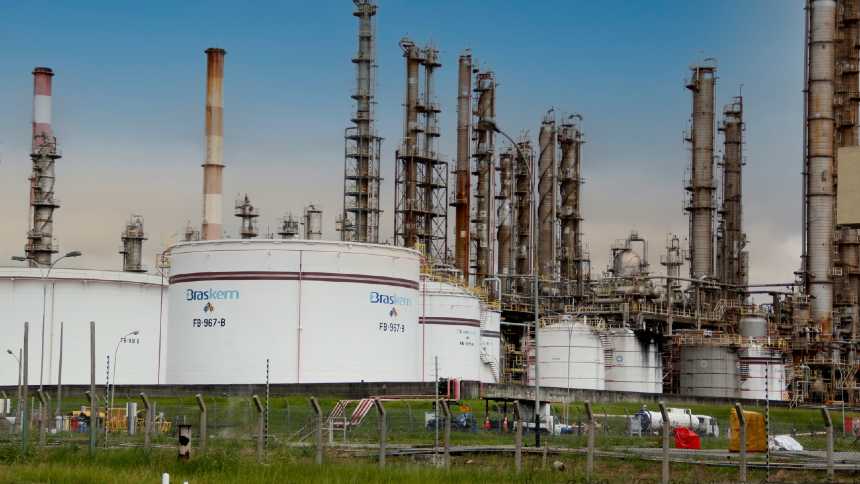
With debt considered unpayable under current conditions and cash generation close to zero, expectations are growing in the market that there is no other path for Braskem than filing for bankruptcy protection.
In its 2025 financial report, released last week, the company recorded a net loss of R$ 10.9 billion, continuing a series of negative results. A significant portion of this pressure comes from high debt, which totals R$ 51.8 billion — of which R$ 47.6 billion is in foreign currency.
The company's liquidity risk was highlighted by KPMG itself, the independent auditor of the balance sheet, which pointed to "significant doubt regarding the company's ability to continue as a going concern."
If high debt erodes net profit, cash generation also remains under pressure. Operating cash flow was negative by R$ 575 million for the year, impacted by high production costs in a scenario of high plant idle capacity.
“The company is bankrupt, with no solution for the debt. The only option left is to file for bankruptcy protection,” a stock manager who closely followed the dispute over the Brazilian petrochemical company's assets told NeoFeed .
The hole in which Braskem finds itself has been deepened by the fall in prices in the global petrochemical market , marked by excess capacity, especially in China and the United States.
Another significant part of this deterioration is linked to the Maceió disaster, which, in addition to the social and financial cost that already exceeds R$ 7 billion for the company's coffers, has increased uncertainties about its future and continues to put pressure on its balance sheet. Even seven years after the interruption of rock salt extraction in Maceió, the case continues to generate repercussions.
A new regulatory process by the Brazilian Securities and Exchange Commission ( CVM ) is investigating how the company disclosed information to the market regarding its environmental liabilities in the region. Among the 33 accused are Marcelo Odebrecht and Fernando Musa, former executives of the company.
One of the proposals that was discussed in the market involved the asset manager IG4 Capital , which sought to negotiate with creditor banks the acquisition of a significant portion of the company's debt, with subsequent conversion into shares and assumption of control.
Earlier this month, the approval of IG4's proposal by the Administrative Council for Economic Defense (Cade) in early March caused BRKM5 shares to rise by 30%. However, all gains were lost after the latest earnings report, considered disastrous by the market. In a single day, the shares fell by as much as 10.8%.
Amid the complexity of the capital structure and the difficulty in aligning creditors, Bank of America has maintained a sell recommendation for Braskem's stock and uncertainties regarding the transaction with IG4.
“We expect cash burn to persist in the coming years, amid the prolonged cycle of low petrochemical spreads. In this context, we believe that Braskem and IG4 Capital will need to seek new solutions to deal with the company's leverage and, more importantly, with a potential liquidity problem that is likely to emerge,” said BofA.
“IG4 is on the right track. But I don’t see a solution that doesn’t involve a significant haircut. It’s necessary to reduce about 90% of this debt and bring in a lot of new money,” said a special situations manager. “The company’s shares and bonds still seem expensive, considering the fundamentals.”
According to him, the only factor supporting this award is the expectation that the company will be rescued, given its strategic importance to the country. "It's the 'too big to fail' logic," he said. But first, it's possible the company will get worse before it gets better.
"If I were a giant player, and I wanted to put a lot of money into this company, I would want it to be through RJ (judicial reorganization), with the money reduced, converted, and extended."
In this scenario, there is also Petrobras, the company's second-largest shareholder, holding approximately 36% of the total capital and 47% of the voting shares. How the company will handle the crisis in its investment strategy remains uncertain.
In the market, the perception is that, despite Braskem's strategic importance and high investment, Petrobras has adopted a more distant stance in managing the crisis, without any indication of new investments.
In the earnings call, Roberto Ramos, CEO of Braskem, limited himself to saying that the state-owned company "is fully aware of Braskem's situation and has a great interest in the investment it has in the company."
While they search for a structural solution, the executives' priority is to keep the company running.
“We will continue with the implementation of the resilience plan, focusing on preserving the company's financial liquidity through rigorous cost control,” said Rosana Avólio, Director of Investor Relations.
Contacted for comment, IG4 did not respond.