

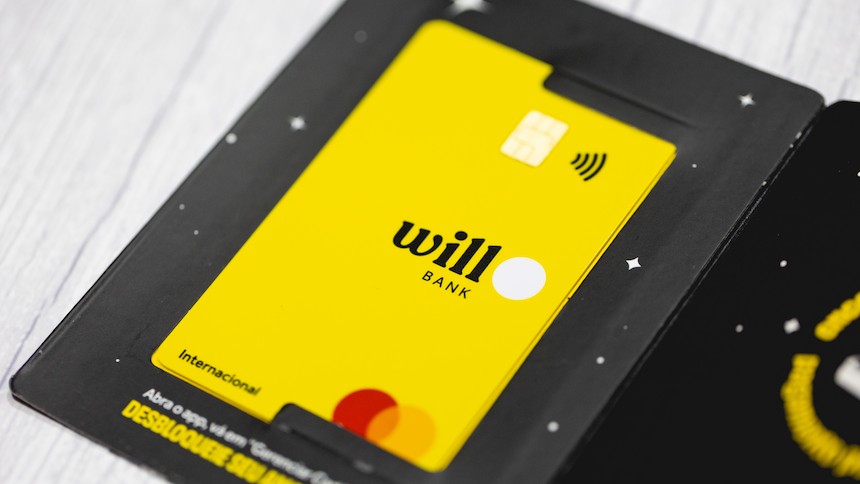
The bill that Banco Master left for the financial system will become even larger given the Central Bank's (BC) decision to liquidate the will bank, an asset that until then was outside the execution process against part of Daniel Vorcaro's institution.
According to the decision released on the morning of Wednesday, January 21, the extrajudicial liquidation of Will Financeira SA Crédito, Financiamento e Investimento is due to "the compromised economic and financial situation, its insolvency, and the link evidenced by the exercise of control by Banco Master."
The monetary authority understood that a solution that would preserve the functioning of will bank proved unfeasible after the fintech company failed to make payments for services provided by Mastercard .
The situation led the credit card company to execute guarantees linked to the fintech's debts, resulting in it holding a 31.87% stake in the home decor company Westwing .
Will Bank had been left out of the liquidation process of Master, decreed in November, operating under a Special Temporary Administration Regime (RAET), while its future was being decided.
As NeoFeed reported in October, Master hired Laplace to advise on the sale. Among the names that appeared as interested parties, Mubadala , Abu Dhabi's sovereign wealth fund, was considered the favorite in the bidding, according to reports on the case.
With the liquidation of Will Bank decreed, the bill left for the Credit Guarantee Fund (FGC) became even larger. Without the fintech company, the fund will bear a shortfall of around R$ 40 billion.
The Brazilian Deposit Insurance Fund (FGC) currently holds approximately R$ 6.5 billion in term deposits, according to data from the Central Bank up to September of last year. The exact amount that the FGC will have to cover is uncertain, considering the payment limit per individual taxpayer identification number (CPF), set at R$ 250,000.
Master acquired Will Bank in 2024, a fintech company focused on the C, D, and E socioeconomic classes, as a way to grow in the retail segment, where it operated with payroll loans, especially through Credcesta .
The intention was to integrate the two products, targeting an audience of 10.5 million people. To that end, in January of last year, Master injected R$ 2 billion into its capital.
According to data from the Central Bank, the bank recorded a net profit of R$ 408.3 million in the period up to September, after closing 2024 with a net profit of R$ 199 million. The loan portfolio totaled R$ 6.2 billion in the period up to the end of the third quarter. Net worth, however, is negative at R$ 76.1 million.