

Amid the expansion of the federal government's social program "Gás do Povo" (People's Gas), which has been available in all 17 Brazilian state capitals since the end of January, Supergasbras, a company controlled by the Dutch giant SHV Energy, the world's largest producer of liquefied petroleum gas (LPG, popularly known as cooking gas), plans to put another two million gas cylinders on the market by the end of the year.
To achieve this, it allocated investments of R$ 500 million solely for the extra volume of gas cylinders. The funds began to be invested in October, starting with the launch of the first phase of the "People's Gas" program, which initially covered 10 capital cities and went on to serve nearly 1 million beneficiary families.
Since then, 700,000 gas cylinders have already been purchased, with investments close to R$ 200 million. The biggest leap is expected from March onwards, when the "People's Gas" program will begin serving all Brazilian municipalities and directly benefit 15 million families nationwide who meet the program's requirements.
“We believe that the government program will guarantee a significant increase in sales of cooking gas cylinders in Brazil. There are many people who still use firewood at home and will now have gas for cooking. In practice, it will be the largest program to combat energy poverty in the world,” says Júlio Cardoso, CEO of Supergasbras, in an interview with NeoFeed .
The "People's Gas" program was approved by the National Congress in early February. It guarantees the free supply of gas cylinders to families registered in the Unified Registry for Social Programs (CadÚnico) with a per capita income of up to half the minimum wage (R$ 810.50). Four refills per year are provided for families of up to three people, paid for by the federal government. Above that number, the total is six cylinders per year.
Currently, Supergasbras sells around eight million gas cylinders per month. With this initiative alone, the company expects to see a revenue increase of approximately 5%. By 2025, the company, which is among the three largest operations worldwide for its Dutch parent company, is projected to have revenues of R$ 9 billion.
The company currently has 5,500 direct resellers. Of the cities where the program is already in effect, 80% of Supergasbras' resellers are already accredited to serve the beneficiaries.
However, according to the executive, there are significant challenges that companies need to face, including the inclusion of the largest share of their resellers and the final price paid by the government, which, on average, is slightly lower than the price charged at the counter. Nevertheless, it represents a guaranteed revenue stream for those who agree to sell through the "People's Gas" program.
“The government pays for the product in one location and delivers it 300 kilometers away, and that's not necessarily included in the price. They are aware of this and are seeking a fair price,” says Cardoso. “In any case, any retailer who doesn't join the program because of the price will watch their competitor sell the gas cylinder.”
The extra volume of gas cylinders that Supergasbras will inject into the market in 2026 will represent almost 10% of the company's total portfolio, which currently has 23 million cylinders.

This volume is distributed across distribution centers, retailers, and consumers' homes. On average, for every cylinder sold, the company needs to have three more in circulation, precisely because of the need for replacements and due to the expiration of the cylinders.
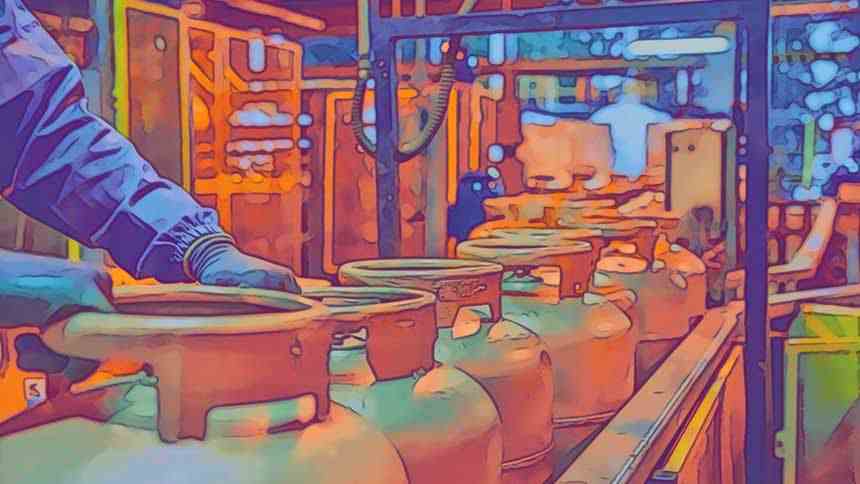
Part of the new gas cylinders will be produced at the company's factory, located in Duque de Caxias (RJ). To achieve this, Supergasbras doubled its production volume, which jumped from 30,000 to 60,000 per month. But this is still insufficient. Therefore, the company will buy from other manufacturers and import a portion.
Investments to absorb a significant portion of this new demand involve a battle between four large companies that, together, hold more than 80% of the LPG market.
According to data from the National Agency of Petroleum, Natural Gas and Biofuels (ANP), the market leadership in 2025, considering all cylinder formats and bulk sales, went to Copa Energia (which owns the Copagaz and Liquigaz brands), with a 23.79% share.
Nacional Gás came in second with 21.37%, followed closely by Supergasbras with 21.21%. Ultragaz was in fourth place with 16.47%.
In total, the LPG market in Brazil reached 7.6 million tons sold last year. With the expansion of the "People's Gas" program, the expectation is that, in 2026, the sector will surpass the 8 million ton mark.
In the P13 packaging alone, which is the 13-kilogram cylinder, 5.1 million tons were sold, equivalent to 67.5% of the total sold in the country.
According to the National Union of Liquefied Petroleum Gas Distribution Companies (Sindigás), the market today reaches a revenue of R$ 60 billion, with R$ 44 billion for distribution companies and R$ 16 billion for resellers (today there are about 59,000 resellers in the country).
In addition to investments in new gas cylinders, Supergasbras plans a capital expenditure of R$ 300 million in 2026, which will be applied to the modernization and innovation of company areas, expansion of the truck fleet, logistics, and technology, such as the recent development of an app for ordering gas cylinder deliveries.
According to Cardoso, the approval of the bill, which guaranteed the sale of a full load of gas cylinders, practically eliminates the chances of regulatory changes in the sector, studied by the ANP (National Agency of Petroleum, Natural Gas and Biofuels), such as the fractionalization of cylinders and the end of the use of dedicated containers, creating a kind of "pirate cylinder".
The measure has been the target of criticism for jeopardizing safety and opening doors to potential irregularities. "Our group is present in 25 countries and we are familiar with legislation worldwide. And Brazil's is one of the best, especially for the consumer, because it guarantees the safety of the container. And the responsibility for the container lies with the company," he says.
According to the CEO of Supergasbras, allowing these changes would be a mistake, mainly due to the difficulty of oversight. "Who will guarantee the safety of the cylinders, with everyone using someone else's? This would implode the industry. It would be irresponsible to change this."
A terminal in partnership with Ultragaz
Supergasbras' growth strategy, however, is not solely based on the "People's Gas" program. It and Ultragaz have created a joint venture to build an LPG terminal in the Pecém port complex in Ceará. The main objective is to reduce dependence on exclusive supply from Petrobras and primarily serve the Northeast market.
“We are in the detailed engineering phase, with quotations and approval of the financial process. We now have the infrastructure to import large ships at competitive prices. Today, only Petrobras does this import,” says Cardoso.
The problem, according to the CEO of Supergasbras, lies precisely in the lack of adequate terminal infrastructure for companies to import this product from abroad.
Currently, the Brazilian market imports about 15% to 20% of what is consumed. And this LPG only arrives via Petrobras, which resells it to companies. For Supergasbras, this operation in Ceará should guarantee that 15% of the gas, at a lower cost.
With the "People's Gas" project, according to Cardoso, this operation has become even more relevant. "The projects are convergent. Since the greatest demand for 'People's Gas' is expected to be in the Northeast, the terminal becomes even more viable," he states.
The terminal will also be open to serve the market. In practice, if a company wants to buy from abroad, it will have a terminal prepared to receive that volume.
Construction is expected to begin at the end of this year, with operations projected to start in early 2029. The project cost is R$1.5 billion, split between the two companies. The LPG is likely to be imported from the United States.
This will not be the first joint operation between Supergasbras and its competitor. Since 2024, the companies have had a consortium managing the bottling plants in the country together, to optimize costs and secure new markets.