

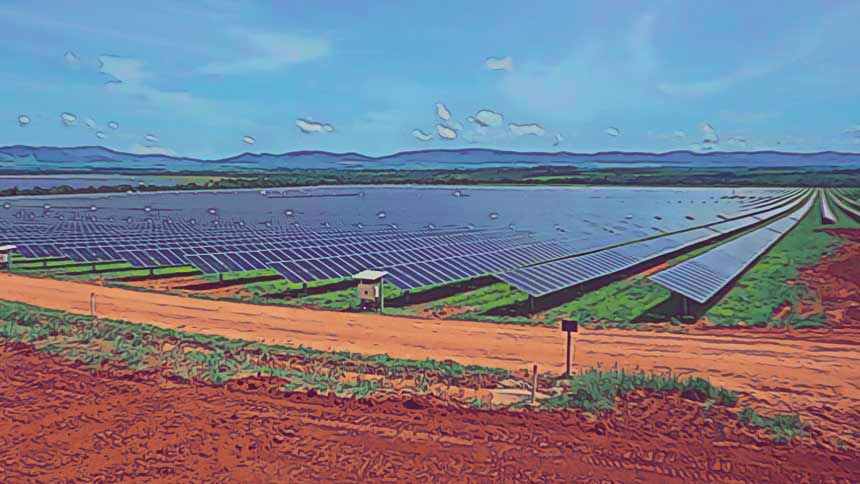
Goiás - Newave Energia, a joint venture formed by Newave Capital and Gerdau, inaugurated the Barro Alto solar park in Goiás this Thursday, March 19th, one of the largest of its kind in Brazil.
The energy generated by the 731,000 solar panels, installed across an area of 841 hectares, is equivalent to 5% of the total energy consumption of the state of Goiás. This corresponds to 365,000 homes.
The project in the Midwest has an installed capacity of 452 MWp (megawatt-peak), the maximum generation capacity under ideal solar irradiation conditions. Of the total, 40% of Barro Alto's production will be used to supply Gerdau's units, and the remaining 60% will be sold on the free energy market.
The energy generated by the Goiás plant alone will be enough to supply 13% of Gerdau's total electricity consumption in Brazil. The company, founded by the Gerdau family 125 years ago, is currently the fifth largest consumer of electricity in the country.
With an investment of R$ 1.3 billion – partly financed through the Superintendency for the Development of the Central-West Region (Sudeco) – the solar park is the second project inaugurated in the country by the joint venture.
At the beginning of last year, Newave delivered the Arinos solar park in Minas Gerais, which received an investment of R$ 1.5 billion. The unit's production can reach 420 MWp, and about a third of the volume is also destined for the largest steel producer in Brazil.
In December 2024, Gerdau increased its stake in the energy trading company. Until then, the company held 33.3% of Newave Energia's shares. Now it owns 40% of the company's stock.
Owning its own energy production is a strategy that Gerdau has been intensifying. As NeoFeed revealed in February 2025, the company made investments of around R$ 3 billion , which involved investments in solar parks and the acquisition of small hydroelectric plants (PCHs).
The construction of Barro Alto, which took 16 months, generated approximately three thousand jobs. The amount of energy generated, sustainably, will prevent the emission of about 40,000 tons of CO2 per year.
“A large portion of the contracts in the free energy market are already sold. And we have a strategy of leaving a portion available. From here, we will primarily serve customers in the Southeast region,” says Edgard Corrochano, CEO of Newave Energia.
With this additional energy sourced from solar panels, the steel company now obtains 43% of its total energy consumption from renewable energy sources, including photovoltaic and hydroelectric power.
“This investment is part of our strategy, focusing on integrating sustainability with competitiveness. Steel production is energy-intensive. And we want to reach 0.82 tons of CO2 per ton of steel by 2031, less than half the world average,” says Marcos Prudente, general manager of energy and natural gas at Gerdau.
The governor of Goiás, Ronaldo Caiado (PSD), a pre-candidate for president who will leave office on March 31, participated in the event, alongside the vice-governor Daniel Vilella (MDB), who will assume the position.
"It is very important for the state to have a project with this technology, which guarantees the greatest capacity for harnessing solar energy, and helps in the decarbonization of Brazil," says Caiado.
Awaiting the battery auction
The next investment that Newave Energia plans to make, after the two solar parks, now depends on the completion of the first large-scale battery auction, scheduled by the federal government to take place this year.
To participate in these projects, companies will have to build and install a built-up energy storage system (BESS). The CEO plans to construct this unit in the Barro Alto park area, next to the Goiânia substation, covering 50,000 square meters (m²), equivalent to five hectares.
The intention, in this case, is to allocate between R$1.8 billion and R$2 billion for the investment, but for that to happen, the federal government needs to issue a decree defining the rules of the auction. According to the executive, the Ministry of Mines and Energy cannot postpone this initiative.
“There are several benefits to having a battery project within a solar park. We are studying it, and the project is quite advanced. Now we will wait for the auction. And we should participate. Our idea is to generate around 200 MW of installed capacity,” says Corrochano.
Barro Alto will serve companies in the Midwest and Southeast regions, which is currently the company's main area of operation. According to the CEO, building a solar park in the Northeast is not part of the company's strategic plan.
Even though there is a better "quality" of solar energy capture, the parks in the Northeast are more impacted by curtailment (reduction of renewable energy determined by the National Electric System Operator, due to excess supply).
“In the Southeast, this impact is smaller. Today, this problem generates a cost of R$ 11 billion for the entire sector. Last year alone it was R$ 7 billion. The renewable market in the Northeast doesn't make sense for us today,” explains the CEO.
Over the past 12 months, Gerdau's GGBR4 shares on the B3 stock exchange have risen 1.5%. The company is valued at R$ 33.6 billion.
The journalist traveled to Goiás at the invitation of Gerdau.