


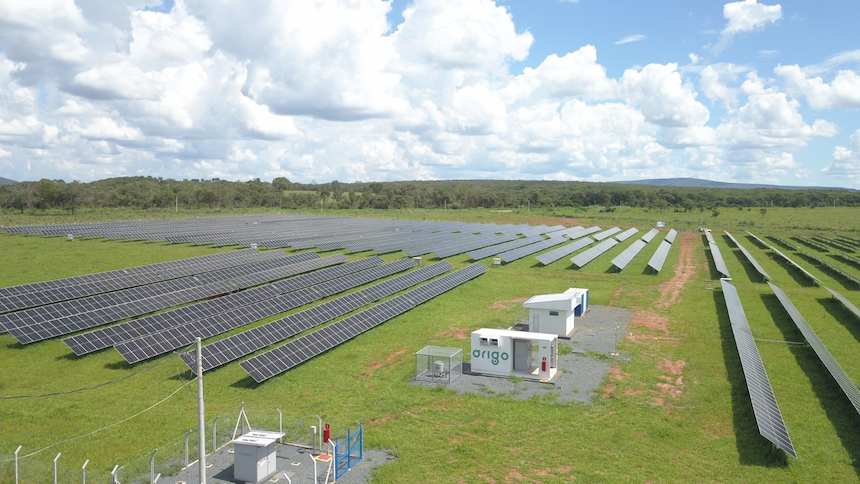
Órigo Energia has completed an issuance of R$ 215 million in incentivized debentures , with remuneration of IPCA + 9.24% per year, a term of 14.5 years, and maturity in March 2040.
The issuance is taking place in an environment of still high interest rates and investors' more cautious appetite for risk, even for a debenture with tax incentives.
Certified green by the Climate Bonds Initiative, the operation was coordinated by Bradesco BBI and will serve to refinance 28 already operational solar farms, totaling 47.1 MWp (megawatt peak, a unit of measurement of power used specifically for photovoltaic systems) in the Southeast and Midwest regions of the country.
“We’ve entered a phase where efficiency, organization, and profitability are becoming as important as scale,” says Aurelio Oliveira, CEO of Órigo Energia, to NeoFeed .
In its last published financial statement, referring to 2024, the company was still burning through cash. Órigo reported a loss of R$ 349.3 million for the period, slightly above the R$ 320.3 million of 2023. Accumulated EBITDA was negative R$ 15.3 million, compared to R$ 36.1 million in the previous year.
At a time of transition for the distributed generation (DG) sector in Brazil, this fundraising marks Órigo's debt restructuring, as it seeks to organize its capital structure after a period of accelerated growth.
The company, which operates in the distributed solar energy generation sector, had previously announced a pipeline that could take it to the 700 megawatt (MW) to 800 MW range. The new goal is more conservative: to keep the company between 600 MW and 650 MW, prioritizing profitability and operational efficiency.
“ Market share for market share's sake doesn't pay the bills. Growing without organization takes its toll later,” says the executive, who has two decades in the electricity sector and took over the company's leadership in September 2025. The company is ending the year adding approximately 250 MW of installed capacity, a pace that will now be reduced.
At the end of the first half of 2024, Órigo had issued R$ 500 million in commercial notes, in a financial operation led by Santander bank. The funds were used to build 149 solar farms in 12 Brazilian states, with an installed capacity of 198 MWp.
A sector in transformation
Órigo's move reflects a broader shift in the distributed generation sector, which is leaving behind the phase of near-automatic growth driven by regulatory incentives and is now facing greater financial scrutiny.
According to the Brazilian Photovoltaic Solar Energy Association ( Absolar ), 2026 is expected to mark the second consecutive year of decline in the sector. In 2025, 11.4 gigawatts (GW) of installed solar power were added, compared to 15 GW added in the previous year. The projection for next year is 10.6 GW.
Therefore, Absolar expects investments to fall from R$ 40 billion this year to R$ 31.8 billion in 2026.
According to the CEO of Órigo, distributed generation (DG) needs to evolve from a model focused exclusively on electricity bill discounts to a more sophisticated approach that incorporates consumption management, energy efficiency, tariff predictability, and, in the future, energy storage.
Distributed generation (DG) is a model that can generate systemic gains for the electricity sector. By producing energy close to the point of consumption, distributed generation reduces technical losses – currently estimated at between 6% and 8% in tariffs – and alleviates transmission bottlenecks, benefits that are not yet fully captured economically.
“Distributed generation is not just a commercial product. It has a structural role in the electrical system, but this still needs to be better recognized,” says Oliveira.
Órigo's main shareholders are I Squared Capital, a US private equity firm, with almost 49.4% of the shares, and Augment Infrastructure, also US, an investment fund manager focused on renewable energy and sustainable infrastructure, with just over 23%.