

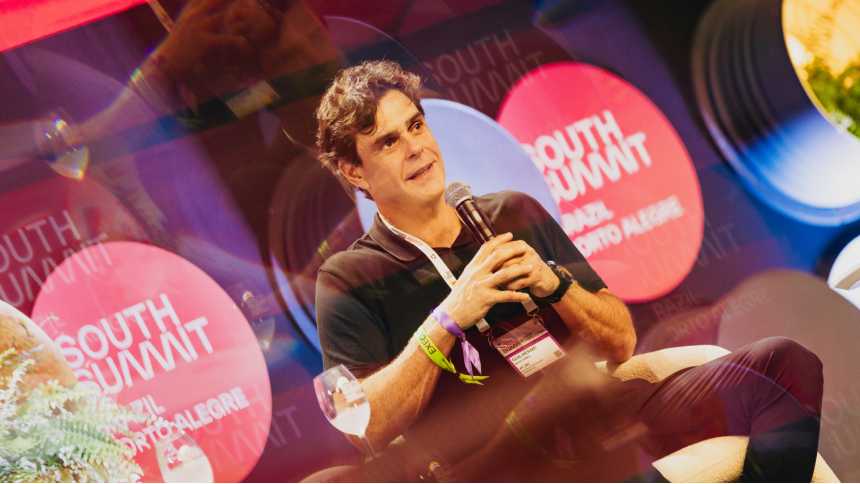
The South Summit Brazil is a space where those who dream of entrepreneurship can hear from people who have already weathered the storm and conquered their place. Packed with founders , the second day of the event featured Guilherme Benchimol and André Street , who shared some of the joys and challenges of starting their own business.
Also demonstrating his entrepreneurial spirit on Thursday, March 26th, was Governor Eduardo Leite , who shared some of the innovation initiatives Rio Grande do Sul is undertaking.
In parallel, the event, which counts NeoFeed as a media partner, also discussed the market situation and prospects for investors to exit, and also debated why Latin America lags behind Asian countries in attracting resources from foreign investors.
Loving problems with discipline
The main venue at South Summit Brazil was packed to hear Guilherme Benchimol, founder and chairman of XP Inc. , and André Street, founder of Stone , discuss their entrepreneurial journeys and the lessons they learned along the way.
One of the tips was to have passion for what the company wants to solve. "At any point in time, you can talk about technology, use technology to improve the customer's life, the company's process, but the most important thing is passion and dedication to the problem," said Street. "If you work on the customer's pain points, you will create products to solve the problem. That won't change in 100 years."
Passion cannot overshadow discipline, especially when it comes to finances. According to Benchimol, many entrepreneurs get "messed up" when they forget to do the important, but tedious, things in order to focus on the legal aspects. For him, it's necessary to have a step-by-step plan and not skip stages. "If you do the right thing at the wrong time, you end up burning out at the start, hurting your profit margin," he said.
AI versus training
In the lecture, Street and Benchimol also spoke about the use of artificial intelligence in business. For the founder of Stone, the technology promises to accelerate the productivity of companies, as long as the focus on the company's mission is not lost. "If you use this to make the company more efficient and serve the customer, it's fantastic," he said. "You have to embrace it and know how to best use the tool within the purpose of your company."
According to Benchimol, the capabilities of AI platforms are transformational for businesses, stating that they will be able to empower people in a much greater way than traditional academic training. "You can analyze countless companies around the world without leaving home. Those who will go furthest with this will be the most curious people; that will be the differentiating factor," he said.
"Startup" milk
While his presence was felt on the first day, the governor of Rio Grande do Sul, Eduardo Leite, made up for it with two presentations on the second day of the South Summit Brazil. After a speech with a more presidential tone, it was his turn to don the "startup" vest and talk about investments in technology, in line with the event's theme.
According to him, Rio Grande do Sul is investing in education to stimulate innovation and technology projects. And after the floods, in addition to infrastructure, the government created a scholarship program for engineering students to retain them in the state, and a program to train professionals in the semiconductor field.
He also discussed Guria, the state's artificial intelligence. Through WhatsApp , this technology communicates with the population to address their needs, in addition to initiatives to gather data related to public safety. "We have a special focus on technology, software, and platforms," he said.
An open window
The IPO window may be closed and private equity funds may not be hungry for M&As, but these funds have gained a new exit route for their investments: the secondary market.
According to Alexandre Noschese, co-founder and partner at Across Capital Partners, this option comes at a time when the quality of companies has improved in recent years. And at a time when strategic buyers have no appetite to pay high valuations, the secondary market becomes a way to provide some liquidity before a definitive exit.
"We now have a secondary market, something that didn't exist before," he said. "The structural aspects have improved, and we see other avenues strengthened and developed for exits."
Exiting through the United States, as PicPay and Agibank did, is something many companies and funds did at the height of the pandemic frenzy to circumvent the situation in the Brazilian stock market; it's only worthwhile for those who are truly large.
"To go public in the United States, a company has to be large, with a valuation in the billions, to have liquidity in its stock. The worst thing is to go public and have the liquidity dry up, because you become a dwarf in a giant market," said Mark Traiman, vice president of General Atlantic .
Image and patience
The Latin American market may be similar in size to Southeast Asia, but it attracts less attention from international venture capital funds. According to Susana Garcia-Robles, managing partner of Capria Ventures, the region needs to market itself better, and international investors need to make a point of getting to know the continent.
"Many of the major innovations are coming from the Global South, with entrepreneurs committed to finding solutions to the region's problems," he said. "The media is quite focused on Asia and needs to learn how to sell Latin America."
Another drawback is the lack of patience some investors have to see returns, compared to the United States, whose market is more developed. "Results come after years. The short-term mentality is a problem," he said.