

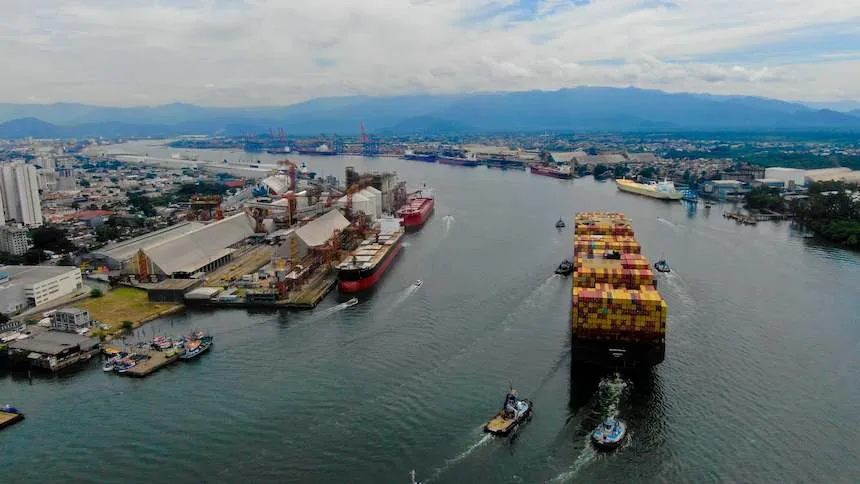
The largest port terminal in Latin America, the port of Santos, will double in size. The Ministry of Ports and Airports has authorized the inclusion of 17.2 million square meters (m²) in land spaces and areas for anchorage and disposal of dredging waste.
In land-based areas alone, where port infrastructure exists, growth will be 56%, increasing from 9.3 million m² to 14.5 million m². This will allow for the construction of at least eight new terminals, on par with the operations of Santos Brasil, BTP, and DP World, leaders in the container segment at the port.
“The port had already been studying possible areas for expansion, and we located spaces that belong to the Secretariat of Federal Assets (SPU), but which were in the possession of the municipalities. Now, they officially belong to the Santos terminal,” says Anderson Pomini, president of the Santos Port Authority (APS), which manages the port of Santos, in an interview with NeoFeed .
In practice, there was no intended use for these areas, but they could be very important if incorporated into the port. The first auctions for the concession of these areas should begin in 2027.
Now, APS management will begin the feasibility study phase for cargo handling in these areas and the suitability of these lands. The main objective is to diversify port traffic, with more space for the fuel sector, pulp and paper, and other cargo types.
“The conclusion is that we will gain new terminals, in line with the increasing volume of cargo handled. If the port realizes that, in the future, it will need more terminals for grains or flammable materials, for example, we will have those areas available,” he states.
According to Pomini, the trend is that this expansion, guaranteed by the Ministry of Ports and Airports, will result in an increase of at least 20% in financial volume within a period of three to four years. In 2025, APS achieved net revenue of R$ 1.4 billion, with R$ 4 billion in cash.
With the auction for the Tecon 10 megaterminal approaching, which, despite recent delays, is still expected to take place in the first half of the year, the trend, however, is that there will be no need to auction off areas for the creation of container terminals.
Since the new terminal will cover an area of 622,000 m² and increase containerized cargo capacity in Santos by 50%, the incorporation of the new land into the port represents the equivalent of eight times the size of the future container terminal.
“Initially, with Tecon 10, we will be able to meet the container demand in Santos for the next ten years. So, certainly, these new areas will attract the attention of other sectors, which have already shown growth. And this needs to happen now,” he says.
This initiative is part of APS's strategic plan to double the cargo handling capacity at the port of Santos within 30 years. With this expansion and the start of new auctions, the expectation is that this goal will be achieved in a shorter time.
“If we take the new space into consideration, we could have at least eight large terminals, like those already operating in Santos. We design the area and make it available to the market. The winner builds and secures the right to operate for 25 years,” says Pomini.
Today, the Santos terminal has a total of 65 berths for ships. And, with this new configuration, it should gain at least 15 more by 2030.
There are still new requests for the incorporation of areas, which are under analysis at the Ministry of Ports. These are plots of land located in Cubatão, São Vicente, and Santos. One of them is the space where the cruise passenger terminal of the Concais company is currently located, which will be relocated.
With an area of 42,000 m², it is currently the main passenger ship embarkation and disembarkation terminal in Brazil. The change was authorized by the National Waterway Transportation Agency (Antaq) in January, but still depends on funding sources, which will come precisely from the Tecon 10 auction.
“When the terminal moves to a new location, we will use the area to handle cargo. The idea is to determine, through a detailed analysis, the best use for that space,” explains Pomini.
The port ended 2025 with a record throughput of 186.4 million tons. The volume growth was 3.6% over the previous record, from 2024 (179.8 million tons).
The container sector was one of the major pillars of growth, with 5.9 million TEUs (twenty-foot equivalent unit). In volume, it totaled 62.3 million tons (up 3.9%).
In solid bulk cargo, it reached 94.5 million tons. In soybeans alone, the movement was 44.9 million tons. In cellulose, the volume reached 9.9 million tons.