

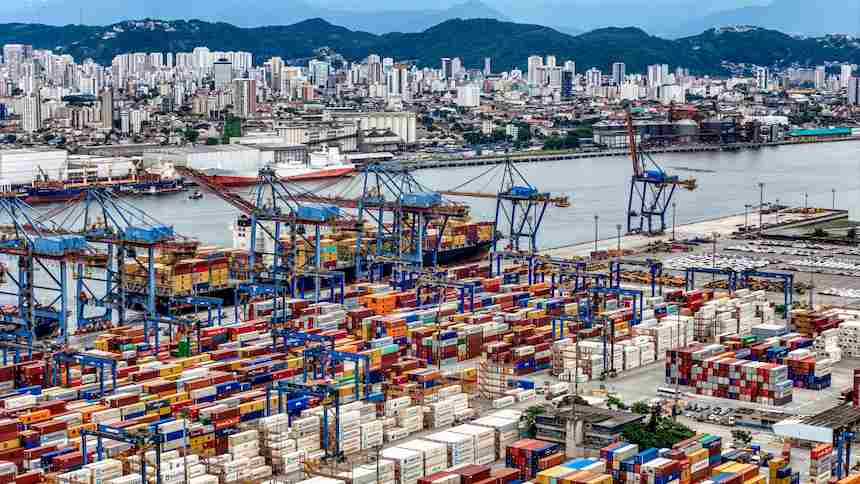
After months of controversy and much political pressure, the plenary of the Federal Court of Accounts ( TCU ) recommended on Monday, December 8, by a vote of 6 to 3, that the auction of Tecon 10 – the mega container terminal to be built in the Port of Santos , the largest in Latin America – should follow the model proposed by Antaq (National Agency for Waterway Transportation), with restrictions on companies that already operate in the port of Santos.
The court's decision, however, is advisory in nature—not binding—and may or may not be adopted by Antaq. The rule proposed by the agency stipulates that the bidding process be carried out in two phases. The first phase would be restricted to companies without container operations at the port, to avoid market concentration.
If there are no interested parties – a highly unlikely scenario, given the interest of at least 10 major global companies in the sector in participating in the auction – the bidding will be open to current container operators in Santos, such as the MSC and Maersk groups, associated with BPT, as well as CMA CGM and DP World . Therefore, if a shipping company were to win the bid, it would be obliged to divest its current asset.
Market experts, however, believe that the dispute surrounding the auction is still far from being resolved. The trend is that companies already operating in the Port of Santos will file lawsuits to challenge the restrictions imposed by the Antaq model – which must now set a date for the auction, probably in the first quarter of 2026.
“Litigation is not only possible, but likely, given the economic impact of the project and the legal relevance of the regulatory precedent set by the TCU,” assesses Daniela Vlavianos, from the law firm Arman Advocacia, which specializes in bidding processes in the logistics sector.
Part of the controversy in recent months surrounding the Tecon 10 auction is justified by what is at stake – the definition of the auction model could impact not only the Tecon 10 bidding process, but also the way the port of Santos operates from now on.
The new terminal will occupy 622,000 m², increasing cargo capacity by 50%. The auction is expected to raise R$ 6.5 billion in concession fees, with an investment of R$ 40 billion over 25 years. The project foresees up to 3.5 million TEUs/year – each TEU represents a 20-foot container, or about 6 meters –, four berthing berths and a passenger terminal.
Two issues have been the focus of controversy surrounding the Tecon 10 auction among industry experts in recent months: the need for the bidding process to ensure competition and the risk that the competition could result in market concentration.
This last possibility, incidentally, guided the votes of the majority of the TCU (Brazilian Federal Court of Accounts) ministers, with the recommendation that, in the first stage, the participation of shipowners be vetoed. Strictly speaking, the risk of concentration already exists in the port, with two-thirds of the cargo under the control of the current operators, two of which (MSC and Maersk) intended to participate in the auction. With the planned 50% expansion of the port, this rate could reach 85%.
According to Vlavianos, the operation in the Port of Santos with a new large entrant is likely to produce significant legal and economic effects. "An operator that does not own terminals within the port itself reduces the risks of economic concentration and avoids the practice of favoring its own cargo, a sensitive issue for defending competition in the port sector," he states.
New candidates
With the port's giant operators out of the auction, attention tends to focus on potential competitors for the Tecon 10 project. Of the ten national and international companies listed to compete in the bidding process, four stand out.
The Chinese company Cosco is one of the favorites. With operations in more than 160 countries – including Brazil, where it has an operational unit in Santos, near the port – Cosco transports about 10% of the containers in circulation on the planet in more than 500 ships, being the fourth largest global shipping company (behind only the Swiss MSC, the Danish Maersk and the French CMA CGM).
If it wins the bid in Santos, Cosco would add another significant asset in South America - in 2024, it bought a 60% stake in the Peruvian deep-water port of Chancay for more than US$4 billion.
Another potential competitor is the ICTSI Group, from the Philippines, an independent operator already present in Brazil, at Tecon Suape in Pernambuco, and at Rio Brasil Terminal in Rio de Janeiro.
In June, ICTSI Americas, a subsidiary of ICTSI, acquired full control of the former Inhaúma Shipyard, which was once one of the main shipbuilding centers in the country. Located near the Port of Rio, Inhaúma is in a strategic area.
PSA International operates the world's largest container transshipment hub in Singapore, where it is headquartered. The company offers a range of services, including port, container, and supply chain operations.
Among national companies, there is much anticipation surrounding the participation in the auction of Tecon 10 by JBS Terminais , from the J&F group, which operates the port of Itajaí (SC). The Batista brothers' group, which entered the sector last year, is among the so-called "white flag" operators, which do not own a fleet of ships.
In a statement, AP Moller – Maersk affirms that, since the announcement of the Antaq model, the company has advocated for clear rules that guarantee free competition and are commensurate with the competitiveness of this strategic asset for the country.
“The current model of the bidding process recommended by the TCU, in addition to violating constitutional principles of equality and legality, goes against the analyses of the technical areas of Ataq and TCU, Cade, the opinion of the Ministry of Finance (SEAE), MPTCU, all converging towards the objective of guaranteeing broad competition and equality for participants who meet the published requirements,” argues Maersk, implying that it will take the dispute to court.
In contrast, the Philippine company ICTSI praised the TCU's decision. "This is a traditional and well-known model in the infrastructure sector, which fosters the effective possibility of a new player entering the Port of Santos, with billions in private investment, more competition and efficiency for end customers, all shipowners in general, and consequently, the national economy," says the ICTSI statement.