

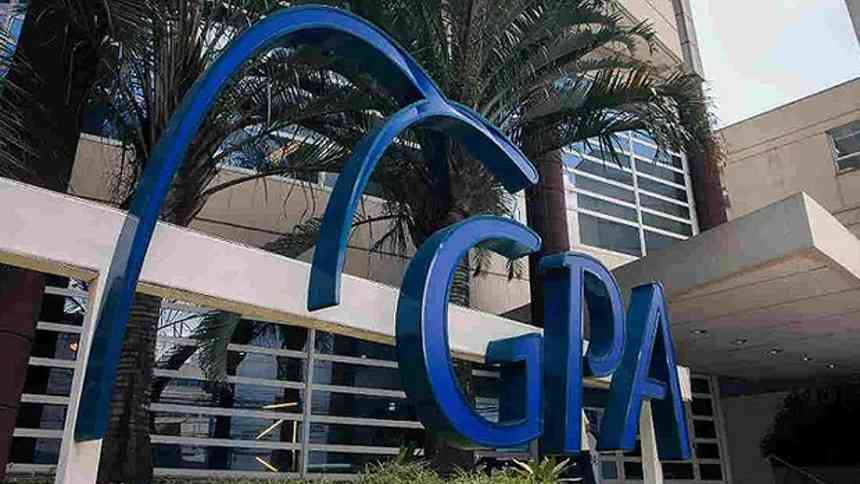
When GPA released its fourth-quarter and consolidated 2025 indicators, some words drew more attention than the balance sheet numbers themselves. In particular, one passage stood out, putting the group, which has been under market pressure for years, even more in jeopardy.
In the explanatory notes accompanying the financial statements for the period, the food retailer stated that certain conditions indicate the existence of "significant uncertainty that may raise significant doubt about the company's going concern."
In translating these conditions, the company reported that, as of December 31, 2025, it had a net working capital deficit of approximately R$ 1.22 billion, mainly due to loans and debentures maturing in 2026, amounting to approximately R$ 1.7 billion.
In this context, GPA, owner of brands such as Pão de Açúcar, highlighted that, despite the improvement in its main operational indicators, as well as the recurring positive generation of operating cash flow in the period, the chain continued to post a loss in 2025 – of R$ 651 million, an annual improvement of 61%.
During a call with analysts about the earnings report, held this Wednesday, February 25th, Alexandre Santoro , the CEO of GPA, highlighted other challenges he inherited when he took over the operation earlier this year.
Among them are approximately R$ 17 billion in fiscal and labor contingencies. In addition to factors beyond the operation's control, which only exacerbate the situation, such as the increase in the basic interest rate, which severely impacted the cost of debts incurred in previous administrations.
“GPA has undergone many changes in recent years, due to different priorities and directions. But the fact is that we need a structural change,” said Santoro. “A company like GPA, with its operations, brand, and position, cannot go years without generating cash.”
Musical chairs
GPA has, in fact, been the scene of many changes in a relatively short period. Starting with Santoro's own position. The executive is the seventh CEO to lead the retailer in just over 11 years – including two interim ones.
One of the symptoms of the challenges faced by the group in recent years, this high turnover in the position is linked to another backdrop that helps explain the network's turbulent context: changes in controlling shareholders.
The Coelho Diniz group, owned by the family of the same name, took over the controlling stake in GPA in 2025, a year that was also marked by a series of disputes between shareholders, which were reflected in constant changes in the board of directors and the company's leadership.
One of these changes occurred in October, when Marcelo Pimentel, who had led the group since 2022, left the position, being temporarily replaced by then CFO Rafael Sirotsky Russowsky, before Santoro's arrival.
Interspersed with successive restructuring plans and changes in direction, this intense game of musical chairs in the position began, in turn, in 2014, two years after the French group Casino , led at the time by Jean-Charles Naouri , took control of GPA.
Casino achieved this status in 2012, after a long battle with Abilio Diniz (1936-2014), who, until then, held that position. In this dispute, the Brazilian businessman even sought a merger between Pão de Açúcar and Carrefour, which Naouri saw as an attempt to prevent him from taking over the Brazilian chain.
In the latest episode of these clashes, Diniz divested himself of his entire stake and left the company. This paved the way for Casino's plan to consolidate its company as a major player in Latin America, through the creation of a broad platform of retail brands.
To that end, in Brazil, the French group had a range of assets at its disposal. Among them was Via Varejo, which brought together the electronics retailers Casas Bahia and Ponto. And, in the food retail sector, in addition to Pão de Açúcar, there was Assaí, a cash & carry chain and the main rival of Atacadão, Carrefour's brand in that segment.
However, burdened with debt and mounting difficulties in its domestic market, Casino began to rein in these ambitions in June 2019. After more than two years of searching for a buyer, the group sold Via Varejo to the Klein family, founders of the retail chain.
This was the starting point for other negotiations, either for the complete sale or the reduction of the stakes that Casino held in these operations. In Assaí, the group divested all its shares. The same path was followed with the Colombian supermarket chain Almacenes Éxito.
At GPA, the last piece – still – in this collection, the market share was reduced from 40.9% to the current level of 22.5% – compared to 24.6% for the Coelho Diniz clan. And, as it ceased to be a priority for the French group, the Brazilian chain saw the turbulence that had already been marking its trajectory worsen.
Latest chapter
In other figures from the most recent chapter of this saga, GPA reported a net loss of R$ 523 million in the fourth quarter of 2025, a 29% improvement over the figure recorded on the bottom line of the balance sheet in the same period of 2024.
Net revenue fell 2% between October and December, to R$ 5.1 billion, but grew 1.7% for the year, to R$ 19.1 billion. Adjusted EBITDA, in turn, expanded 2.5% in the quarter, to R$ 510 million, and is projected to grow 5.2% in 2025, to R$ 1.75 billion.
GPA ended the period with net debt of R$2.07 billion, compared to R$1.39 billion a year earlier. On the same basis of comparison, the operation's leverage went from 1.6 times in 2024 to the current level of 2.4 times.
In its report, XP highlighted that the group reported modest results for the quarter, with revenue pressured by weak demand, but with expansion in gross margin and EBITDA following operational efficiency initiatives.
“Nevertheless, the dynamics of free cash flow remain concerning, with 2025 free cash flow being consumed by significant financial expenses,” wrote analysts at XP, with a neutral recommendation and a target price of R$ 4 for the stock.
With the same rating and target price for the stock, Itaú BBA highlighted that the group reported numbers that reflect a resilient operation, with growth in lines such as same-store sales – noting that this indicator was probably the best among its peers.
But it warned: “That said, high leverage and high interest rates continue to put pressure on the bottom line ,” the bank noted. “Overall, the story remains one of gradual operational progress offsetting persistent financial difficulties.”
In the call with analysts, Santoro emphasized that there are several fronts to be addressed at GPA, in what he called structural liabilities – from tax and labor contingencies to negotiations to extend the operation's debt.
“My mandate is to address the company’s structural issues, aligning operations, profitability, and cash generation,” he said. “I am fully aware of the challenges ahead, but also have great confidence in our strategies, the strengths of our brands, and the support of our partners and suppliers.”
On the B3 stock exchange, after opening the day with a drop of more than 3% and falling more than 9% during the trading session, leading the losses on the Ibovespa index, GPA shares closed Wednesday down 2.24%, giving the group a market value of R$ 1.5 billion.