


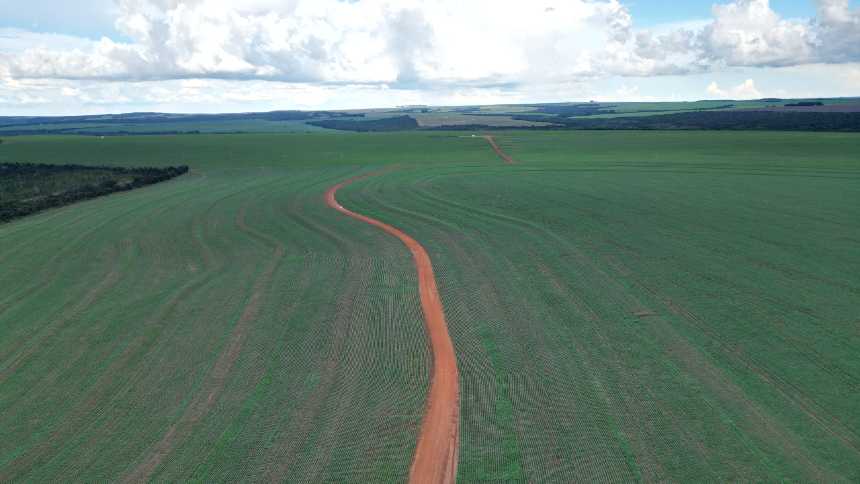
Brasilia - A controversial topic that has faced historical debate in the National Congress for over a decade and transcends governments, the purchase of land by foreigners may be nearing a conclusion in the Supreme Federal Court ( STF ). The issue divides opinions even within agribusiness, a sector that has already advocated for flexibilities in the law to attract more international capital for investment in the sector.
The Supreme Court may at any time resume and conclude the trial of a lawsuit filed by the Brazilian Rural Society (SRB) against restrictions imposed by the law on the subject, which dates back to 1971. The entity challenges an article of the law that extends the current restrictions to the purchase of rural property by foreigners or to any Brazilian company composed of citizens or companies with a majority of foreign capital or that reside or have their headquarters abroad.
After being under consideration in the Supreme Court since 2015, with even a vote from a retired rapporteur – former Justice Marco Aurélio Mello – the trial resumed in March of this year, and the score is 5-0 in favor of maintaining the restrictions imposed by legislation on the purchase of land by foreigners. If one more justice joins his colleagues in this decision, the SRB (Brazilian Rural Society) and the permission for foreigners to buy land in Brazil without so many legal constraints will be defeated in Brasília.
Voting is suspended in plenary session after Minister Alexandre de Moraes requested a review, but he has already returned the case for judgment and asked the president of the Supreme Court, Edson Fachin, to set a new date to resume the trial. For now, there is no date set, but NeoFeed has learned that the matter may be resumed soon.
If this trend forms a majority – only one minister is needed to vote in favor of maintaining the law's restrictions – the discussion will inevitably return to the parliamentary debate, but it is unlikely that a law to guarantee greater land purchases by foreigners will pass in an election year, according to a source in Congress.
At a time when geopolitical tensions are escalating amid wars around the world, those who oppose greater permission for the purchase or lease of land by foreigners, or even by Brazilian companies controlled by foreign capital, such as soybean and corn producers in the Midwest, are more strongly defending the discourse of national sovereignty.
Moreover, sovereignty is a factor that has always hindered greater permission for these transactions in Congress, even for Brazilian companies controlled by multinationals or foreign capital. Military figures and environmentalists have always feared that an unlimited liberalization of land transactions in Brazil could compromise control of Brazil's borders.
“The pressure on the Court is real and significant, we admit, but the whole world is talking about national sovereignty today,” says lawyer Eumar Novacki, who represents Abrafrutas, one of the entities participating in the trial and advocating for limiting land purchases by foreigners.
"Brazil plays a fundamental role in global food security. And this defense is very important to guarantee the sustainability of agribusiness and, obviously, sovereignty," he adds.
According to Novacki, removing restrictions from the law might initially increase land values and benefit companies or rural producers who want to abandon their activity in the country. However, it could also increase pressure to open new areas or engage in "predatory" exploitation of Brazilian natural resources. He also believes that there could be an unprecedented effect of "land speculation."
Novacki was the executive secretary of the Ministry of Agriculture during the administration of Blairo Maggi, one of the biggest agribusiness entrepreneurs in Brazil, who at the time opposed the release of land to foreign groups.
Foreigners can too.
Those who advocate for greater land liberalization for foreigners or multinational companies are betting on more investment by large international groups in sectors such as paper and pulp, for example, provided that there are limits to prevent the ownership of large territories in the same municipality or region by an individual or company based abroad.
Better known as "Rural," the SRB argues that if the Supreme Federal Court (STF) accepts its legal action and considers that the law in force for 55 years cannot equate foreigners with foreign companies with a Brazilian CNPJ (Brazilian tax identification number), it will boost the acquisition of land by Brazilian companies with foreign capital, "heating up the market, generating investments, jobs, and economic and regional development."
“If the action is unsuccessful, it will maintain the current restrictions, with the legislation limiting rural land ownership in the country remaining in effect,” the organization said in a statement sent to NeoFeed .
The organization considers it important to have legal prohibitions against specific restrictions, especially in border areas, "aiming at the full protection of national sovereignty and guaranteeing the proper use of these lands." However, it understands that the debate on national sovereignty in a "riskier and more unstable" geopolitical environment does not weaken the argument for foreign investment in Brazilian lands.
“In the case of foreign investment in land, it is essential that the requirements be objective in order to optimize oversight and regulation by the competent bodies. Therefore, by strengthening regulatory compliance, it becomes clear that there is no relativization of the fulfillment of requirements, generating greater legal certainty and, consequently, strengthening national sovereignty,” the entity adds in a statement.
In addition to the lawsuit filed by SRB, the STF is also discussing another similar lawsuit, filed by the Union and Incra to annul an opinion from the General Inspectorate of Justice of the State of São Paulo that exempts notaries and registry officials from applying the law that restricts the purchase of land by foreigners.
Back and forth
The Workers' Party governments of President Luiz Inácio Lula da Silva and former President Dilma Rousseff have always opposed a greater release of land to foreigners. Furthermore, an opinion from the Attorney General's Office (AGU) tightening limits on these transactions, which remains in effect today, dates back to 2010, during Lula's second term.
Later, with support mainly from the rural caucus, during the government of Michel Temer (MDB), the National Congress made several attempts to approve bills or include amendments in provisional measures and other proposals under discussion to try to expand the permission, mainly for Brazilian companies controlled by foreigners or large multinational groups.
During the following administration, the purchase of land by foreigners had the support of the then Minister of Agriculture, Tereza Cristina, and a bill, authored by Senator Irajá Abreu (PSD-TO) - son of the also former Minister of Agriculture, Kátia Abreu - even passed in the Senate. But it stalled later in the Chamber of Deputies.
The bill faced strong resistance from Bolsonaro, who vetoed any discussion on the matter during his administration. The former president feared an influx of Chinese companies into Brazilian territory, which gave the issue a more ideological dimension.
Starting in 2021, the issue resurfaced with greater force, this time in the virtual plenary of the Judiciary. And after inheriting the case from Marco Aurélio, Minister André Mendonça granted an injunction in 2023 suspending all legal proceedings dealing with the purchase of rural properties in the country by Brazilian companies with foreign shareholding control. The intention was to avoid conflicting decisions and legal uncertainty.
However, the trial, which took place in a virtual plenary session, ended in a 5-5 tie because there was a vacant seat at the time: that of Minister Ricardo Lewandowski, who also retired. At that time, Moraes dissented, voting in favor, pointing out that, in the drafting of the 1988 Constitution, the legislator failed to differentiate between Brazilian companies and Brazilian companies with foreign capital.