

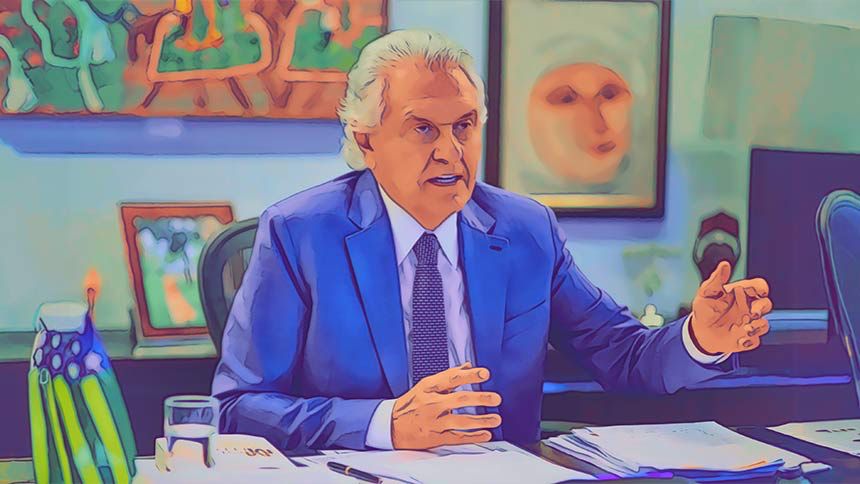
Brasilia - With the surprising withdrawal of Paraná Governor Ratinho Jr. from the presidential race, the governor of Goiás, Ronaldo Caiado , emerges as the most likely third-party presidential candidate - he should be announced by his party, the PSD, soon. But, at this moment, he divides opinions within the business community.
While it should gain traction within the agribusiness sector, which has a long tradition in the state, this support is not expected to extend nationally, according to sources within the sector consulted by NeoFeed .
This is due to the profile of the agricultural sector, which is strongly identified with former president Jair Bolsonaro (PL) and naturally tends to support the candidacy of his son, Senator Flávio Bolsonaro (PL-RJ).
During Bolsonaro's government, agribusiness was the sector of the economy that most supported his administration and continues to offer fierce opposition to the current administration of President Luiz Inácio Lula da Silva (PT), Flávio's main opponent in this year's elections.
Therefore, the internal assessment within the agribusiness sector is that Caiado will only garner part of this support, mainly linked to producers and industries in Goiás and the surrounding region. He has the sympathy of the rural community, but transforming this empathy into votes is an arduous task, as people in the agricultural sector point out.
A prominent agribusiness executive, close to Caiado and who has been with him in recent days, believes that the politician from Goiás has significant appeal within the conservative sector and has the potential to win votes there with issues such as public safety, one of the cornerstones of his administration in the state. However, he acknowledges obstacles in the national electoral landscape, given that Goiás is a small state.
"Agribusiness has a lot of lobbying power, but it doesn't have that many votes. And nationally, he [Caiado] doesn't add anything. Unfortunately, he doesn't have the electoral quotient," says the source, speaking anonymously to NeoFeed , who recently met with Caiado.
Caiado has the sympathy of the rural, conservative community, but he still doesn't have enough support from the agricultural sector to launch his campaign.
And the market?
On the other hand, an important segment of the economy, the financial market, also shows no signs, at least so far, of significant enthusiasm for a ticket headed by Caiado.
Despite being an experienced politician and having run for president once, in 1989 during Fernando Collor's election, Caiado is seen by business sources as a member of the "old politics" with a sometimes radical discourse that bears more similarities to Bolsonarism – he was once an ally of Bolsonaro, but currently positions himself as independent.
"It is very difficult for the financial market to embrace his [Caiado's] candidacy," says a market source, who adds that agents in the sector have already been requesting meetings with economic advisors of the likely candidate Flávio Bolsonaro.
Parliamentarians, politicians, congressional sources, and market analysts believe that, overall, the PSD had already been facing difficulties behind the scenes in launching a "third-way" candidacy and more competitively confronting the polarization in the country between the PT and Bolsonaro's supporters. The candidate with the highest approval ratings in the polls was precisely Ratinho, with around 6% of voting intentions, who withdrew from the race.
Initially, aligned with market sentiment, Gilberto Kassab's party, for the most part – despite internal dissension – dreamed of supporting the governor of São Paulo, Tarcísio de Freitas (Republicanos), as a candidate for president of the Republic. Kassab is Tarcísio's Secretary of Government. But with Tarcísio's withdrawal, Ratinho's name began to excite the party, which later also affiliated Caiado, formerly of União Brasil.
Even within the PSD, however, there is no total support for its own candidate or for the so-called third way. One wing of the party supports the Lula government, which even has three PSD ministers: Alexandre Silveira (Mines and Energy); Carlos Fávaro (Agriculture); and André de Paula (Fisheries and Aquaculture).
Ratinho frustrated businessmen.
What surprised both members of the PSD leadership and businesspeople who saw Ratinho as an alternative to polarization was that the Paraná governor's presidential campaign was already at an advanced stage, according to sources in the productive sector who were involved in the negotiations.
A center-right senator told NeoFeed that Kassab had been communicating with several parliamentarians in recent days that Ratinho would be launched this week, probably next Friday, March 27th. His digital marketing and social media strategy was also well advanced. And he even recently met with state deputies to reiterate the campaign.
Ratinho's decision also frustrated part of the business community that had been enthusiastic about him but initially hoped that Tarcísio would be the most competitive candidate on the right. However, sources from the PSD and Congress rule out that all of Ratinho's votes will migrate to Caiado.
In recent conversations with an interlocutor, Ratinho Jr., however, raised doubts about whether he would really be willing to face a campaign that is already shaping up to be very tough and marked once again by political polarization. And in recent days he has also had to deal with a local political problem: the PL, Flávio Bolsonaro's party, announced its support for Senator Sérgio Moro for governor of Paraná, as an opponent of Ratinho Jr.'s group.