

Polls may suggest that President Luiz Inácio Lula da Silva and Senator Flávio Bolsonaro will be the leading candidates in the presidential election, but Gilberto Kassab sees the possibility of the governor of Goiás, Ronaldo Caiado , breaking this polarization.
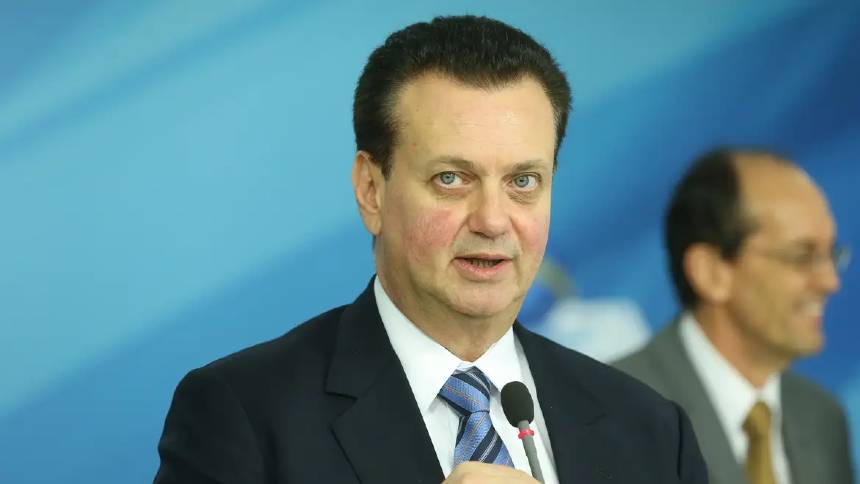
“There is strong name recognition for these two politicians, due to their names, but the existing polarization is not yet consolidated. I bet that Caiado can succeed, with hard work and dedication, to make up for lost time,” said the president of the PSD on Tuesday, April 7th, at the Brazil Investment Forum event, promoted by Bradesco BBI .
Considered one of the country's leading political strategists, Kassab argued that Caiado, the name chosen by his party to position itself as "the third way" in the elections, is the only one capable of getting the necessary economic reforms through Congress, given his track record and political capital.
Regarding the Legislative branch, he was quite harsh, criticizing the quality and priorities of politicians, while taking the opportunity to reiterate his defense of district voting.
Below are the main points addressed by Kassab:
Caiado, the reformist
The president of the PSD argued that the country needs to implement fiscal adjustments to guarantee credibility among investors. Highlighting that Lula has no interest in the topic, Kassab stated that Flávio Bolsonaro is not a strong enough figure to impose an agenda of spending control, something his father also never showed much interest in.
“We have a clear position that we will combat the fiscal deficit in the first few days,” he said. “It’s not Lula who will have this stance, because he didn’t have it in five terms. And I don’t think Flávio has that experience, nor his team,” he said.
According to him, Caiado's strength comes from his history as governor, the fact that he has no corruption allegations on his record, and the results achieved in the area of security in Goiás . Kassab believes these will be the two main issues in the elections.
The big question is whether Caiado is capable of positioning himself as the alternative and attracting votes from both sides. A poll commissioned by BTG Pactual and conducted by Nexus – Pesquisa e Inteligência de Dados, of FSB Holding, released last week, shows that, in a scenario with Caiado, President Lula appears with 41%, 3 percentage points ahead of Flávio (38%). Caiado has 4%, as does Zema.
According to Kassab, Lula and Flávio have high rejection rates, around 40%, paving the way for Caiado. "Lula's vote is not consolidated; of the 40% he has, half is fluid. The same goes for Flávio Bolsonaro," he said.
He understands that Caiado's candidacy gains traction if he manages to reach 10% of the vote by June. "There has to be a third alternative, even if it's to lose, to show that there is an alternative," he stated.
Poor quality congress
Kassab considers this political capital fundamental to getting the reforms through a Congress that, in his opinion, is of very low quality.
"The only things discussed in Congress are parliamentary amendments and the allocation of positions in regulatory agencies," he said. "Unfortunately, politics is losing credibility; there's a lack of public policy discussions that consider Brazil as a whole. 80% of the energy dedicated by politicians is focused on parochial issues."
Kassab stated that Caiado is committed to ending the mandatory amendments, an "excrescence" that Jair Bolsonaro created and Lula increased. Or else, to ensure that they are allocated to government programs.
According to him, neither Lula nor Flávio will address this issue because they will be serving the "self-serving interests" of Congress.
District voting and reforms
In addition to a president with "moral stature" and experience, Kassab believes that Congress will only improve and discuss the country's main issues when district voting is adopted, which can prevent opportunistic candidacies.
"We need to switch to district voting, there's no other way, because celebrities and YouTubers will take over Congress," he said.
Kassab also defended the need for judicial reform, including imposing a minimum age of 60 for Supreme Court justices, as well as reducing the size of the state. On these issues, he again criticized Lula, Flávio Bolsonaro, and Congress.
Citing the case of the administrative reform proposed by Congressman Pedro Paulo, from his party, he said that parliamentarians are not discussing the issue due to inaction by the Lula government, which does not want to see the project pass, and they are unlikely to discuss it if Flávio Bolsonaro is elected, as they do not see any intention on the part of the senator to deal with the situation of public employees.
"The change has to come from the Executive branch, with moral authority, to impose these changes on the Legislative branch," said Kassab.