

Amid criticism regarding the lack of unity within the center-right to contest the presidential election against Luiz Inácio Lula da Silva (PT) and present themselves as an alternative to Bolsonaro's policies, governors Ratinho Jr. (PSD-PR), Romeu Zema (Novo-MG), Ronaldo Caiado (PSD-GO), and Eduardo Leite (PSD-RS) sought to demonstrate that, at least in terms of their proposed agenda, they are aligned.
The quartet – each with presidential aspirations – demonstrated a commitment to a reformist agenda and control of public finances, betting that this agenda can win over an audience tired of polarization and, above all, of the Workers' Party (PT).
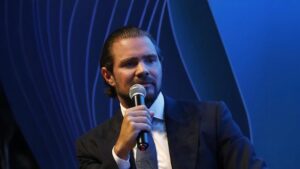
"There's a lot of noise on social media, from the left and the right, this back-and-forth, that doesn't reach a large part of the population," said Ratinho Jr., governor of Paraná, on Wednesday, January 28.
"I think Brazilians are fed up with this polarized environment that only benefits two or three groups," he added during the Latin America Investment Conference (LAIC) 2026, hosted by UBS and UBS BB .
Under pressure from the candidacy of Senator Flávio Bolsonaro (PL-RJ), chosen by former President Jair Bolsonaro (PL) to face Lula, the governors understand that there is space to be occupied in the centrist electorate, breaking the polarization.
"The feeling we perceive is that many people vote for Lula to avoid Bolsonaro, many people vote for Bolsonaro to get rid of Lula, but they are not happy with their vote," said Leite.
Given this situation, according to the governor of Rio Grande do Sul, there is a feeling of "alignment of projects" among the governors, around a common proposal.
“Caiado showed a detachment from his own interests, joining a party with two pre-candidates who are welcoming him, because it’s not about our individual aspirations as politicians, but about our aspirations as Brazilians to steer Brazil in the right direction. That’s much bigger than occupying a position of power,” Leite stated.
This joint project, in the economic field, foresees fiscal adjustment and reforms, such as a new version of Social Security and an administrative reform , to improve efficiency and reduce the size of the state.
"We will inherit a country in 2027 that is like it was during Dilma's second term, a complete collapse. The next president will have to have the courage to adopt austere measures so as not to further disillusion the business community and investors," said Caiado.
The reforms proposed by the center-right also include rebalancing the relationship between the three branches of government, pacifying the institutional environment. "The friction between the branches of government is negative because, instead of developing a plan for the future, we remain in this eternal squabble, which jams the machinery," stated Zema.
Among the governors' proposals is a political reform, with the implementation of district voting, the end of reelection, and limits on the terms of Supreme Federal Court (STF) justices.
Despite the intention to pacify tensions between the branches of government, with each acting within its own sphere, the governor of Minas Gerais said that the current Supreme Court "is the worst in history," stating that there is a reversal of values, as demonstrated by the idea of creating a Code of Conduct.
It is still undecided who will be the candidate to unite the center-right. Despite signaling unity, Zema has already stated that he intends to maintain his candidacy. In the case of Ratinho, Caiado, and Leite, everything will depend on a decision by the PSD. "We'll wait and see when [party president Gilberto] Kassab will release the white smoke signal," said Caiado.
Although the idea is to contest the election with an agenda capable of attracting audiences that, in recent years, have been divided between supporters of the Workers' Party (PT) and supporters of Bolsonaro, the inclination towards the right side of the political spectrum means that criticism is more incisive towards Lula than towards Bolsonaro.
Some have already made it clear that if someone from the group doesn't win, the strategy will be to go against Lula and the PT. "Any candidate who opposes the PT will have my support, just as it was in the last election," Zema stated.