

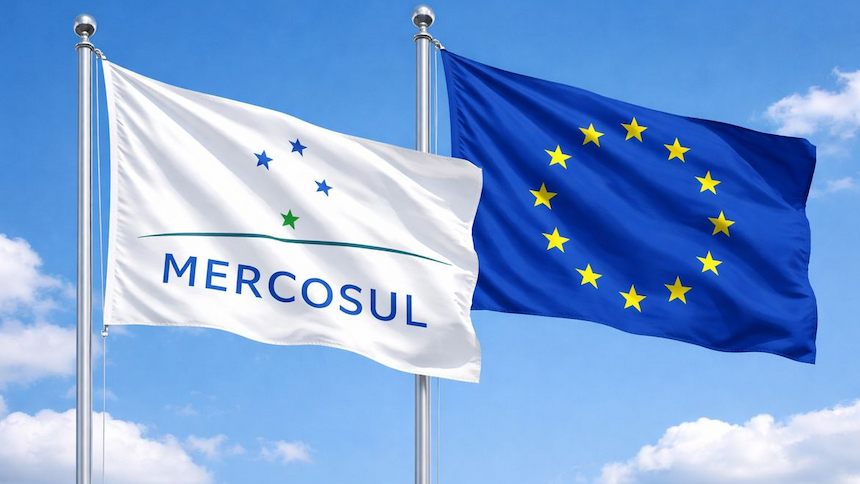
Brasilia - The trade agreement between Mercosur and the European Union has barely reached the National Congress and has already generated a strong reaction from the agribusiness lobby, which is expected to lead the government to adopt bilateral measures through the Foreign Trade Chamber (Camex) to try to circumvent safeguards imposed by the Europeans on South American agricultural products that are very harmful to Brazil, according to the sector here.
What most worries the agricultural sector at the moment is a European safeguard, contained in the agreement, which allows agricultural exports of sensitive products (beef and chicken, for example) from Mercosur member countries to the European bloc to only increase by an average of 5% every three years. Otherwise, if shipments exceed this limit, the European Commission may launch an investigation to adopt protective measures against Mercosur.
Even if this criterion were applied to Brazilian beef today, our current exports would already exceed this level and be subject to reprisals by the EU, according to the agreement, industry sources point out.
Since the agreement was sent by President Luiz Inácio Lula da Silva to the Legislature on Monday, February 2nd, ruralist parliamentarians have initiated a series of meetings and negotiations with Brazilian government authorities in an attempt to mitigate or seek alternatives to the safeguards included in the agreement that was signed in Asunción, Paraguay, on January 17th.
“We are discussing resolutions at Camex so that there are a kind of bilateral agreements and several safeguards that are more favorable to agriculture and not just a general one for all products,” a source directly linked to the negotiations told NeoFeed .
The idea, which is still being discussed among parliamentarians and the government, is that Brazil could have bilateral measures, individually with each country it wishes (not only the 27 EU members, but also others that are not part of the agreement), so that this 5% ceiling can be increased depending on the European importing country. For example, establishing a separate agreement with Germany that allows for an 8% or 10% increase in coffee exports. And so on with each country.
In this regulation via Camex, however, the tendency is for it to be more successful with countries that have a larger import profile. In the case of Ireland or France, which are important food producers, it is more likely that the 5% increase level will be maintained.
In a technical note released at the end of January, the Brazilian Confederation of Agriculture and Livestock (CNA) reinforced that these bilateral safeguards can be used by member countries of both blocs, as already foreseen in the Mercosur-EU agreement clauses.
Members of the Parliamentary Agricultural Front (FPA) have already discussed the matter with the president of the Senate, Davi Alcolumbre (União-AP), with the vice-president and minister Geraldo Alckmin (Development, Industry, Trade and Services), and with diplomats from Itamaraty.
And on Wednesday, February 4th, the president of the Senate Foreign Relations Committee (CRE), Senator Nelsinho Trad (PSD-MS), announced a working group to monitor developments and possible adjustments regarding the trade agreement.
“The [agricultural] entities are apprehensive because the safeguards are very low. There is, indeed, a great willingness on the part of Brazil and the other Mercosur countries to sign this agreement, but we need to take the necessary precautions,” said Senator and former Minister of Agriculture, Tereza Cristina (PP-MS), who will be one of the members of this group.
On another front, yesterday, at the FPA meeting in Brasília, there was a reaction to the agreement. “We cannot be harmed. This is a different text from the one originally drafted years ago, which requires a focused and in-depth study of its effects. Furthermore, other sectors of the economy will also be impacted,” said the president of the FPA, Pedro Lupion (PP-PR).
The intention, according to sources in Congress, is that this solution to circumvent safeguards on Brazilian agricultural products be adopted before the National Congress approves the Mercosur-EU agreement. But the Speaker of the House, Hugo Motta (Republicanos-PB), has already stated that he intends to put the agreement to a vote quickly in the plenary session after Carnival – after which the text goes to the Senate.
The parliaments not only of Brazil, but also of all other countries that are part of the South American and European blocs, need to ratify the agreement for it to become valid.
Besides Camex, another solution discussed among parliamentarians would be to activate trade protection mechanisms foreseen in the Reciprocity Law, recently approved by Congress but which has not yet needed to be used. It even provides for retaliation by Brazil in cases of tariff protectionism or non-compliance with trade agreements, for example.