

Sandro Dias, nicknamed Mineirinho, came out of retirement to set a world record: he descended 70 meters on the largest skateboard ramp ever built, installed on a building in Porto Alegre, reaching almost 100 km/h. The stunt lasted only a few seconds, but its success depended on extensive preparation.
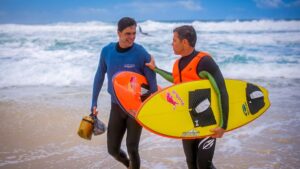
This journey was the subject of the skater's interview on Bravamente, a program by Carlos Burle in partnership with NeoFeed , recorded in Nazaré, Portugal.
Mineirinho had heard many times that the idea was impossible to achieve. Even so, in the beginning, he believed that all he would need was courage to take on the challenge.
This perception changed when he gained access to physical studies conducted by specialized engineers, who projected what would happen during the descent: speeds exceeding 120 km/h, impacts close to 70 km/h, and a load of hundreds of kilograms on his legs. Based on this data, he understood that his talent would not be enough.
He started going to the gym, something he had always avoided, and put together a routine focused on strength and endurance, as well as speed training on long descents, even being towed by a car to simulate the conditions of the ramp. In one of his first training sessions, he reached about 60 km/h and was shocked by the reality of the challenge itself.
“I was desperate. I said, ‘My God, what am I doing?’”, he recounted.
Over time, he raised the level and even surpassed the expected conditions, training beyond the speed and impact he would face. On the big day, he felt no fear. His strategy was to think that everything that was there had already been tested before and to chant a mantra to himself: “I invented it, I convinced, I prepared. The big day has arrived. Let's go!”
In his conversation with Burle, Mineirinho stated that mental preparation was just as important as physical preparation. Besides transforming the unknown into something familiar, he reduced the pressure on himself by believing that the record wasn't the focus, but rather realizing a project he had dreamed of for years. Recognition would come later, as a consequence.