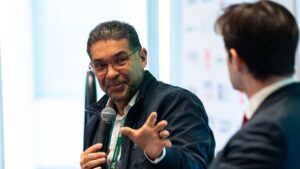


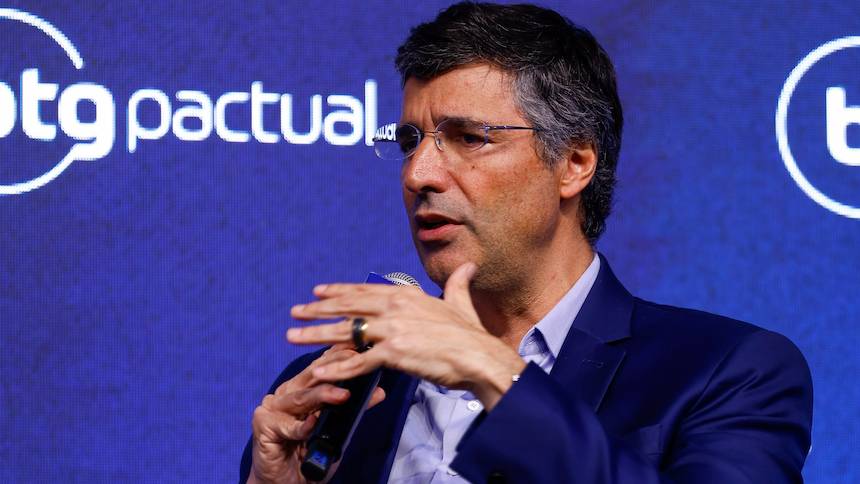
BTG Pactual partner and chairman, André Esteves , has no doubt. This year's presidential election will be hotly contested. But, in his view, that's not exactly a problem. The proof is that Brazil has entered the financial and geopolitical radar even with this uncertainty.
“Elections have become less relevant to medium- and long-term beliefs in the country. The general perception is that political risk in Brazil has decreased. This is a formidable achievement for us and should be celebrated. It shows that Brazil is institutionally reliable,” says Esteves, in his participation in the CEO Conference, an event held by BTG Pactual.
According to the bank's chairman, however, society is leaning more to the right in terms of values, and whoever can bring this demand together will be competitive. And apparently, Flávio Bolsonaro is achieving this, judging by the polls.
"It will basically be a 50/50 election. With a slight advantage for Lula because he's in office, but it will be difficult for both sides," says Esteves.
When asked if the opposition's agenda wasn't too focused on amnesty for January 8th and Jair Bolsonaro, Esteves dodged the question, saying that it was up to the judges and that the back-and-forth of decisions was part of the political process.
"Perhaps some leniency is warranted in what is being considered punishment for this entire plot. But I don't think the institutions are out of line. And a good response to this is the candidacy of Senator Flávio Bolsonaro, who is there, competitive, very close to the president in the simulations. I think that's a statement from society."
Bipolar world
Esteves also analyzed how he sees the new geopolitical landscape of the world, in which the multilateralism that dominated the last 70 years with strong institutions like the United Nations and the World Trade Organization is losing strength. "I regret it, but as we say here at the bank, there's nothing to complain about. It's the world as it is now," he states.
The change he sees as "very interesting" is the consolidation of a more bipolar world with the US and China as major economic powers. And in this context, Brazil would have room to move with pragmatism and neutrality.
“We have the geopolitical capacity to position ourselves neutrally. There is no demand to choose one side or the other; we can trade with both, and that already gives us an advantage in the current scenario,” says Esteves.
Another positive point for Brazil is that the US has become more interested in Latin America. When questioned about Donald Trump, he separated the US president's agenda into two layers: one that he considers constructive and another that he sees as distorted.
On the positive side, he cited deregulation, reduced corporate taxes, incentives for innovation, and cheaper energy. On the side that bothers him, he mentioned its "mercantilist" bias, which, according to him, "does not reflect American success."
In all these contexts, according to Esteves, Brazil has an underutilized "power" that becomes even stronger in a more polarized world, where energy, food, and raw material security have once again become matters of state.
In his view, Brazil's advantage would be being the "low-cost producer" of basically all commodities, from agriculture and protein to minerals and energy.
In other words, Brazil has the scale, cost, and productive base to play as a central player. And the country stubbornly refuses to take advantage of this competitive advantage.
“There’s no point in trying to do what we’re not competitive in. Turning into a chip factory and going back to having a shipyard won’t work. We are very competitive in commodities. And there’s nothing wrong with us exploiting this competitiveness,” he stated, mentioning that Australia is an example of a country that takes advantage of this.