

A controversy that had been dormant since 2023 between biodiesel producers and distributors is stirring up the Brazilian market in this segment. It concerns whether or not to prohibit the use of imported biofuel to meet the mandatory 15% blending percentage with diesel fuel.
The regulation stipulates that all biodiesel must originate from production units authorized by the National Petroleum Agency ( ANP ). Strictly speaking, the regulation refers to 20% of the demand, since 80% of the total must come from producers holding the Social Biofuel Seal.
But it is precisely the tax benefits provided by the Seal – imported biodiesel would not follow the same rules as the national product – among other reasons, that are behind the controversy surrounding the import ban, the lifting of which could generate trade asymmetries.
The issue has once again mobilized the sector with the conclusion, last week, of Public Consultation 203/2025, opened in November by the Ministry of Mines and Energy (MME), regarding the proposed resolution of the National Council for Energy Policy ( CNPE ) concerning the prohibition of the use of imported fuel. The prohibition has been suspended since 2023, when the CNPE created the working group on the subject, which generated the current public consultation.
The trajectory of biodiesel in Brazil combines productive expansion, economic maturation, and successive regulatory changes that have shaped the sector. Production has grown consistently since the late 2000s, driven primarily by the availability of soybean oil —which accounts for about 70% of the raw material used.
National biodiesel production in 2025 reached a record level, according to data released by ANP and compiled by market analyses. The growth was mainly driven by the advancement of mandatory blends – including the adoption of B15 (an acronym referring to the requirement that commercial diesel contain 15% biodiesel blended with fossil diesel) starting in August 2025.
Growth was also driven by the expansion of installed industrial capacity, which reached 42,600 cubic meters (m³) per day, and by increased consumption of soybean oil, which totaled 7.9 million tons last year.
Projection by StoneX, a commodities market intelligence consultancy, It predicts an increase in biodiesel demand, which should reach 10.5 million tons in 2026 if the 15% blend is maintained throughout the year. If the blend increases to 16% from March onwards, as planned, demand could exceed 11 million m³.
More competition
Distributors and entities in the oil and energy sector, led by the IBP (Brazilian Institute of Petroleum and Gas), advocated during the Public Consultation for the regulated opening of biodiesel imports as a way to increase competition, strengthen supply security, and reduce price volatility in the diesel market.
Five entities, including IBP, signed a joint statement recognizing the success of the National Biodiesel Production Program, which, according to them, has structured a solid industry integrated into the energy transition. According to the statement, the country's installed production capacity fully meets domestic demand, has the potential to absorb future increases in the blending mandate, and has allowed Brazil to become an exporter.
"Precisely because of this maturity, there is no technical or economic basis for restricting, through sub-legal means, access to additional sources of supply that increase market contestability and contribute to competitive discipline in biodiesel price formation," the statement says.
The import ban is supported by the national production sector, such as the Brazilian Association of Vegetable Oil Industries ( Abiove ). But divisions are emerging within the federal government.
The sectors most focused on agribusiness and family farming – such as the Ministries of Agriculture (Mapa) and Agrarian Development (MDA) – as well as the Ministry of Industry and Commerce and the Energy Research Company (EPE), sided with the Ministry of Mines and Energy (MME) in prohibiting imports. The Ministry of Finance and the National Agency of Petroleum, Natural Gas and Biofuels (ANP), however, favor a complete opening of the market. The expectation is that the topic will be debated again in the National Energy Policy Council (CNPE).
André Nassar, president of Abiove, states that Brazil has biodiesel production capacity exceeding the current mandate, operating with approximately 60% idle capacity – meaning there is no risk of shortages due to internal production limitations.
"The supply of raw materials, especially soybean oil, is robust, with the crushing industry expanding, and there are no capacity constraints to increase the blend to 16% or more," he says.
According to him, importing biodiesel harms the national industry and creates unfair competition, since imported biodiesel would not follow the same rules as the national product, such as the requirements of the Social Biofuel Seal. Thus, the import would fall within the 20% market quota that does not require the seal, affecting the 80% that comply with social and quality obligations.
“This cannibalizes the local industry, which already follows strict ANP standards and contributes to family farming,” adds Nassar, who believes the debate about imports is misaligned.
“If the focus is on price and competition, the solution already exists: the free import of vegetable oil, which represents 75% of the cost of biodiesel,” he emphasizes. “Producers can import oil from Argentina or Paraguay when the domestic price diverges from the international price, producing biodiesel in Brazil and preserving jobs and added value in the country.”
Trade asymmetry
Tax lawyer Ingryd Rodrigues, from the law firm Fonseca Brasil Serrão Advogados, points out that the Brazilian biodiesel model is structured around the Social Biofuel Seal, an instrument that conditions the enjoyment of tax benefits — such as the reduction of PIS and COFINS rates — on the promotion of the development of family farming.
“In this context, an unregulated opening to imports tends to generate significant competitive asymmetry, insofar as foreign biodiesel would enter the market with potentially lower prices, but dissociated from the social counterparts and incentives that support the national production chain, especially in agricultural frontier regions, such as the North and Northeast,” he says.
Daniel Goulart, director of Biofuels at Grupo Delta Energia , states that the negative aspect of the debate regarding the authorization or not of biodiesel imports is that it is occurring at a time of uncertainty about increasing the blend to 16% and with a sharp drop in biodiesel prices due to expectations of a bumper soybean harvest, a controlled dollar, and the harvest already underway in Mato Grosso.
He clarifies that this drop does not negatively impact the financial health of companies, as it reflects the fall in raw material costs. However, low-price scenarios require greater managerial skill to maintain profitability.
Goulart states that the legislation foresees an annual increase of 1 percentage point in the biodiesel blend until 2030, rising from 15% to 16% in March. However, Goulart notes that, although theoretically confirmed, the increase still depends on approvals from the CNPE (National Energy Policy Council), generating apprehension in the market.
"The sector is in a holding pattern, waiting for the regulatory framework to be fulfilled," Goulart says in an interview with NeoFeed .
"From the producer's point of view, predictability is fundamental both for short-term operational planning for the purchase of raw materials and for long-term investments in new plants, renovations, and increased capacity," he adds.
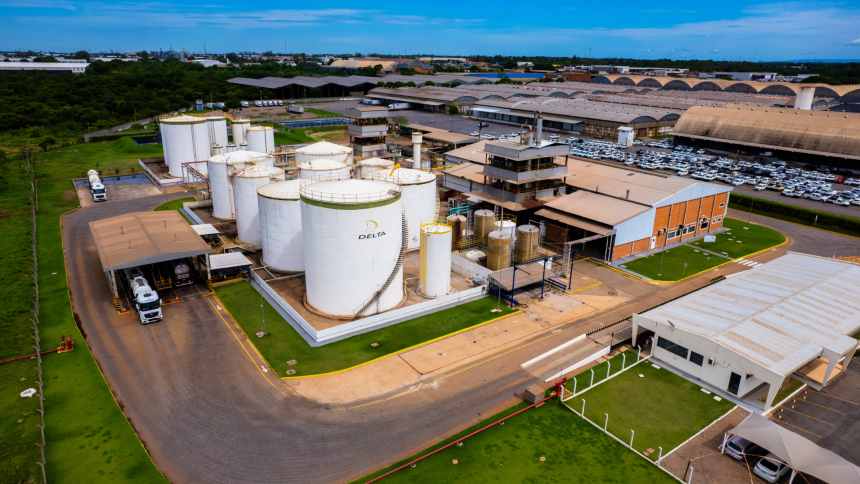
Delta Biocombustíveis has been gaining ground among the main biodiesel producers in Brazil. The company has two units: one of them in Rio Brilhante (MS), in operation since 2010, with the capacity to produce 600,000 liters of clean fuel per day.
In 2019, the company inaugurated a second biodiesel plant, located in Cuiabá (MT). The plant's production capacity is up to 1 million liters of clean fuel per day. The biodiesel produced in the factories comes from diverse raw materials, namely animal fat and vegetable oil.
Goulart explains that the price of biodiesel is indexed to soybean oil (70% of the raw material) and fluctuates with the supply and demand of commodities. "Currently, the situation is balanced due to the absence of stress in the soybean harvest; unlike gasoline, whose price is frequently controlled by the government, the price of biodiesel immediately reflects the turbulence in the commodities market," he adds.
Regarding the controversy surrounding biodiesel imports, Goulart states that any change that haphazardly disrupts the balance between supply and demand is harmful.
He argues that structural discussions like this need time and maturity for the benefits to be assessed and for all players to organize themselves. "The Fuel of the Future project, which created the regulatory framework for biofuels, can be cited as a positive example of predictability," he warns.