


One of the federal government's major bets for 2026, the Ferrogrão concession project – a 933 km long railway to be built, linking Sinop (MT) to the port of Miritituba (PA), with a projected budget of around R$ 30 billion – is not expected to get off the ground this year.
Since it was first presented in 2012, during Dilma Rousseff's government, the Ferrogrão project has faced environmental controversies, criticism of its economic and financial viability, and pending litigation in the Supreme Federal Court (STF) regarding its route, which runs parallel to the BR-163 highway, cuts through a national park and indigenous territories.
Even so, the Ministry of Transport included Ferrogrão in the package of eight railway concession auctions in 2026, which are expected to generate R$ 530 billion in long-term investments, due to its potential to create more efficient logistics corridors and reduce transportation costs, especially for agribusiness in the Midwest.
The government's objective was to launch the concession tender in May of this year and hold the auction in September, while simultaneously attempting to resolve pending issues. Two recent events have, in practice, put the Ferrogrão project back on hold.
The first refers to an authorization process for the concession that has been underway since 2020 at the Federal Court of Accounts (TCU). At the end of last year and the beginning of this year, ANTT, the regulatory agency for the transport sector, submitted updated versions of the Technical, Economic and Environmental Feasibility Study of the project and drafts of the tender and contract to the court, requesting authorization to proceed with the concession process.
In February, however, acknowledging irregularities pointed out in a report by the court's technicians, Deputy Minister Marcos Bemquerer Costa, who took over the case at the TCU after the retirement of Minister Aroldo Cedraz, decided to halt the merit review of the concession until the conditions that motivated the suspension are remedied by the public authorities.
Among these issues were a lack of evidence of socio-environmental viability, the failure to hold a new public hearing despite significant changes to the project, and gaps in social participation and economic-financial modeling.
In this respect, the TCU (Brazilian Federal Court of Accounts) identified structural changes: socio-environmental Capex jumped from R$ 42 million to R$ 799 million, while projected demand grew by up to 30% and the cost of capital increased by 13.74%.
Worse, the concession model projected a public investment of R$ 3.66 billion, partly financed by investments from concessions of other railways. But the TCU (Brazilian Federal Court of Accounts) detected a shortfall of R$ 1.4 billion in this account – since the government projected receiving R$ 2.25 billion through this route.
This week came the final blow. Ibama (Brazilian Institute of Environment and Renewable Natural Resources) announced that the environmental licensing process for the Ferrogrão railway will only resume after the environmental study – filed in 2020 – is revised. Therefore, the government will have to update socioeconomic data, land use and occupation, demographic and territorial dynamics, as well as records of extreme weather events that occurred during the period.
Contacted for comment, the Ministry of Transport did not respond to the interview request nor did it provide a statement regarding the two cases.
Logistics
Experts interviewed by NeoFeed agree that the Ferrogrão project would help improve the logistics of transporting grains from the Midwest to the ports of the Northern Arc .
In this respect, the economic gains are undeniable. The EF-170, the technical name for Ferrogrão, will have the capacity to transport up to 52 million tons of agricultural commodities per year when it is completed.
Studies in the agribusiness sector estimate a reduction of R$ 60 per ton transported by Ferrogrão in Mato Grosso compared to road transport, which is widely used to transport grain production from the region's agribusiness. In the medium term, it will bring a reduction of US$ 1 billion per year in the state's logistics costs.
But these gains do not mask the problems of building a nearly 1,000-kilometer railway in the heart of the Amazon, which would require more careful planning that takes into account, especially, the environmental impact on a sensitive region and on indigenous territories, as well as a more sophisticated financial feasibility study.
Luiz Baldez , president of the National Association of Freight Transport Users (Anut), sees merit in the project and defends its implementation. However, he notes the regulatory bottlenecks that prevent Ferrogrão from moving forward.
"Environmental studies and licenses require constant updates, as we have seen now, and each update reopens the cycle, with many of them taking two years to be completed," says Baldez.
The president of Anut also cites the difficulty of reconciling the construction of the railway – which should take 10 to 12 years, at a cost of R$ 25 million per kilometer – with the supply and demand for cargo in the region.
“The Ferrogrão railway only makes sense when the entire route is completed, that is, almost 1,000 km,” Baldez continues. “The recent truck traffic jams on the BR-163 show that the capacity of the highway and port access roads is already below demand,” he adds, noting that interventions on the BR-163 would be necessary in the next 5 years.
Paulo Resende , coordinator of the Infrastructure and Logistics center at the Dom Cabral Foundation, admits that the Ferrogrão railway is technically adequate for transporting bulk goods to the Northern Arc, but points to a list of problems that show the railway is unfeasible in practice.
“There is a lack of long-term intermodal planning, there is a blatant conflict of interest with the highway concession on the same route – the BR-163 – in addition to environmental and social barriers in sensitive areas of the Amazon,” he says, citing the route's passage through indigenous territory near Miritituba, in Pará.
According to Resende, the planning has been deficient from the outset. The fact that the railway was designed alongside the highway creates modal competition that brings insecurity to the investor.
Another planning error highlighted by the expert is precisely the threat to the Ferrogrão railway's potential to enable the flow of grains through the Northern Arc, the logistical solution for agribusiness. This is because, according to Resende, all railway planning in recent years has been done "from the bottom up" on the map.
“Just look at the Fico-Fiol route, the Bioceanic Route, and the railway authorizations of Rumo, all below Sinop, the starting point of Ferrogrão, in other words, these projects literally isolate the Northern Arc,” says Resende ( see map ).
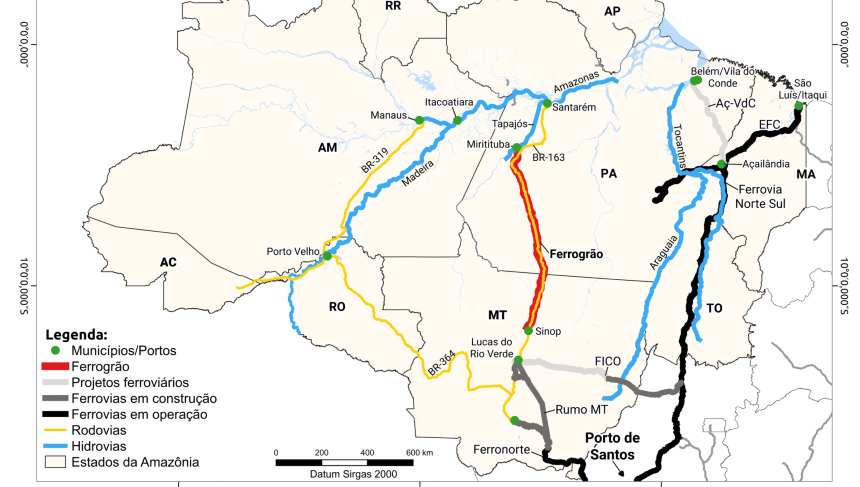
With the Ferrogrão railway practically out of the picture, at least in the medium term, Resende argues that strengthening the waterway concession plan is the best option for transporting grains through the Northern Arc. The environmental and economic efficiency gains compared to rail and road transport are striking: a super-train with 35 barges can transport up to 70,000 tons of grain on a waterway, much more than a train with 120 wagons (11,500 tons) and a grain truck with a trailer (40 tons).
However, the alternative faces obstacles within the federal government – following pressure from indigenous leaders and the invasion of an area linked to the Cargill terminal in Santarém (PA), a decree from the Civil House halted, in February, the progress of concessions for the Madeira, Tapajós, and Tocantins waterways.
The Madeira Waterway, for example, could transport grains from Porto Velho to Santarém. The Tapajós Waterway would be a solution to reduce the use of the BR-163 highway from Mirituba to the port of Santarém.
West of the Ferrogrão railway route, the academic suggests using the Tocantins Waterway to transport cargo from the North-South Railway to the port of Vila do Conde, near Belém. And the same North-South Railway could provide a greater volume of cargo to the grain terminal at the port of São Luís (MA), also in the Northern Arc.
Resende emphasizes that Brazil doesn't have a state plan for logistics, only a government plan. "If there were a state plan, this wouldn't be happening with Ferrogrão, not in this way," he asserts.
Economist Claudio Frischtak , from the consulting firm Inter.B and an expert in infrastructure planning, is a harsh critic of the Ferrogrão project.
Your consulting firm released a study in 2024, in partnership with Amazônia 2030 – a research initiative formed by a consortium of academic institutions and civil society organizations, with philanthropic funding – which pointed out three types of problems related to the project: economic and financial unfeasibility; lack of justification for the need for the work; and socio-environmental impacts.
According to the study, the low financial return of the project would force the government to subsidize it to guarantee the expected rate of return. The cost to the National Treasury could exceed R$ 32.5 billion to restore the project's regulatory rate of return, given the cost and time uncertainties associated with implementing a project without a certified executive plan in the Amazon.
“In practice, this is a public works project disguised as a concession that distorts the railway market and drains resources, without a thorough cost-benefit analysis by independent third parties or the government proving that the project would be good,” says Fischtak.
The expert calls the arrangement made for the BR-163 concession – a shorter term of up to 12 years, so as not to jeopardize the future Ferrogrão concession – a "disaster upon disaster".
“It would be better to establish a long-term concession for the BR-163 highway, from 35 to 40 years, with a robust socio-environmental project, and only then evaluate the railway, guaranteeing at least one functional highway in the short and medium term,” he says. “We don’t have a functional highway and we won’t have the Ferrogrão railway.”