

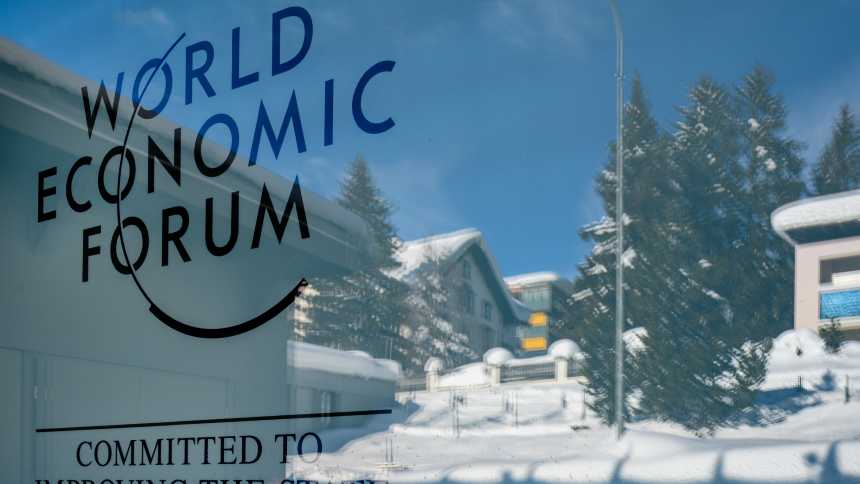
This year's meeting of the World Economic Forum (WEF), which opened on Monday, January 19, in Davos, Switzerland, is laden with symbolism. On one hand, it will offer US President Donald Trump the ideal stage to consolidate his final blow against the multilateralism that has marked global geopolitics in the post-World War II era.
On the other hand, it should reinforce the loss of relevance of the Davos forum, which after last year's edition saw its creator, executive chairman and main organizer, Klaus Schwab - a German economist who founded the WEF in 1971 - resign after internal allegations that led to the opening of an investigation into misappropriation of funds and harassment of female employees.
For decades, Schwab attracted the world's economic and political elite to the small village in the Swiss Alps to discuss global integration and climate change, among other multilateral issues. After investigations, Schwab was exonerated. He was replaced by Larry Fink , CEO of the American investment giant BlackRock and considered closer to Trump.
The very theme chosen to lead the debates at the 56th edition of the World Economic Forum, "A Spirit of Dialogue," sounds strange given the current moment of geopolitical uncertainty in the world, marked by trade protectionism and the territorial ambitions of the American president.
In presenting this year's Forum agenda, the organizers justified the theme as necessary to discuss "the most complex geopolitical scenario in decades, marked by increasing fragmentation and rapid technological changes."
But the evident preoccupation with flattering the American president, who will bring a large entourage and speak on Wednesday, January 21st, shows that this year's event promises to be quite different.
Instead of promoting an open dialogue about opposing proposals, the official program relegated the sustainable agenda of companies to the background and highlighted topics more aligned with Trump's interests, such as artificial intelligence and cryptocurrencies.
By offering business leaders and politicians from 130 countries an excellent opportunity to interact with Trump, this year's event promises to be the most popular in previous years. In its 56th edition, which runs until Friday the 23rd, the World Economic Forum is expected to have around 3,000 participants, including 65 heads of state and 850 executives from major companies.
Confirmed attendees include Jensen Huang , CEO of Nvidia, Jamie Dimon , CEO of JP Morgan Chase, and Satya Nadella , CEO of Microsoft, among other prominent executives. Despite the diminished importance given to climate change at the forum, Al Gore, climate activist and frequent Davos attendee, will also be present.
Mohamed Kande, global president of PwC, based in Washington, explained the reason for the expectation surrounding Trump's presence – who last year spoke via videoconference: “The US continues to be the main destination for investments; people respect the fundamentals of the economy and the fundamentals of the country's companies.”
Escalation of tension
The days leading up to the forum's opening were marked by increased tension between the US and European leaders over the American president's promise to remove Denmark's sovereignty over Greenland .
Trump threatened the weekend before the event began to implement a wave of escalating tariffs starting February 1st on European countries – Denmark, Sweden, France, Germany, the Netherlands, Finland, Great Britain, and Norway – which last week sent a small contingent of troops to reinforce security on the Arctic island.
Europeans reacted with unprecedented harshness in their relationship with the US, their NATO partner. One of the options being considered is imposing tariffs on €93 billion ($108 billion) worth of American imports, which could automatically take effect on February 6.
Another option, this one from the European Union countries, is to invoke the Anti-Coercion Instrument (ACI), which has never been used and could limit access to public tenders, investments or banking activities, or restrict trade in services, an area in which the US has a surplus with the bloc, including in digital services.
British Prime Minister Keir Starmer even called for a "calm discussion between allies," adding that he did not believe Trump was considering military action to seize Greenland.
On Monday the 19th, Trump showed signs that he intends to go all the way to annex the island. In a letter to the Norwegian Prime Minister, Jonas Gahr Store, published on his social network, he warned: "Considering that your country has decided not to award me the Nobel Peace Prize for having prevented more than eight wars, I no longer feel obliged to think only about peace, although it will always be predominant, but now I can think about what is good and appropriate for the United States of America."
The Norwegian Nobel Committee angered Trump by awarding the 2025 Nobel Peace Prize to Venezuelan opposition leader María Corina Machado. She presented her medal to Trump last week during a meeting at the White House, even though the Nobel Committee stated that the prize cannot be transferred, shared, or revoked.
In his message, Trump also repeated his accusation that Denmark cannot protect Greenland from Russia or China. "Why would they have a 'right of ownership,' after all?" he wrote, adding: "The world will not be safe unless we have full and complete control of Greenland."
Following the release of the letter, European stocks fell on Monday, while the dollar weakened as investors sought safe-haven currencies. US Treasury Secretary Scott Bessent further fueled tensions by stating that "everyone should believe the president's word."
Bessent predicted that Trump will use his speech on Wednesday in Davos to take stock of the year and talk about his plans for the future. He emphasized that Trump will make it clear that "America First" doesn't just mean America, stating that the American president will demonstrate "what American leadership looks like in the world."
Hence the expectation that Trump will take advantage of the packed audience of heads of government – including Europeans – to make another impactful announcement, such as the effective annexation of Greenland. A possible American military intervention on the island would, in practice, mean the end of NATO.
Cautious, EU leaders will discuss their options at an emergency summit in Brussels scheduled for Thursday, a day after Trump's speech. Depending on how the crisis unfolds, the Davos forum risks ending on Friday the 23rd, mired in obscurity.