


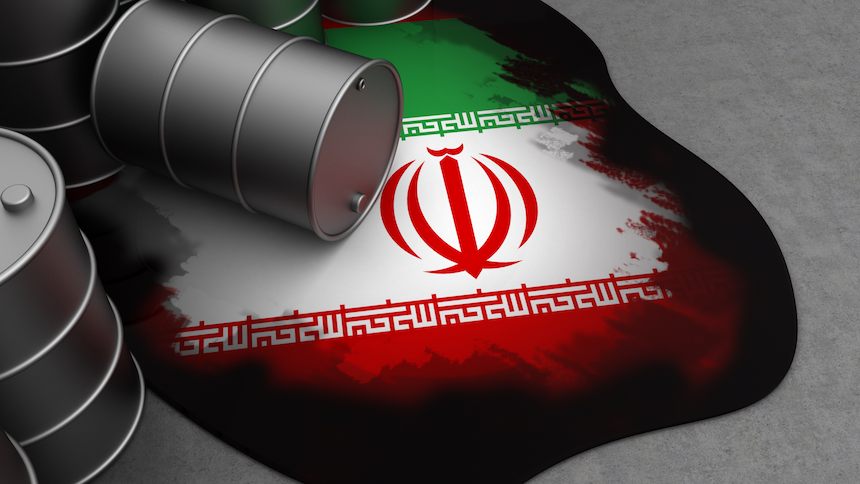

Oil markets reacted on Monday, March 2nd, with a sharp rise in the price per barrel following the joint attack by the United States and Israel on Iran over the weekend, and the aggressive Iranian response – attacking Arab oil-producing countries in the Persian Gulf – fueling fears of a medium-term supply crisis.
This perception became even clearer after Donald Trump changed his discourse, from a triumphalist tone over the weekend – as if the fall of the Iranian regime was a matter of days – to a more cautious one on Monday, January 2nd, when he admitted that the military campaign could last “four to five weeks.” According to analysts, the American president simply acknowledged that he did not have a clear plan for the outcome of the crisis.
Brent crude oil rose as much as 13% on the first day of trading after the Iran attacks, reaching $82.37 a barrel, before retreating and closing around $77 a barrel, up 7% in London.
Gold prices rose 1.6% to $5,362 an ounce, as investors sought safe-haven assets. The dollar strengthened 0.4% against a basket of currencies from its major trading partners. Asian stock markets retreated on Monday, with Japan's Topix index and Hong Kong's Hang Seng index falling 1.5% and 1.4%, respectively.
The rise in the price of oil was expected and did not worry the White House, given the oversupply of oil, of 2 to 3 million barrels per day, in the international market – almost triple the demand, according to calculations by the International Energy Agency (IEA).
During the period of US military intervention in Iraq, between 2003 and 2011, the average price of crude oil was approximately US$72 per barrel. Adjusting for current values, this is equivalent to more than US$100 per barrel – well above the current price.
The US government expected a repeat of the scenario from the 12-day war between Israel and Iran in June 2025, in which Brent crude prices briefly exceeded $80 before returning to pre-war levels within two weeks.
The mistake may have been in comparing an extremely short conflict, with limited objectives, like last year's, with the current offensive, whose outcome is still open and uncertain.
In this sense, the rapid escalation of the conflict on Sunday, after American and Israeli bombings killed Iran's supreme leader, Ayatollah Ali Khamenei, and 49 military leaders, including much of the top brass of the Revolutionary Guard – the regime's armed wing – caused a reversal in the White House's expectations.
In addition to attacking Israeli targets, Iran has fired missiles at several oil-producing Arab countries, internationalizing the conflict.
Activity in the Strait of Hormuz , the narrow sea passage at the entrance to the Persian Gulf, which runs along the Iranian coast and through which a fifth of the world's oil and gas flows, has practically stopped after the attacks – not least because insurance companies have refused to negotiate policies for tankers attempting to navigate the strait.
“The immediate price shock is not the main threat to the White House achieving an Iran free of nuclear weapons and the Ayatollah regime,” says Landon Derentz of the Atlantic Council, one of the leading U.S. think tanks on international relations. “Instead, it’s the duration and scale of that shock.”
According to him, markets can tolerate a spike, but not prolonged uncertainty about trade flows through the Strait of Hormuz. In practice, closing the Strait threatens to prevent 15 million barrels per day of crude oil—about 30% of global seaborne crude oil trade—from reaching the markets.
Even if alternative infrastructure is used to bypass the strait's flows, the impact would be a loss of 8 to 10 million barrels per day in crude oil supply, according to the consulting firm Rystad Energy.
The wave of attacks also led to the shutdown of oil and gas facilities across the Middle East. Saudi Arabia's Aramco closed its largest oil refinery in the country on Monday after being targeted by Iranian drones. Qatar Energy, one of the world's largest natural gas producers, halted LNG (Liquefied Natural Gas) production, causing gas prices in Europe to soar.
William Jackson, chief emerging markets economist at Capital Economics, explained in a note to clients what is at stake. According to him, as a general rule, a 5% increase in oil prices compared to the previous year usually adds about 0.1 percentage point to average inflation in major economies.
"Therefore, a rise in Brent crude to $100 per barrel could add 0.6 to 0.7 percentage points to global inflation," Jackson said.
Reverse effect
The possibility that the conflict in the Middle East could cause price increases in the United States would be a stronger indication that the military operation in Iran could turn into a gigantic fiasco for the White House, overshadowing any potential political gain from Khamenei's death.
Last week, Trump saw his popularity hit its lowest point – 50% of Americans disapprove of his administration. In this sense, the attack was a way to regain popularity ahead of the midterm elections in the second half of the year.
During his State of the Union address on Tuesday, February 24, Trump made brief mentions of Iran, but did not mention regime change. He also said he would prefer to resolve issues of Iran's alleged military threat through diplomacy.
Trump's hope may be that, as in Venezuela in January, the US will be able to decapitate the regime and strike a deal with its allies. However, this scenario is unlikely to be repeated in Iran. The appointment of Ali Larijani, one of Khamenei's main aides, as interim leader is seen as a signal that internal repression is likely to increase, which could lead the regime to descend into even greater radicalization.
Larijani heads the Supreme National Security Council and made his political career in the Islamic Revolutionary Guard Corps (IRGC), the military arm that controls all sectors of the Iranian economy. Furthermore, there is no known opposition leadership inside or outside Iran that could be boosted by Trump.
By stating on Monday that the military campaign in Iran could not only last "four to five weeks" but that the US would have the capacity "to extend it for much longer," the American president ended up triggering a nightmare of a possible long-term American military intervention. This would mean going beyond aerial bombardments, that is, sending soldiers, something that Trump himself has always ruled out.
Although the interventions in Afghanistan in 2001 and Iraq two years later received support from 90% and 70% of the American population at the time, respectively, the number of American casualties in both conflicts left a harsh lesson. A YouGov poll released last week – before the weekend's military action – showed that only 27% of Americans support the use of military force against Iran.
Since Sunday, January 1st, criticism has rained down from the Democratic opposition and analysts regarding Trump's lack of a clear plan to address the crisis in Iran, amid fears that the US could be drawn into a protracted conflict.
"One of the things we've certainly learned from everything, from the Korean War to the Cold War, through Vietnam and certainly Iraq and Afghanistan, is that it's not enough to start a war, you need a plan to end it," said Steven Cash, a former CIA operations officer and now head of the Stationary State – an organization of former U.S. national security officials.
With no clear plans on how to overthrow the Shiite regime or how to conduct a possible transition in Iran, Trump needs to worry for now about the negative economic effects on the oil market, as Landon Derentz of the Atlantic Council warns.
According to him, to secure the necessary time to neutralize the Ayatollah regime and its nuclear program, maritime traffic needs to be resumed. Otherwise, increasing price pressure could force a premature end to the conflict before its main objective is achieved.
“Military success takes time, time takes economic stability, and economic stability requires the flow of energy,” says Derentz. “Energy security and the dismantling of the Iranian regime and nuclear program are therefore not competing objectives, but interdependent ones.”