




When Allied Tecnologia announced to the market that it had sold the rights to a tax credit to a fund managed by Itaú, the transaction went almost unnoticed outside of specialized circles.
But what was behind the decision of the company led by Silvio Stagni helps to explain the emergence of an industry that is growing on the border between the financial market and the legal world.
The company had won a dispute involving tax benefits linked to the Lei do Bem (Law of Good) and earned the right to recover approximately R$ 890 million. The problem was time.
Although the credit was recognized, the liquidity event for the company would still depend on a lengthy bureaucratic process. The solution was to sell this right to an investor willing to wait – at a discount of approximately 60%.
"There are hidden assets within legal proceedings, tax credits, fees, inheritances, and corporate disputes that are not yet treated as financial assets," says Daniel Kalansky, partner at the law firm Loria e Kalansky Advogados, to NeoFeed .
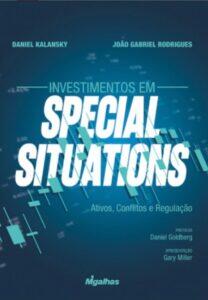
"And Brazil is full of these hidden assets," adds the co-author with João Gabriel Rodrigues of the book "Special Situations: Legal and Financial Opportunities in Distressed Assets" (Migalhas Publisher, 240 pages, R$ 149).
Allied – one of the cases featured in a chapter of the book – transformed a legal asset into cash. And this story is not an exception. The special situations market is beginning to take shape in the country because assets like this exist everywhere.
They can be related to tax credits, legal fees, corporate disputes, inheritances, bankruptcies, judicial reorganizations, or even contentious divorces.
In common, they all represent economic rights that, although they have value, remain illiquid - and which can be monetized through specialized financial structures.
"Today, many people and companies don't know they own an asset that can be monetized," says Kalansky.
It is precisely in this space that so-called special situation investments emerge. And the idea behind Kalansky and Rodrigues' book is to present real stories and connect them to legal practice.
Unlike traditional investments, where managers buy stocks, bonds, or real estate, here the goal is to find value in complex situations.
Often, these are rights that depend on court decisions, arbitrations, debt recovery, or property disputes.
In some cases, funds buy these assets directly. In others, they finance the legal dispute in exchange for a share of the future outcome.
The concept already generates billions of dollars in markets such as the United States, the United Kingdom, and Australia, where so-called litigation finance has established itself as one of the most sophisticated branches of alternative investments.
One of the examples the book gives is the scandal that rocked the United Kingdom and the country's postal system. Franchisees were accused of embezzling money. Sued to settle their debts with the Post Office, they were backed by investment funds in the legal battle.
In the end, the case resulted in a settlement of £57.75 million - and a series created by the British network BBC : "Mr. Bates vs. The Post Office".
Nobody knew he had
Many opportunities arise precisely from a lack of awareness about the existence of these assets. Kalansky cites the case of companies that accumulate significant tax credits but do not see a way to convert them into cash in the short term.
There are also law firms with millions of reais in fees to receive in the coming years, but which need working capital immediately. And there are even more unusual situations.
In recent years, specialized funds have begun financing disputes involving inheritances and divorces. In many cases, one of the parties has a legitimate right but lacks the necessary resources to sustain a legal battle that can span years and different jurisdictions.
One of the examples cited by the authors involves an international dispute in which a woman sought to recover assets allegedly hidden by her ex-husband in offshore structures scattered around the world.
In another case, an Australian fund specialized exclusively in financing women involved in divorce proceedings.
The logic is always the same: the investor provides the necessary resources to conduct the dispute and, if the thesis is successful, receives a portion of the recovered value.
The market is still in its early stages.
Rodrigues believes that Brazil is only in the early chapters of this story. According to him, the share of alternative investments in Brazilian portfolios remains far below that of developed markets, where institutional investors frequently allocate larger portions of their resources to strategies outside the traditional universe of stocks and fixed income.
This room for growth helps explain the increasing interest in transactions related to distressed assets, judicial credits, and litigation financing.
Today, a large portion of Brazilian investors prefer operations where the legal risk has already been substantially reduced, such as judicially recognized credits or court-ordered payments close to being made.
The challenge lies in so-called binary options, which are situations where the investor can multiply their invested capital several times over or lose everything.
It is precisely this type of operation that has driven the growth of the litigation finance industry in the most developed markets.
The risk is far from the spreadsheet.
The book offers an unintentional example of this special sits limitation. Among the cases analyzed by the authors is the dispute involving Petersen Energia and the Republic of Argentina regarding the expropriation of the oil company YPF.
For years, the story was treated as one of the greatest success stories in the history of litigation finance.
Leading this dispute was Burford, a firm that bills itself as the world's largest provider of litigation finance . Its calling card is a $12.1 billion investment since its inception in 2009 and a 92% success rate (cases concluded that resulted in recoveries for clients, up to that point).
Investors who bet on the dispute have accumulated successive victories in American courts. The favorable rulings have brought the potential compensation to something close to US$16 billion.
It seemed like the perfect proof of the thesis. But the outcome was different - and the conclusion came after the book was published.
On March 27 of this year, the decision was reversed. The U.S. Court of Appeals for the 2nd Circuit, in Manhattan, declared that the plaintiffs' claims—breach of contract—were unfounded under Argentine law.
The reversal explains the essence of this special sit market: the final value of these assets continues to depend on something impossible to predict with absolute precision. And the weight of the defeat falls on the investors who had financed the dispute.
With its shares publicly traded on the NYSE, Burford's stock plummeted from $7.83 to $4.14 on the day Petersen Energia's defeat was announced – a drop of just over 47%.
While Allied demonstrated how a tax credit can be converted into cash ahead of schedule, the Argentinian case presents the other side of the coin. After all, not every hidden asset ends up becoming wealth.