

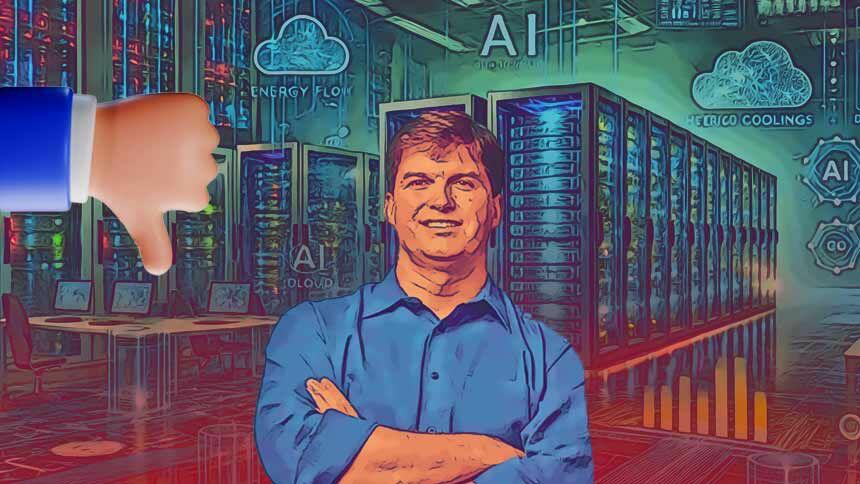
I've written about Michael Burry before. I'm writing about him again because he's back to betting, and betting bigger. It's no longer just a position against Nvidia and Palantir. Now there's a basket that includes Tesla, Nvidia, Caterpillar, Applied Materials, and the SOXX semiconductor ETF, with puts rolled over to March 2027. It's his biggest bearish bet since he stopped managing third-party capital after closing the registration of Scion Asset Management at the end of 2025.
And I'll say what needs to be said: in this case, Burry remains completely wrong .
I'm not speaking from the outside. I'm a fund manager at a firm with over R$38 billion under management. I have direct positions in AI infrastructure in the financial market and in real-world economic projects in Brazil. I read every report, every quarter, every piece of data. I have skin in the game on both sides. And that's precisely why I can say, without euphemism: he got the diagnosis right, but the patient wrong.
Respect and disagreement. Burry predicted the American subprime crisis in 2008. He shorted mortgage-backed securities when the entire Wall Street was laughing at him. He has my unwavering respect for that.
But respect is not agreement. And there's an unsettling detail: between 2008 and today, 18 years have passed. He was right once, spectacularly, and spent almost two decades repeating the same alarm. It's like a broken clock that gets the time right twice a day. Getting 2008 right was worth a fortune. But 18 years of warning that the roof is going to collapse isn't a prediction, it's a stance. You understand what I mean.
Alex Karp, CEO of Palantir, summed it up better than I could: the two companies that Burry shorted first are precisely the ones that make the most money. Shorting chips and ontology, Karp said, is a difficult choice to defend.
First mistake: Burry confused the car manufacturer with the toll plaza. The token maxing thesis is real. Companies have employees burn tokens to collect data, train proprietary models, and build internal rankings. This phase is temporary. When it ends, demand may decrease. But for whom?
Model labs, like OpenAI, Anthropic, and xAI, are the car manufacturers. If the demand for tokens compresses, they suffer. Amazon, Microsoft, and Google are the toll plaza. It doesn't matter if you drive a Ferrari or a Honda. The toll is charged. And the cheaper the model becomes, the more trips happen, the more tolls are paid.
The data proves it in real time. Google processed 1.3 quadrillion tokens per month in the third quarter of 2025, more than 20 times the volume of a year earlier. Microsoft processes more than 100 trillion tokens in a single quarter, five times more than the previous year. Google Cloud's operating margin, which for years was a point of doubt, came close to 33%. This is not a projection. It's the number disclosed in corporate results.
Burry is shorting the car manufacturers and hasn't realized he's betting against the toll plaza at the same time.
Second mistake: he built a demand-driven thesis and ignored supply. Industrial costs are once again putting pressure on the world. In South Korea, the producer price index closed May 2026 with an 8.5% year-on-year increase, the largest since July 2022, driven by industrial inputs, energy, and manufacturing-related components. In the United States, the PPI rose 6.5% in 12 months during the same period. It's a global phenomenon of production costs.
Samsung and SK Hynix, two of the world's largest memory manufacturers, are operating under increasing pressure from cost, capacity, and demand. On the other hand, the energy needs of American data centers continue on a strong upward trajectory, with estimates pointing to a significant expansion of load throughout the decade.
Burry is shorting the car manufacturers and hasn't realized he's betting against the toll plaza at the same time.
When Burry sees the announcement of approximately $520 billion in new Korean investments and says it's the beginning of the end, he reads irrational exuberance. I read it as confirmation that the world is at war over processing capacity, and that whoever has cheap energy and secure infrastructure is on the right side of history.
And here the United States is tying its own legs apart. By the end of June 2026, 116 American municipalities had already imposed local moratoriums on data centers. New York approved the country's first state AI moratorium, still awaiting the governor's signature. Sanders and Ocasio-Cortez proposed a federal moratorium. Billion-dollar projects are being blocked or delayed by local opposition. AI infrastructure capital is being pushed out of the United States by political decision, at the very moment when demand is exploding.
Brazil has one of the cleanest energy matrices in the world. The country has data center infrastructure with contracted energy, held back by temporary regulatory issues, at a fraction of the cost in the United States or Korea, and without the moratorium wars that hinder expansion elsewhere. This isn't wishful thinking. It's arithmetic. When the compression that Burry predicts happens, and it will happen in part, capital doesn't disappear. It migrates to where operating costs are lower. It's always been that way.
Third mistake: the multiple without the context of growth. Burry says the sector trades at 16 times revenue, 65% above the 200-day average, at 2000 levels. Technically, the numbers are correct.
But in 2000, there weren't quadrillion tokens being processed per month. In 2000, AI infrastructure wasn't accounting for such a significant portion of the S&P 500's earnings growth. Goldman Sachs projects that beneficiaries of AI infrastructure will account for about half of the index's earnings per share growth in 2026. A high multiple with real, accelerated growth is not the same as a high multiple with imaginary growth. That difference is everything.
The data that Burry didn't mention. The Financial Times published a study of nearly 22,000 American companies. Those investing more heavily in AI are hiring faster than their competitors. Entry-level employment has also grown. Automation is still in the capacity expansion phase, not the mass replacement phase.
On one side, Burry says it's the beginning of the end. On the other, the man who built AWS says there will be a staff shortage. I know which side I'm on. And I have evidence to prove it.
And Jeff Bezos, founder of Amazon, which operates the world's largest toll plaza, said that AI should create a shortage of workers, not unemployment. Technology enhances human productivity and opens up opportunities for new activities.
On one side, Burry says it's the beginning of the end. On the other, the man who built AWS says there will be a staff shortage. I know which side I'm on. And I have evidence to prove it.
What Burry got right, and what he got wrong. He got the diagnosis right. The boom phase is real. There will be compression. Some assets will suffer. Those who arrived late, took on too much debt, and don't have an operational cost advantage will pay a high price.
But he chose the wrong patient. Those who will suffer are the poorly capitalized model labs and the data center operators without a structural advantage. Those who will win are those who control the toll roads, those who have guaranteed cheap energy, and those who built physical infrastructure with discipline and a long-term vision.
The purpose of this article is to refute Michael Burry. But what it ultimately reveals is the magnitude of the opportunity for Brazil, not only to become a global leader in AI, but also to build a significant infrastructure legacy in energy generation and storage, data transmission, and everything else that surrounds and supplies a large data center.
I'll put my name on it. The bill will come due.
Walter Maciel Neto is the CEO of AZ Quest Investimentos, an independent asset management firm with nearly R$ 40 billion under management.