

This week I was in Wimbledon for the first time. Some places are visited. Others are traversed as a ritual. Wimbledon is one of them.
The impeccable grass, the endless queues, the excitement of the audience. Everything there is a blend of elegance and meticulous planning to provide unforgettable moments.
I had the privilege of seeing Serena Williams, at 44 years old, return to center court and battle point for point against a 20-year-old opponent. It was more than a match. It was a champion negotiating with time, with her body, with memory, and with her own legend.
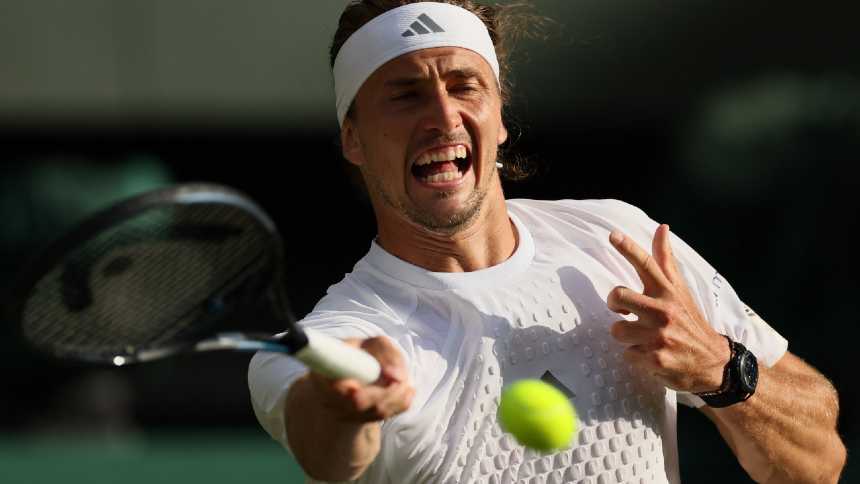
But the scene that struck me most came in another match, on Tuesday, June 30th, also on center court, between Alexander Zverev and Alexander Blockx. On one side, Zverev, Grand Slam champion and world number 3. On the other, Blockx, a young 21-year-old Belgian, still unknown to much of the public, but already capable of causing significant damage on the circuit, as he showed by reaching the semi-finals of the Madrid Masters 1000.
Sitting very close to the court, I could follow the speed of the ball, the precision of the movements, and the silent violence of each rally. Tennis, seen from that distance, ceases to be merely beautiful. It becomes brutal. The ball arrives before thought. The body must decide while the mind is still trying to understand.
What interested me most, however, was not the technique. It was the reaction. What happened after a mistake. How each player behaved in the face of a breakpoint . What changed in their bodies, their gaze, their breathing rhythm when the game entered what the NBA calls clutch time —the moment when the game stops testing only technique and starts testing the whole person.
Human performance under pressure is a topic that deeply interests me. I've been studying it for years in the corporate environment, talking to CEOs, board members, entrepreneurs, and executives during times of immense exposure. Even so, witnessing that match so closely was a lesson that no case study could replicate.
Blockx played incredibly well. At times, he seemed poised to take control of the match. There was talent, audacity, and a clear hunger to make a bigger impact on the circuit. He didn't step onto the court just to survive. He did it to showcase himself to the world.
Zverev, however, had something that, in that context, seemed as important as his serve or forehand : a mind trained to stay in the game. In decisive points, it was possible to see how he used his breathing to reorganize himself. How he avoided mistakes. How he prevented a bad shot from contaminating the next one. A lost point didn't become a drama. It was just a lost point.
In the corporate world, the logic is increasingly similar. Careers, reputations, and businesses are also transformed by decisive moments. A meeting with the CEO. A presentation to the board. A negotiation with a major client. Defending an idea that could become a product, an acquisition, or a strategy. Sometimes, years of preparation culminate in just a few minutes of exposure.
And in those moments, having a resume isn't enough. Knowing the subject matter isn't enough. Having worked hard isn't enough. You need to be mentally available to deliver what you know at the moment it matters most.
This is one of the great pitfalls of executive life. We imagine that technical competence, accumulated experience, and a built reputation will be enough when the decisive moment arrives. Often, they are not. The pressure demands presence.
"The future of high performance, in sports and in business, will be less about eliminating pressure and more about learning to live with it. Mental fitness is the ability to approach life's decisive moments with more presence, clarity, and less internal noise."
This is where the concept of mental fitness stops being just an interesting expression and becomes a competitive advantage. Just as we train our bodies to gain strength, endurance, and flexibility, we need to train our minds to better handle pressure, frustration, ambiguity, and recovery.
High-performance athletes understood this a long time ago. They work on visualization, breathing, focus, internal dialogue, and the ability to quickly return to the present.
We, corporate athletes, still treat the mind as if it were merely a consequence of experience. It's not. Mental fitness isn't about positive thinking, motivational phrases, or a naive attempt to eliminate pressure. It's about developing mental muscle to function better within it.
This training begins in a simple, though not easy, way. Before an important meeting, negotiation, or presentation, it's not enough to review the content. You need to mentally rehearse the context: the difficult questions, the interruptions, the discomfort, the tension of silence. The mind suffers less from what it has already visited before.
It also requires focusing on the process, not just the result. The result matters, of course. But, under pressure, thinking only about it usually increases anxiety. The best alternative is to return to what needs to be done now: listen better, breathe, organize your response, choose your next sentence, maintain your presence.
And this involves breathing. It may seem too simple to be strategic, but it's not. More regular and deep breathing helps regulate the body, reduce impulsiveness, and restore clarity of thought. In critical moments, controlling your breathing can be the difference between reacting and responding.
Wimbledon reminded me that, in a world where competition has become tighter, pressure more constant, and opportunities rarer, the advantage will not only lie with those who know more, work harder, or run faster. It will lie with those who can remain composed when the game gets intense.
The future of high performance, in sports and in business, will be less about eliminating pressure and more about learning to live with it. Mental fitness is the ability to approach life's decisive moments with greater presence, clarity, and less internal noise.
Because all of us corporate athletes have our center court.
It doesn't come with grass, linesmen, and packed stands. It's in a meeting room, on a difficult phone call, making a solitary decision, having a conversation with the board, or presenting an opportunity that doesn't announce its arrival.
And it is there, in those few minutes, that it is revealed who trained to get there — and who trained to stay there.
Sergio Chaia is a coach for CEOs and high-performance athletes and chairman of Unico Skill.