

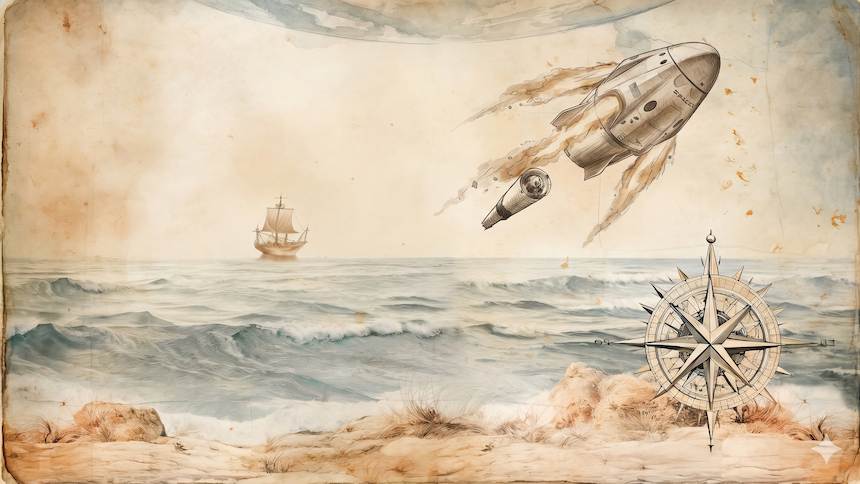
The Hague, Holland. 1602. Johan van Oldenbarnevelt hasn't slept for three nights. He's the most powerful man in the Republic. A lawyer. Grand Pensionary of Holland. And he's just made the most insane bet of his life.
He forced six rival companies, who hated each other, to become a single entity. He convinced merchants, widows, and shoemakers to hand over their savings in exchange for a piece of paper. All to finance a crossing that swallows entire ships and rarely returns them. In an ocean that no one has mapped. Against a Spanish empire that is at war with him at this very moment.
Down below, on the dock, the tide begins to turn. He hears, without seeing, what his decision has set in motion. The smell of hot tar. Rigging being stretched against the mast. The creaking of the hull. The knot that tightens and won't loosen. The sail that crackles and fills with wind. In a few hours the ships set sail towards the unknown.
He's not going aboard. He's staying. He lights the fuse and stays. On the other side of the Atlantic. Four hundred and twenty-four years later...
Boca Chica, Texas. October 13, 2024, 7:25 am. Elon Musk watches the countdown, in the final seconds. He is the richest man in the world. A physicist. Controversial. He watches the service arm retreat. The tanks close, filled with methane and liquid oxygen. Ignition sequence starts. The Raptor engines ignite one by one. The platform disappears in a white cloud. And thirty-three points of fire lift from the ground the heaviest thing humanity has ever tried to throw into the sky.
He's not going on board either. He lights the fuse and stays.
Four hundred and twenty-four years and an ocean separate these two men. One wanted to conquer a new world, seeking the hidden riches on the other side of the planet. The other wanted to conquer a new world, in search of the riches on the other side of the solar system.
Ultimately, they were both selling the same thing: the dream of an impossible journey. Risky. Brutal. But ambition is sometimes too great. Too gigantic for traditional coffers. The money of kings wasn't enough. Private capital couldn't reach it. Today's government can't pay for it. Today's funds can't finance it.
The crossing demanded more. It demanded the crowd. The shoemaker's pocket.
And this is where things really get complicated.
Last week, on June 12, 2026, Elon Musk took SpaceX public. The largest IPO ever undertaken by humankind. A $75 billion fundraising. Over two trillion dollars in market capitalization on the first day. Numbers that defy gravity.
Despite being the largest IPO in history, SpaceX didn't invent the tool. An equally ambitious dream required similar effort. Four centuries earlier. No government or private investor could finance such an ambition.
So, on August 31, 1602, Johan van Oldenbarnevelt opened the capital of the Dutch East India Company. In Dutch, Vereenigde Oostindische Compagnie. The famous VOC. The first public offering of shares in history. It was so first that the stock exchange didn't even exist yet. It had to be invented later, just so those shares could change hands. The IPO wasn't born from the stock exchange. The stock exchange was born from the IPO.
It's worth stopping and experiencing the sheer insanity that was 1602.
You were being invited to hand over your savings to a company that would send ships to the other side of the planet. A journey of up to two years. Through uncharted seas. Where most crews died. Of scurvy. Shipwreck. Or combat. Where the seller on the other side was a Spanish empire in open war against your country.
And what's more, you couldn't get your money back. The capital was locked up. The patent stipulated that the venture would be frozen for 21 years.
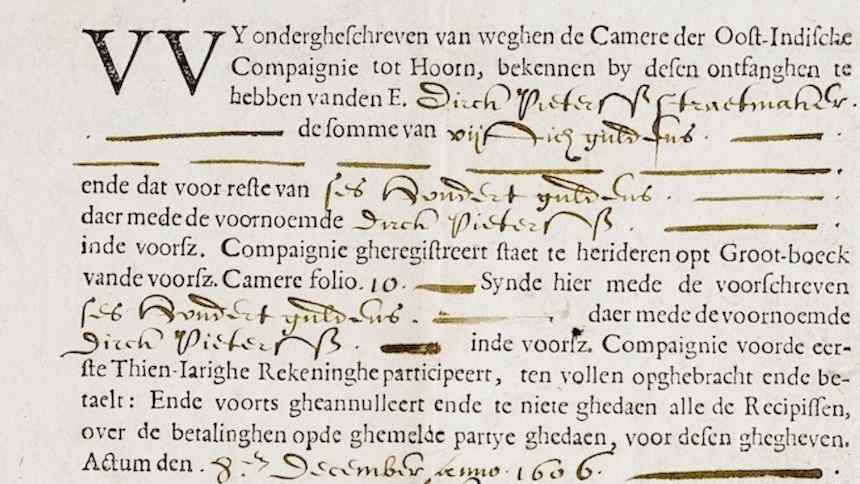
No company had ever asked for that before. And it was precisely that restriction that forced the invention of everything else. If you can't redeem the money, but you need liquidity, someone has to be able to buy your share. That's how the secondary market was born. The stock exchange. The price that goes up and down every day. The VOC didn't just invent public shares. It invented the entire organism of modern financial capitalism. Out of necessity. To solve an engineering problem.
But in the beginning... there were no investment banks. There was no stock exchange. VOC didn't even have a headquarters. The first roadshow in history was in a living room. Investors from Amsterdam were invited to the private home of a wealthy merchant, Dirck van Os. They went there to register. Inside that room, the directors took turns. They supervised the notary as he entered the names, one by one, into the capital book. The announcement? A piece of paper posted on a lamppost.
The first IPO announcement the world ever saw. What backed it wasn't an audited prospectus. It was the names of the well-known merchants behind it. When the subscription closed on August 31, 1602... 1,143 investors in Amsterdam had joined. The modern capital market was born in a living room queue.
For almost two hundred years. Between 1602 and 1796, the VOC sent nearly a million Europeans to Asia. In 4,785 ships. The gamble that seemed like madness became the most successful capital machine the world had ever seen.
Four centuries separate the two dates. But the challenge is the same. The tool is the same. To let the general public buy a piece of the impossible. SpaceX is selling, today, the very same promise that Johan sold back then. The world's first IPO and the world's largest IPO. United by the same constraint. And fueled by the same ambition.
The Naus business model
VOC's success wasn't in the spices. It was in the engineering. The great technological trump card had a name: the ship Fluyt.
While other nations built galleons for war, the Dutch optimized for pure economic efficiency. The hull was designed to evade taxes. Wide at the base. Narrow on the deck. Construction became almost industrial. Standardized parts. Mass production. And the result followed brutal rules. The Dutch ship carried more cargo. Required fewer crew members. Cost less to build. Consumed fewer resources to operate.
The economy was booming. A rival ship required dozens of men. The Fluyt operated with twelve. But the vessel was only the tip of the iceberg. The VOC merged naval engineering, cartography, and a global network of ports into the first logistics platform in history.
But ships don't build empires on their own. The company had access to a continuous flow of money that no state could match. The VOC stifled the competition, not only through the brute force of its cash reserves, but also through its business model.
The mechanism was perfect. Technology as a competitive advantage. Capital. Mastery of navigation. Mastery of logistics. By mastering logistics, they closed the route. With the largest war chest on the planet financing this road, they imposed an absolute monopoly and controlled trade between the West and the East. They created a stacking of monopolies.
If VOC had Fluyt, SpaceX has Starship.
Anyone who looks at SpaceX and sees a rocket company is making the same mistake as someone in 1602 who saw a pepper importer.
The architecture is the same as always. You control the crossing and, from there, you control everything that depends on it. The 75 billion dollars raised are not cash to run day-to-day operations. They are ammunition. A war chest to suffocate any competitor before they learn to breathe in the new frontier. What is for sale is not the launch. It is control of the largest market that humanity has ever had before its eyes.
And this control is built in layers, each one supporting the next.
First comes the journey itself. The rocket is no longer a single-use piece of scrap. It goes up, completes its mission, and returns. It lands intact. It flies again. The cost of putting a ton into orbit has plummeted 36 times since the space shuttle, from $54,000 per kilogram to $1,500 per kilogram. It's the raw advantage of engineering, the same as the old ships that crossed the ocean cheaper than anyone else. Only now it's made of stainless steel.
Whoever has the cheapest toll controls the road. And whoever controls the road charges a toll on everything that goes up it. There were 165 launches in 2025, practically one every two days.
With the road in hand, the sky becomes cheap. You fill the orbit with your own constellation at a cost that no one else can match and, potentially, become the largest and perhaps only mobile phone and broadband company, a market today worth US$1.5 trillion in revenue and US$500 billion in profit.
And upon this constellation revolve the following levels. Connectivity. Defense. Earth observation. Data. And those that don't even have a foundation yet. Mining on the Moon. Colonization of Mars. Suborbital cargo and passenger flights, capable of connecting São Paulo to Tokyo in less than an hour, not a full day's journey. These are options on the infinite that would come as a bonus in the package, were it not for the premium in valuation.
Look at the machine. A cog that feeds on its own scale. That's how the first publicly traded empire in history was built. It's happening again: a new stacking of monopolies. VOC would be worth US$7 trillion in today's dollars, three times more than SpaceX.
(One caveat, and it's a serious one. All of this is market size. It's the ocean that opens up ahead. And having an entire ocean ahead is not the same as being a good investment today, at this price. This is not investment advice, and I have no direct exposure to SPCX. The frontier will be explored in decades, perhaps centuries. Not in quarters. Confusing the size of the map with the speed of the crossing is the most expensive mistake there is. In the sea of 1602 and in the stock market of 2026.)
The ship that returns
There's a detail that separates the dream from madness. Before asking for the money, the ship had already sailed and returned. No one sold a fantasy without proof. Years before the big fundraising, a first expedition had already set sail for Asia. The journey was brutal. It took about two years. It killed a good part of the crew. It crossed conflicts with the Portuguese and with local populations, and lost ships along the way. But it did the only thing that mattered. It arrived. And returned.
The holds of the ships didn't return overflowing with gold. The financial return was mediocre. But the voyage proved something that was infinitely more valuable than the cargo. The route existed. It was possible to sail there. It was possible to buy the spices. It was possible to return alive. And everything indicated that it was possible to make ends meet.
It was the difference between "imagine if it worked" and "it already worked once, and now it's just a matter of repeating it on a larger scale." Any founder recognizes this shift. Capital doesn't fund the impossible. It funds the impossible that has already happened once and now needs to be industrialized. Today's startups have simply rediscovered this rule.
And here the parallel ceases to be a metaphor and becomes physics. For four hundred years, "the ship that returns" was a metaphor. The ship that returns laden shows that it is possible.
On October 13, 2024, at 7:25 a.m., in Boca Chica, the image turned to steel. Minutes after takeoff, high above, the engine shuts down. It reverses against its own gravity. It descends. And at 7:32 a.m. it is captured in mid-air by the tower's arms. Intact. Almost ready to ascend again.
For the first time in history, the ship returned to its home port alone.
It is this return that unlocks everything. A rocket returning lowers the cost of the crossing to the point of making each level of the empire viable. Four centuries ago, the ship returning from Asia was proof of the dream and the machine of profit. Today, the rocket returning from orbit is exactly the same thing. Both crossings succeeded for the same reason. They knew how to return.
Four hundred years later, the same gesture.
Two men who didn't embark. One, in The Hague, listening to the rigging being tightened on the dock before a fleet disappears into the Atlantic. The other, in Boca Chica, listening to the countdown before thirty-three engines tear through the Texas sky. Four hundred and twenty-four years and an ocean separate them. The gesture is identical. To light the fuse and stay. All that remains is to entrust the dream to a ship of wood or stainless steel. And to convince strangers to finance it.
The scale is daunting, but the mechanism is familiar. It's the same one I see at every founder's table. Before the big check, someone needs to send the first ship. Build the MVP. Prove the route exists. Find product-market fit, which is essentially the ship returning with a full hold for the first time. Only then comes the capital that industrializes the journey. The order never changes. First the proof. Then the fleet.
That's what separates those who raise capital from those who only raise their hand. It's not the size of the dream. It's the ship that returns.
And there's always a new ocean opening up. Today's spice is orbit. Tomorrow's will belong to the dreams of the next Johans… the next Elons. The map has never been so big, and that's the best news our generation could receive. There's still a lot of sea ahead. A lot of impossible things waiting for someone with the courage to sign off on it before knowing if the ship will return.
The first people signed, four centuries ago, and the world was never the same again. Now the pen is in your hand.
The question isn't whether the ship will return. It's whether you have the courage to light the fuse.
Romero Rodrigues is a partner at XP and managing partner at Headline.