

After successive quarters of growth in its US operations, the Brazilian steel giant Gerdau saw its domestic division grow more than its American unit in the second quarter of this year. But, at least for now, the company sees no reason to celebrate.
Between April and June, the company recorded a 22% increase in adjusted EBITDA in Brazil compared to the previous quarter, reaching R$ 705 million. In the United States, EBITDA growth was lower, at 15.4% compared to the first quarter, reaching R$ 2.6 billion.
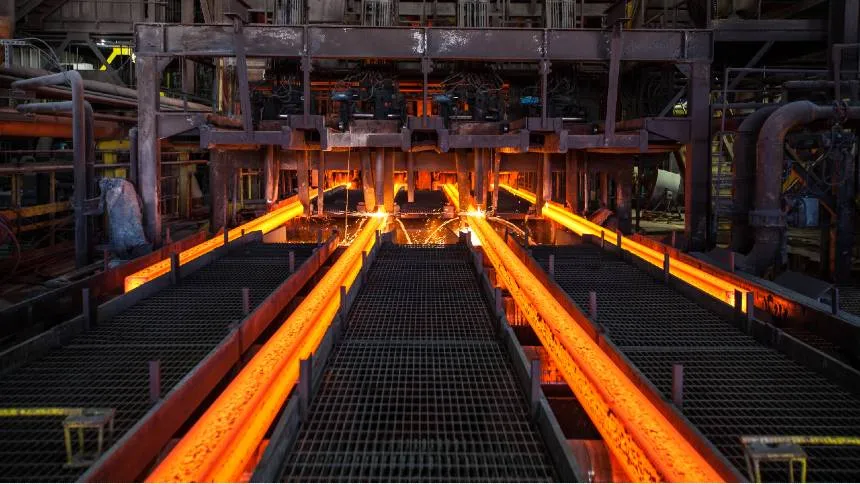
In crude steel production, the Brazilian operation also outperformed in the quarter. Gerdau's local units recorded a 6.2% increase over the first quarter, and 10% more than recorded in the second quarter of 2025.
In the case of factories in the United States, production volume fell 1.3% compared to the first three months of the year, and increased 0.5% compared to the second quarter of 2025.
Nevertheless, the results from the Brazilian operation during this period were not enough to signal the beginning of a market recovery. The trend suggests that this scenario is unlikely to continue into the third and fourth quarters.
“We can’t say that this is the beginning of a more intense recovery. Brazil has a lot of volatility, with elections coming up. But we continue to strive to be more competitive and reduce expenses,” says Gustavo Werneck, CEO of Gerdau, in response to a question from NeoFeed at the press conference.
According to the executive, the scenario of increasing imported steel in Brazil continues to be a major challenge for the recovery of the national industry, even with this slightly better performance recorded in the quarter.
“I don’t see a radical change in the scenario. The difficulties continue and the challenges remain intense. If the anti-dumping issue moves forward, with fairer competition, perhaps it will allow us to return to a level of profitability. We remain very concerned,” says Werneck.
Among the main reasons that explain the increase in EBITDA are the rise in domestic demand, relative to the product exported from Brazil, and a consolidation of price recovery during the period.
But the fact is that there is still a large gap between the United States' share and Brazil's share of the company's total revenue. Today, ¾ of the revenue still comes from the American market.
The issue is that, according to Werneck, the quarterly results are not enough to recover the poor performance recorded throughout the year. "Our results in Brazil are still far from what we need to create a future. Our optimism is very weak."
Even with growth of 1.3 percentage points in the last three months, Brazil's margin reached 9.9% in the first half of the year, a number well below the 24.9% recorded in the United States.
“The Brazilian operation, which is our home and has always been our stronghold, has been incurring losses since the middle of last year. EBITDA did indeed rise 22% in Brazil, but from a very low level. When we look at the year-to-date figures, the accumulated EBITDA is below R$ 1.3 billion,” explains Rafael Japur, CFO of Gerdau.
In any case, the company continues to invest in its local operations. According to the CFO, investments in Brazil have reached R$ 1.7 billion, well above what the company has generated in the country.
“A 10% margin is still far from the minimum necessary to justify long-term growth. We believe there is room for gradual improvements, but they will not come without work and sacrifice,” Japur concludes.
“When it’s close to zero, any result tends to be beneficial. And, if the United States grew little, it was from a very high margin. We continue with accumulated losses in Brazil. The improvement needs to be very significant to reverse the losses in the bottom line,” analyzes the CFO.
Analysts also see progress in the company's results in Brazil, and, unlike the executives, adopt a more optimistic tone regarding the company's revenue for the coming quarters.
"In Brazil, EBITDA was 10% above our estimate. Margins remain below historical levels, but improved significantly to 10.5%, compared to 9.2% in 1Q26," says BTG Pactual.
"The United States once again boosted the overall result, while Brazil showed an encouraging sequential improvement," states the report signed by analysts Leonardo Correa, Marcelo Arazi, and Rodrigo Gotardo.
Citi also highlights the increase in steel production volume during the period. "Volumes in Brazil increased 2.1% compared to the previous quarter, driven by better seasonality, although shipments fell 4.3% year-on-year, reflecting still moderate demand in the end-consumer market, with construction activity remaining largely stable."
In the case of the United States, Gerdau sees progress at the forefront of the data center segment, driven by the significant increase in investments from big tech companies in the country.
“This scenario has grown significantly, along with the advancement of energy production. Demand has been very strong, especially in the last 12 months. The consumption of steel to build data centers is substantial,” explains the CEO of Gerdau.
According to him, there is room for this path to be forged in the Brazilian market in the future. “Artificial intelligence is an irreversible trend. I would like to see the same in Brazil. We are still behind in terms of opportunities for data centers, but growth in the coming years will be inevitable. It's just a matter of time.”
In its consolidated quarterly results, Gerdau reported net revenue of R$ 17.8 billion, a 2% increase over the same period of the previous year, and 6.9% higher than the first quarter. Adjusted net income of R$ 1.46 billion was 69.7% higher than the second quarter of 2025.
EBITDA for the period reached R$ 3.4 billion, 33.9% higher than the same period of the previous year. The margin for the quarter was 19.2%.
In the accumulated total for 2026, GGBR4 shares on the B3 stock exchange registered a 27% increase. Over 12 months, the appreciation is 61.1%. Gerdau has a market value of R$ 49.4 billion.