


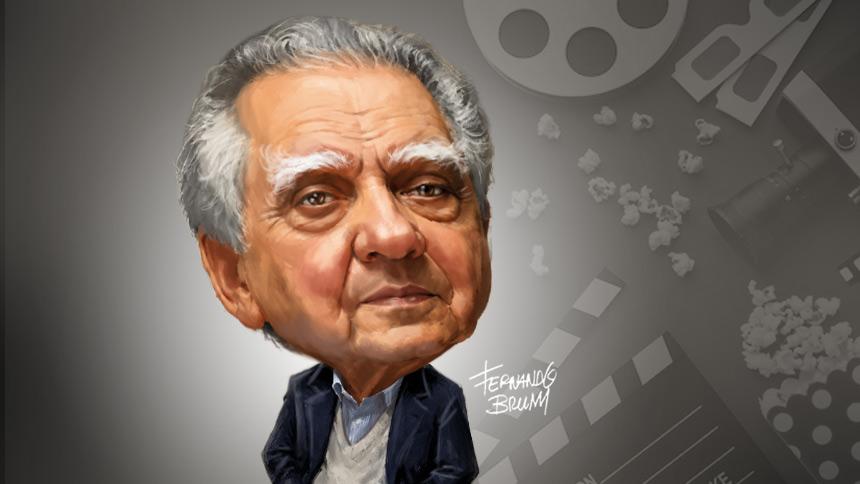

In the dictionary of Brazilian film personalities, the nickname Barretão had two distinct meanings: admiration and reservations. Luiz Carlos Barreto, perhaps the most influential figure in the history of audiovisual media in the country, spoke little and did much. A photographer, screenwriter, and producer, he also stood out as a political strategist in the sector, which earned him some enemies and some controversies.
Few people, however, have had such an ability to transform ideas into movement and films into cultural heritage. Upon his death on Wednesday, July 22nd, at the age of 98, he leaves behind a legacy that transcends the films he helped create. He was one of the forces that transformed Brazilian film production into an industry with international reach. "Cinema is a useful thing, not a frivolous one," he used to say.
Throughout his 60-year career, Barreto was present at the most decisive moments in the country's audiovisual industry — from Cinema Novo to the resurgence of the 1990s — witnessing the aesthetic, political, and industrial changes that shaped the sector's evolution in recent decades.
Alongside his wife, Lucy Barreto, he founded LC Barreto Produções Cinematográficas. The company was responsible for more than 80 productions and co-productions. His works won awards at festivals such as Cannes and Berlin, in addition to two Oscar nominations, with O Quatrilho (1995) and O Que É Isso, Companheiro? (1997).
Barreto's career also includes fundamental works for Brazilian cinema, such as Terra em Transe (1967), Dona Flor e Seus Dois Maridos (1976), Bye Bye Brasil (1979), Inocência (1983), and Memórias do Cárcere (1984).
Born in Sobral, Ceará, Barreto had his first contact with cinema as a young boy in the early 1940s. At that time, the American filmmaker Orson Welles, of Citizen Kane fame , came to Brazil to film the (never completed) documentary It's All True . During one of his travels through the country, he went to Ceará to record the saga of four jangadeiros (traditional fishermen).
“I never even dreamed of it, I was 12 years old. I was going for a swim in the sea and, suddenly, that team of foreigners arrived and set up shop there,” he said on the program Conversa com Bial . “I just stood there, fascinated.”
His professional career, however, began far from the film sets. In the 1940s and 1950s, Barreto worked as a photographer for important newspapers and magazines in Rio de Janeiro, such as O Cruzeiro. In 1958, he was assigned to cover the World Cup in Sweden. During the awards ceremony, to get the picture, he shouted to the captain of the Brazilian team: "Bellini, raise the cup!"
The defender raised the trophy above his head. And the photograph taken by Barreto helped popularize a gesture that has since become a tradition in sporting celebrations around the world.
The light that destroys the plantation.
His entry into cinema came about through his friendship with producer Herbert Richers. “Herbert and I had known each other for a long time; we did many reports together for different media outlets. He worked in newsreels and I was a photographer for O Cruzeiro magazine,” Barreto told the author of this text in the 2010s. “By the time I decided to make films and went to work with Roberto Farias, he and Herbert had already started making films together.”
Thus, in 1962, he signed on to write and co-produce Assault on the Pay Train .
Around the same time, on a trip to Bahia as a photojournalist, Barreto met Glauber Rocha. From this encounter, a deep friendship and a historic partnership emerged—one that would revolutionize the aesthetics of Cinema Novo. The Bahian filmmaker suggested that he take on the cinematography for Vidas Secas , the classic film by Nelson Pereira dos Santos.
According to the filmmaker from Bahia, the films portrayed the Northeast as "a garden." Following Hollywood's playbook, the lighting should be controlled, with filters to soften faces, balance contrasts, and enhance aesthetic elements.
At first, Barreto hesitated. He said he only knew how to photograph with his Leica. He ended up accepting the challenge and made light "a character that destroys the plantation, that bothers man," as he would later recall in interviews.
Thus was born the aesthetic of "raw light," one of the visual hallmarks of Cinema Novo. Later, Barreto would also do the cinematography for Glauber Rocha's Terra em Transe (1967).
Heir to the critical spirit of Cinema Novo, Barreto maintained a political presence in the cultural sector, advocating for financing mechanisms and the construction of a Brazilian film industry.
Starting in the 1970s, he helped professionalize national film production by consolidating a business model for cinema and became one of the main architects of public policies for the sector, including Embrafilme, created by the military regime.
Although the state-owned company's origins were controversial, Barreto saw it as a fundamental tool for financing, distributing, and scaling up Brazilian cinema. More than just producing films, his ambition was to create the conditions for an industry to exist—one capable of uniting artistic quality, international recognition, and audience success, an equation that had remained a challenge since the failure of the Vera Cruz experiment in the 1950s.
Barreto was heavily criticized. His opponents claimed that his close ties to governments and industry leaders primarily benefited his own production company, LC Barreto. He always denied any such favoritism. On the other hand, he never hid his political activity and negotiated directly with ministers and presidents to prevent cuts in film incentives.
Admirers saw this as institutional leadership. Opponents perceived it as excessive influence from the man who undoubtedly became the most powerful producer in Brazilian cinema.
Culture, identity and resistance
The biggest controversy of his career arose with the production of the biopic Lula, the Son of Brazil , directed in 2020 by his son, Fábio Barreto. The film was accused by some critics and the opposition of functioning as political propaganda for the then-president—especially since it was released in the last year of his first term.
Questions also arose regarding the financing of the production, estimated at around R$ 17 million. Barreto said he avoided direct government funding precisely to dispel suspicions of political interference, although criticism persisted regarding the support from large construction companies.
Commercially, the film fell far short of expectations, weakened by negative exposure in the press and on social media — at a time when political polarization was beginning in the country.
The last fiction film produced by Barreto was João, o Maestro , directed by Mauro Lima and released in 2017. The film narrates the trajectory of the pianist and conductor João Carlos Martins. Barreto thus maintained the LC Barreto tradition of adapting far-reaching Brazilian stories.
The film brings together the hallmark characteristics of Barreto's work: sophisticated production, a theme linked to national culture, popular appeal, and a concern for the memory of great Brazilian figures.
In the following years, the production company focused primarily on television and documentary work. Its last credit as a producer was the documentary series Slavery — 21st Century (2021), broadcast on Canal Brasil, directed by Bruno Barreto, its son.
Despite his fragile health, Barreto remained lucid and continued to participate in the debate about the future of Brazilian cinema. From 2024 onwards, his clinical condition worsened after a fall during a trip to Ceará.
With his reduced mobility, he practically stopped appearing at public events. Although away from the sets, he maintained intense involvement in the production company's decisions.
With each film he produced, he reaffirmed that telling Brazilian stories was an act of culture, identity, and resistance. With this conviction, Barretão made Brazilian cinema a heritage—admired both inside and outside the country.