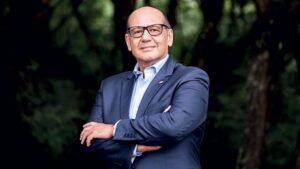




The episode known as the "divorce of the century," which directly involves the artificial intelligence (AI) sector, is nearing its end. An appeals court in South Korea has ruled that Chey Tae-won, chairman of chipmaker SK Hynix, must pay US$645 million (in cash) to his ex-wife Roh Soh-yeong.
The issue at stake was Chey's fortune, estimated at around US$5 billion. It is estimated that this value has doubled in recent years due to the company's significant growth, considered a key partner of Nvidia.
The court's decision, made this Friday, July 24th, represents the latest chapter in a saga that has lasted at least a decade and involved episodes of betrayal and corruption.
Chey's ex-wife is the daughter of Roh Tae-woo, the first democratically elected president of South Korea in 1988. The current sentence represents a significant increase over a lower court ruling in 2022, which ordered Chey to pay approximately US$45 million.
The Seoul High Court stated that its decision took into account the large increase in the value of Chey's shares, as his fortune grew along with the boom in artificial intelligence.
SK Hynix's market value has soared by about 2,500% since he filed for divorce in 2017. "SK's share price rose sharply during the legal proceedings. We cannot say that Chairman Chey's managerial contributions played no role in this increase," the court ruling stated, according to the Financial Times .
The settlement is the largest ever paid in a South Korean divorce and represents approximately 12% of Chey's estimated fortune, according to the Bloomberg Billionaires Index.
During this period, Chey's global profile also grew, with SK Hynix posting record profits as the main supplier of memory chips for Nvidia's AI processors.
He has frequently appeared alongside Nvidia CEO Jensen Huang, reinforcing SK Hynix's central role in the global AI supply chain. Chey also rang the opening bell at SK Hynix's Nasdaq listing in early July.
Market analysts stated that the decision is unlikely to weaken Chey's control over the conglomerate, as he could finance the payment by selling his stake in non-core businesses, such as the silicon wafer (raw material for semiconductors) manufacturer SK Siltron, or by obtaining loans secured by shares.
“There will be no major impact on Chey’s control,” says Park Ju-geun, head of the corporate research group Leaders Index. Lawyers for the company’s chairman said they “will decide whether to appeal after reviewing the ruling.” Roh’s lawyers declined to comment.
The 34-year marriage began to publicly crumble in 2015, when Chey published a three-page letter in a South Korean newspaper revealing that she had had an extramarital affair that resulted in a child.
Two years later, he sought mediation for the divorce, but the couple couldn't reach an agreement on the division of assets, triggering nearly a decade of litigation.
Chey, nephew of the founder of the SK Group, argued that much of his wealth was inherited and should not be treated as property in the marital proceedings.
He has led the conglomerate since 1998, expanding it from textiles and oil to alternative energies, semiconductors, and batteries for electric vehicles.
His empire encompasses more than 150 companies, including SK Hynix, the world's second-largest memory chip manufacturer; SK Telecom, South Korea's largest mobile phone operator; and the energy group SK Innovation.
The South Korean chipmaker raised $26.5 billion in the largest initial public offering (IPO) of a foreign company in the United States, through American Depositary Receipts (ADRs).
Its ADRs began trading at $170 on their Nasdaq debut on July 10, after being priced at $149 each, a slight premium over the closing price of the shares in Seoul earlier that day.
Bank of America, JPMorgan Chase, Citigroup, and Goldman Sachs were the lead underwriters for SK Hynix's offering.
On Friday the 24th, the company's shares on the American stock exchange were down 6.4%, around 11 am (local time).
The surge in memory chip prices at SK Hynix helped the company nearly triple its revenue in the first quarter compared to the previous year, reaching $35 billion during the period.
On Nasdaq, the shares are down 5% compared to the start of the listing. The company's market capitalization is US$955 billion.