


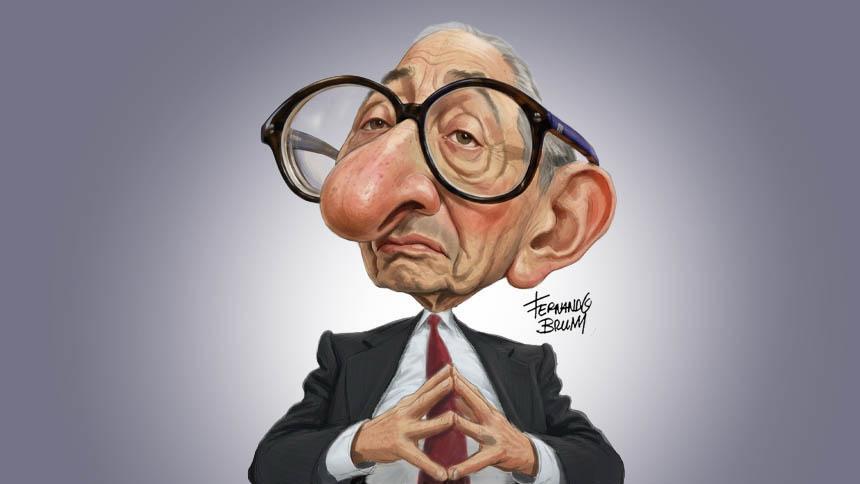
Someone who doesn't follow economic history, who has never paid attention to how central banks work, might not even fully understand the magnitude of what Alan Greenspan represented, who passed away on Monday, June 22nd, at the age of 100 (06/03/1926 - 22/06/2026).
But anyone with even a basic understanding of the economy of the last few decades knows clearly that we are talking about one of the most influential figures the financial world has ever seen. He spent almost 19 years at the helm of the Federal Reserve, from 1987 to 2006, spanning four American presidents, from Reagan to George W. Bush.
He wasn't just any bureaucrat. He was the most closely watched man in world finance, the one who dealt with Wall Street, who followed him with a magnifying glass to the point of trying to interpret what it meant if his briefcase was larger or fuller than usual.
The truth is that the market analyzed his every statement, looking for signals. In December 1996, with just two words, "irrational exuberance," he sent the market into a tailspin. That was his power, earning him the nicknames "Maestro" and "Oracle."
From an outsider's perspective, it's difficult to understand how he could wield such power to influence the perceptions of stakeholders, whether investors, businesspeople, or small savers worldwide. But Greenspan's greatest merit wasn't in his mystique. It lay in seeing what almost no one else could see.
Back in the second half of the 1990s, while half the world thought the American economy was going to overheat and was demanding interest rate hikes, he bet on the exact opposite. He realized, before the market, before many economists, that productivity gains driven by technological advancements were changing the game.
The reasoning was simple, yet surprising: if companies produced more with the same resources, the economy could grow faster without generating inflationary pressures. And without this type of pressure, there was no reason to raise interest rates.
This was the opposite of what central bankers traditionally did, tending to raise interest rates as soon as unemployment shows any sign of increasing swell. Greenspan kept borrowing costs low and watched unemployment plummet without inflation rising along with it, defying what economists thought was equilibrium unemployment. It was the gamble of someone who understood the new economy before it became obvious to everyone.
Of course, it wasn't all roses. After he left, the 2008 crisis tarnished his record to some extent; he was a strong advocate for the deregulation of the financial system, which ended up generating unimaginable leverage for the institutions.
Many people blamed him for keeping interest rates low for too long, inflating the housing bubble that burst badly, but deregulation played a significant role in this. He became known both as a genius of monetary policy and as the regulator who was too lenient, celebrated for the boom he helped create and criticized for the collapse he failed to prevent.
Is this the inevitable contradiction of someone who makes big decisions? Was the same instinct to read reality before others, which made him legendary in the 90s, what led him to the risks that were accumulating in the system?
What seems to be the case, in fact, is that Greenspan's greatest lesson lies neither in historical accuracy nor in final error. It lies in the courage to look at the numbers and confront what they say, even when it contradicts consensus, even when tradition dictates otherwise. That is exactly what he did in the 1990s. And perhaps it was the absence of this, the belated reading of what the data already showed, that weighed against him in 2008.
Active until the end, in January of this year he even signed a declaration alongside other former leaders in defense of the central bank's independence. This was the man who, joking about his deliberately convoluted way of speaking, once told a congressional committee: if you understood what you think I said, perhaps you didn't realize that what you heard wasn't what I meant.
This is a farewell, and it leaves us with the question that every economic policymaker should consider: are we truly understanding reality, or merely repeating tradition? Because, ultimately, the difference between the "Maestro" of the 1990s and the regulator being criticized in 2008 may have been precisely this.
* Luiz Fernando Figueiredo is a partner and advisor at Jubarte Capital. Previously, he was chairman of Jiva Mauá. He served as a director of the Central Bank of Brazil between 1999 and 2003.